
LFP Battery Cell Manufacturing Plant Subsidy & Project Finance
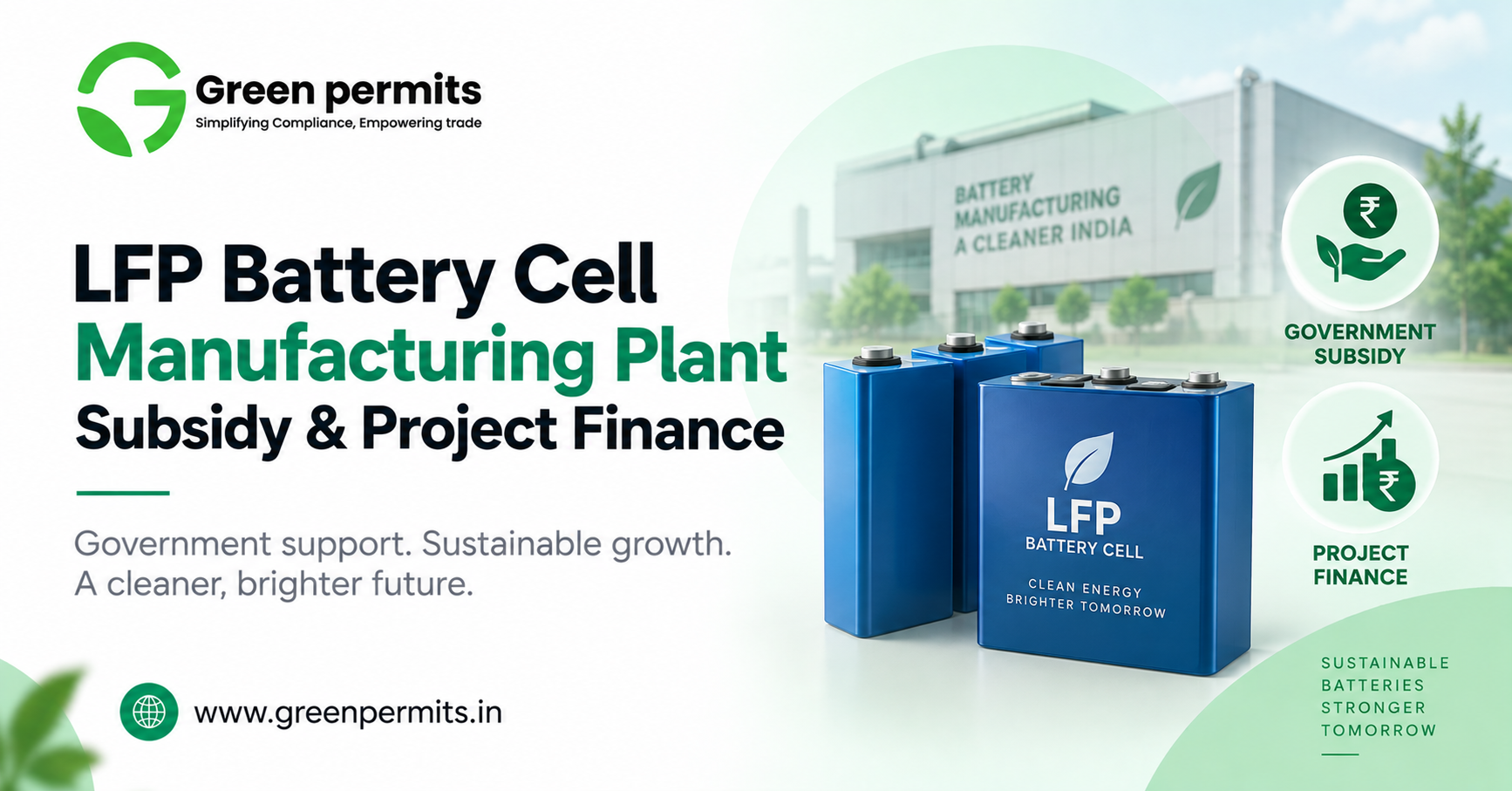
Setting up an LFP Battery Cell Manufacturing Plant in India is a capital-intensive project requiring specialised cell manufacturing equipment, dry-room infrastructure, utilities, quality laboratories, fire-safety systems, raw materials and substantial working capital.
LFP - Lithium Iron Phosphate - cells are increasingly used in electric mobility, Battery Energy Storage Systems, telecom backup and industrial energy-storage applications because of their cycle life, thermal stability and suitability for applications where cost and durability are important.
For investors, however, the project should not begin with machinery selection. The first questions should be whether there is sufficient market demand, what capacity can realistically be sold, which government incentives may apply and how the project will be financed.
Green Permits Consulting supports investors with LFP battery cell manufacturing feasibility studies, DPR preparation, subsidy assessment, machinery planning, location analysis, project finance documentation and financial modelling.
What is an LFP Battery Cell Manufacturing Plant?
An LFP cell manufacturing plant produces lithium-ion cells using lithium iron phosphate as the cathode chemistry.
This is different from a battery pack assembly facility.
A pack assembly unit generally purchases finished cells and integrates them into modules and battery packs. Cell manufacturing starts much earlier and requires electrode preparation, coating, cell assembly, electrolyte filling, formation, ageing and testing.
A simplified process is:
Raw Materials → Electrode Mixing → Coating → Drying → Calendaring → Slitting → Cell Assembly → Electrolyte Filling → Formation → Ageing → Testing
Because the manufacturing environment must be tightly controlled, cell manufacturing generally requires significantly higher investment and technical capability than battery-pack assembly.
Why LFP Cell Manufacturing is Growing in India
India's battery demand is being driven by electric vehicles, renewable-energy integration, grid-scale storage and industrial energy systems.
LFP chemistry is particularly relevant for electric buses, two-wheelers, three-wheelers, commercial vehicles and stationary storage applications where cycle life, safety and cost can be more important than maximum energy density.
The Government is also encouraging domestic Advanced Chemistry Cell manufacturing through the PLI Scheme for ACC Battery Storage.
The scheme has an approved outlay of ₹18,100 crore and targets 50 GWh of domestic ACC manufacturing capacity. As of 2026, 40 GWh had been awarded to four beneficiary firms.
This shows the scale of India's domestic cell-manufacturing push, but it does not mean that every new LFP plant automatically receives PLI support.
Government Subsidy for LFP Battery Cell Manufacturing
The major central programme is the Production Linked Incentive Scheme for Advanced Chemistry Cell Battery Storage.
The scheme is technology agnostic, which means eligible advanced cell technologies are not restricted to one chemistry such as LFP or NMC.
Under the scheme framework, beneficiary companies are required to meet investment and domestic value-addition conditions. The Ministry of Heavy Industries states a mandatory investment benchmark of ₹225 crore per GWh for committed capacity, while domestic value addition is expected to increase from at least 25% to 60% within the prescribed period.
These figures are scheme conditions and should not be treated as a universal estimate of what every LFP plant will cost.
Is PLI Subsidy Automatically Available?
No.
This is one of the most important points for new investors.
A company cannot simply establish an LFP cell factory and assume that it will automatically receive an ACC PLI incentive. Capacity under the scheme has been allocated through a beneficiary-selection process.
Government data published in July 2026 also stated that no beneficiary had yet claimed an incentive under the ACC PLI scheme at that point, even though investments had already been made.
Therefore, a new project's financial model should be commercially viable without assuming an unconfirmed subsidy.
A better approach is:
Base Project Economics + Confirmed Incentive = Improved Project Returns
rather than making subsidy the foundation of the business model.
State-Level Incentives for LFP Manufacturing
Apart from central programmes, state governments may offer industrial incentives depending on the proposed location, investment size and current policy.
Possible support can relate to capital investment, electricity, land, stamp duty, employment, interest support or other industrial incentives.
The actual benefit varies significantly between states and projects.
For this reason, states such as Gujarat, Tamil Nadu, Karnataka, Maharashtra, Telangana and other manufacturing regions should be compared on the basis of total operating economics, not just the headline subsidy.
A location with a smaller incentive may still be better if electricity, logistics, supplier access and customer proximity are stronger.
Selecting the Right LFP Cell Capacity
Battery cell factories are commonly planned in GWh of annual capacity.
But the biggest plant is not automatically the best project.
Before selecting 1 GWh, 5 GWh or a larger capacity, the promoter should estimate realistic demand from EV manufacturers, BESS developers, battery-pack companies and other industrial customers.
The better sequence is:
Target Customer → Annual Demand → Cell Specification → Capacity → Machinery
If a large factory operates at low utilisation, depreciation, manpower, energy and finance costs are spread across fewer cells, increasing the manufacturing cost per kWh.
LFP Cell Format and Technology Selection
The project should also decide the proposed cell format.
LFP cells can be manufactured in formats such as cylindrical, prismatic or pouch depending on the intended application.
The decision affects machinery, plant layout, customer segment, automation and project investment.
For example, a cell designed for a stationary-energy-storage system may have different dimensions, performance expectations and customer qualification requirements from a cell designed for an electric two-wheeler.
Technology therefore needs to follow the target market.
Major Plant Infrastructure
LFP cell manufacturing requires much more than a production line.
A commercial facility can need dry rooms, humidity-control systems, HVAC, electrical infrastructure, formation and ageing areas, testing laboratories, fire-safety systems, warehouses and material-handling systems.
Dry-room design is particularly important because moisture can affect lithium-ion cell performance and manufacturing quality.
Therefore, the investor should compare the complete installed project cost, not only the machinery quotation.
LFP Cell Manufacturing Plant Cost
There is no standard cost for setting up an LFP battery cell plant.
Investment depends on capacity, cell format, automation, machinery origin, localisation, factory design and the extent of backward integration.
The financial estimate should consider:
Land + Building + Manufacturing Equipment + Dry Room + Utilities + Laboratory + Safety Systems + Pre-Operative Cost + Working Capital
A 1 GWh project and a multi-GWh gigafactory will have very different economics.
The DPR should therefore be prepared using current machinery quotations and plant-specific engineering assumptions.
Raw Materials and Supply Chain
LFP cell manufacturing requires reliable access to materials such as LFP cathode active material, graphite or other anode materials, electrolyte, separator, copper foil, aluminium foil and specialised chemicals.
Material cost can represent a major part of cell manufacturing economics.
A project dependent heavily on imported raw materials should also assess foreign-exchange movement, shipping costs, supplier concentration and inventory requirements.
The supply chain should therefore be evaluated before financial projections are finalised.
Working Capital Requirement
Working capital is often underestimated in battery manufacturing projects.
The company needs to purchase expensive raw materials before cells are manufactured, tested and sold.
Cash can remain tied up in raw materials, work-in-progress, finished inventory and customer receivables.
Therefore:
Factory CAPEX ≠ Total Funding Requirement
The financing plan needs to provide enough liquidity to operate the factory after commissioning.
Project Finance for LFP Cell Manufacturing
A large LFP cell project may use a combination of promoter equity, strategic investment, term loans and working-capital facilities.
Lenders will usually assess the project's technology, customer demand, machinery supplier, raw-material strategy, promoter contribution and expected cash flow.
A bankable project should demonstrate that the factory can generate sufficient operating cash to meet loan repayments.
This is where a well-prepared DPR becomes important.
Customer Offtake and Bankability
A lender will generally be more comfortable when the promoter can demonstrate identifiable demand for the proposed cells.
Potential customers may include EV manufacturers, battery-pack companies, energy-storage developers or industrial battery businesses.
Long-term supply arrangements, customer discussions or credible purchase commitments can strengthen the financing case.
Building a 5 GWh plant and assuming that the complete capacity will automatically be sold is not a strong financing strategy.
The project should first demonstrate where the cells will go.
Production Ramp-Up Should Be Realistic
A new battery cell factory normally requires time for commissioning, process stabilisation, quality qualification and customer approval.
The financial model should therefore not assume full utilisation from the first year.
A gradual production ramp-up provides a more realistic picture of revenue, working capital and debt repayment.
The DPR should also test downside scenarios such as lower capacity utilisation, increased raw-material prices or reduced cell selling prices.
Environmental and Regulatory Planning
LFP cell manufacturing also requires environmental and industrial compliance planning.
Depending on the process and location, the project may need to assess Consent to Establish, Consent to Operate, hazardous waste requirements, fire and factory approvals and other project-specific permissions.
Battery manufacturing scrap and rejected cells also need an appropriate handling route.
Where the business falls within the producer framework, obligations under the Battery Waste Management Rules, 2022 should also be assessed separately.
DPR for LFP Battery Cell Manufacturing Plant
A Detailed Project Report - DPR helps convert the manufacturing idea into an investable project.
The DPR should cover market demand, target customers, cell chemistry, cell format, plant capacity, raw materials, manufacturing process, machinery, land, utilities, project cost, working capital and implementation schedule.
The financial model should analyse revenue, manufacturing cost, profitability, cash flow, break-even and debt servicing.
For a large cell project, sensitivity analysis is equally important because even relatively small changes in raw-material prices or utilisation can materially affect project returns.
Common Mistakes in LFP Cell Projects
A common mistake is beginning with the subsidy instead of the market.
Another is selecting a very large manufacturing capacity before identifying customers or finalising cell specifications.
Investors may also underestimate working capital or assume that all LFP cells compete in the same market.
The better planning sequence is:
Market Study → Cell Specification → Customer → Capacity → Location → Subsidy Assessment → Technology → DPR → Project Finance
This produces a much stronger investment case.
How Green Permits Helps with LFP Battery Cell Manufacturing Projects
Green Permits Consulting supports investors and manufacturers with LFP battery market studies, feasibility reports, subsidy assessment, plant-capacity planning, machinery evaluation, location analysis, DPR preparation, project finance documentation and environmental approval planning.
The objective is to determine whether the proposed manufacturing project is technically feasible, financially viable and ready for lender or investor evaluation.
Learn More About LFP Battery Cell Manufacturing Plant Subsidy & Project Finance
If you are planning an LFP battery cell manufacturing facility in India, the project should be evaluated for market demand, cell technology, capacity, raw materials, machinery, incentives, project cost and financing before major investment.
Read more about project feasibility and DPR consulting services here:
👉 https://www.greenpermits.in/09/lfp-cell-manufacturing-subsidy-finance-in-india/
📞 Get Expert Assistance for LFP Battery Cell Manufacturing Plant
If you need help with LFP Battery Cell Manufacturing Plant subsidy assessment, feasibility study, DPR preparation, machinery planning or project finance, Green Permits Consulting can assist you.
🌐 Website: www.greenpermits.in
📞 Phone: +91 78350 06182
📧 Email: wecare@greenpermits.in
 Greek
Greek
 English
 Arabic
 French
 Spanish
 Portuguese
 Deutsch
 Turkish
 Dutch
Dutch
 Italiano
 Russian
 Romaian
 Portuguese (Brazil)