
E-Waste Recycling Plant Setup in India
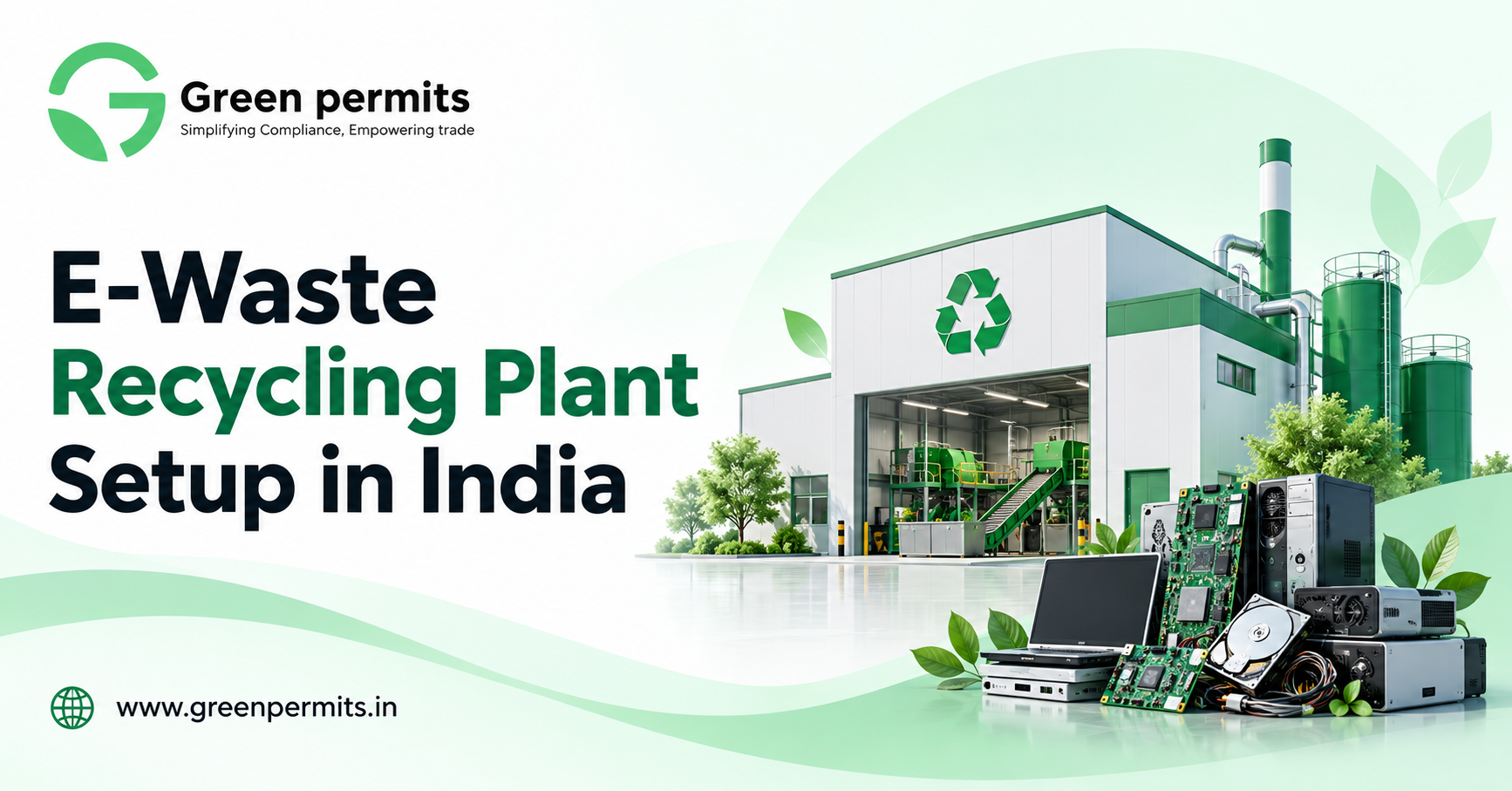
An E-Waste Recycling Plant Setup in India can be a strong opportunity for entrepreneurs, recyclers and industrial investors as discarded electronics, IT equipment, appliances and electrical products continue to create recoverable streams of copper, aluminium, steel, plastics and valuable electronic fractions.
However, a profitable e-waste recycling plant cannot be planned only around machinery. The project must connect feedstock availability, recycling technology, recovery yield, plant capacity, buyer demand, environmental approvals, CPCB registration and working capital.
India's current e-waste framework is based on the E-Waste (Management) Rules, 2022 and subsequent amendments. CPCB requires recyclers covered by the framework to register through the E-Waste EPR system, and registered recyclers have responsibilities around recycling records, downstream handling and EPR-related transactions.
Green Permits Consulting supports investors with e-waste recycling plant feasibility studies, DPR preparation, feedstock mapping, technology selection, plant-capacity planning, CTE/CTO support, CPCB recycler registration and financial modelling.
What is an E-Waste Recycling Plant?
An e-waste recycling plant receives discarded electrical and electronic equipment and processes it to recover reusable materials.
Depending on the business model, incoming material may include computers, servers, cables, electronic assemblies, appliances and other eligible electrical or electronic waste.
A typical process can be understood as:
Collection → Receiving → Sorting → Dismantling → Shredding → Separation → Material Recovery → Sale
Some plants focus mainly on dismantling and mechanical separation, while others send higher-value fractions such as PCB-rich material to specialised downstream processors.
The correct processing depth should depend on feedstock quality, technology capability and buyer requirements.
Step 1: Assess E-Waste Feedstock
Feedstock is the foundation of the project.
A plant may have the capacity to process 10,000 tonnes per year, but that capacity has little commercial value if only 3,000 or 4,000 tonnes can realistically be secured.
Potential sources can include manufacturers, bulk consumers, corporate IT disposal, service networks, authorised collection channels, aggregators and other registered stakeholders.
CPCB guidance confirms that registered recyclers can collect e-waste and can source material through the regulated ecosystem. It also allows registered recyclers and refurbishers to collect and transport e-waste from other states for processing at their registered facilities.
A practical feedstock assessment should map:
Supplier → Waste Category → Quantity → Composition → Purchase Price → Transport Distance
Plant capacity should be based on realistic supply rather than national waste-generation estimates.
Step 2: Decide What Material You Want to Recover
Different types of e-waste contain different concentrations of valuable material.
IT equipment may contain printed circuit boards, copper, aluminium, steel and plastics, while other equipment may contain a higher proportion of ferrous metals or lower-value material.
The project should therefore decide:
Which E-Waste → Which Fractions → Which Process → Which Buyers
This decision directly affects machinery selection and plant economics.
A facility targeting high-value PCB fractions will have a different process and buyer network from a plant focused mainly on dismantling appliances and recovering bulk metals.
Step 3: Select the Recycling Process
Mechanical recycling typically combines manual dismantling with shredding and material separation.
A practical process may look like:
Receiving → Sorting → Dismantling → Size Reduction → Magnetic Separation → Non-Ferrous Separation → Plastic Separation → Recovered Fractions
Sensitive components should be removed before bulk shredding wherever necessary.
The plant should also prepare a material balance:
E-Waste Input = Recovered Metals + Plastics + PCB Fraction + Residues + Process Loss
The material balance is important because profitability depends on the value of recovered output, not only on tonnes processed.
Step 4: Select Machinery Based on Feedstock
Machinery should be selected after the feedstock and recovery strategy are defined.
Depending on the project, equipment may include dismantling stations, conveyors, shredders, crushers, screens, magnetic separators, non-ferrous separators, dust-control systems and weighing equipment.
The wrong approach is:
Machinery First → Search for Feedstock Later
The stronger approach is:
Feedstock → Recovery Target → Process → Machinery → Capacity
This reduces the risk of installing an expensive line that is poorly matched to actual incoming material.
Step 5: Decide the Right Plant Capacity
Plant capacity should be linked to secured feedstock and realistic buyer demand.
The calculation can follow:
Annual Feedstock → Operating Days → Daily Input → Recovery Yield → Saleable Output
For a new entrant, phased capacity can often be safer.
The investor may begin with dismantling and mechanical separation and reserve land and utilities for additional recovery systems once feedstock and buyer relationships are proven.
A smaller plant operating at high utilisation can be commercially stronger than a larger facility operating far below capacity.
Step 6: Select the Plant Location
E-waste can be bulky, and transportation cost can significantly affect margins.
The site should therefore balance access to feedstock with access to buyers of recovered materials.
Location assessment should consider:
Feedstock Distance + Industrial Land + Road Access + Power + Labour + Buyer Distance + Compliance Suitability
The layout should provide separate areas for incoming material, dismantling, processing, finished products, rejects and safe storage.
Fire safety should also be considered carefully, especially where battery-containing devices may enter the facility.
Step 7: Plan Environmental Approvals
Environmental compliance should be planned before major plant installation.
A recycling facility may need applicable Consent to Establish and Consent to Operate from the concerned SPCB/PCC, along with registration under the current e-waste regulatory framework. The current CPCB system issues registration to recyclers under the E-Waste (Management) Rules, 2022.
The project sequence can broadly be:
Site → CTE → Plant Setup → Pollution Controls → CTO → CPCB Recycler Registration → Operations
The exact approvals should be assessed project by project.
Capacity, process flow and machinery details should remain consistent across the various applications.
Step 8: Plan Residue and Downstream Management
Not every fraction recovered from e-waste will be processed completely within one facility.
CPCB states that fractions not recycled in a recycler's own facility should be sent to the relevant registered recyclers, while recycling residues need to be managed through authorised channels as applicable. Recyclers are also expected to maintain records relating to e-waste collected, dismantled, recycled and transferred.
This makes downstream planning important.
The plant should identify buyers or authorised processors for:
Copper → Aluminium → Steel → Plastics → PCB Fractions → Residues
A recycling plant should not depend on producing mixed output with no confirmed downstream market.
Step 9: Understand EPR Revenue Carefully
Registered recyclers participate in the e-waste EPR ecosystem, and CPCB's framework provides for generation of EPR certificates based on eligible recycling activity and relevant outputs.
However, EPR income should not be the only reason to invest in the plant.
The stronger commercial model is:
Feedstock Security + Recovery Yield + Material Value + Reliable Buyers
EPR-related revenue should strengthen the project rather than replace the core economics of recycling.
Step 10: Calculate CAPEX, OPEX and Working Capital
CAPEX can include land, civil works, dismantling infrastructure, shredding and separation equipment, pollution-control systems, fire protection, utilities and material-handling systems.
The investment structure may be represented as:
Land + Civil Works + Machinery + Pollution Control + Utilities + Safety + Working Capital
OPEX may include feedstock, electricity, labour, maintenance, transport and waste handling.
Working capital is especially important because recyclers may need to purchase e-waste before processing and selling the recovered material.
The cash cycle is:
Feedstock Purchase → Inventory → Processing → Recovered Product → Sale → Payment
Prepare a DPR Before Investing
A Detailed Project Report should connect the commercial, technical, regulatory and financial parts of the project.
A practical development roadmap is:
Market Study → Feedstock Mapping → Technology → Capacity → Site → DPR → Approvals → Machinery → Registration → Operations
The DPR should include material balance, machinery, plant layout, CAPEX, OPEX, working capital, buyer mapping and sensitivity analysis.
Investors should test what happens if feedstock cost increases, recovery yield falls or recovered-metal prices decline.
How Green Permits Helps with E-Waste Recycling Plant Setup
Green Permits Consulting supports entrepreneurs, recyclers and industrial investors with e-waste recycling feasibility studies, DPR preparation, feedstock assessment, site selection, machinery planning, CTE/CTO support, CPCB recycler registration and CAPEX-OPEX modelling.
Our objective is to connect feedstock, technology, recovery output, buyers, approvals and project finance before major investment begins.
Learn More About E-Waste Recycling Plant Setup
A successful e-waste recycling project should begin with secured feedstock, realistic recovery assumptions and confirmed downstream buyers. Proper feasibility and DPR preparation can help investors select the right capacity, technology and regulatory roadmap before purchasing machinery.
Read more about recycling plant setup and DPR consulting services here:
👉 https://www.greenpermits.in/03/e-waste-recycling-plant-setup-in-india-2026-cpcb-guide/
📞 Get Expert Assistance for E-Waste Recycling Plant Setup in India
If you need support for an E-Waste Recycling Plant Setup in India, Green Permits Consulting can assist with feasibility study, DPR preparation, feedstock mapping, machinery planning, CTE/CTO, CPCB recycler registration and complete project implementation support.
🌐 Website: www.greenpermits.in
📞 Phone: +91 78350 06182
📧 Email: wecare@greenpermits.in

 Arabic
 French
 Spanish
 Portuguese
 Deutsch
 Turkish
 Dutch
 Italiano
 Russian
 Romaian
 Portuguese (Brazil)
 Greek