
Battery Recycling Plant Setup in India
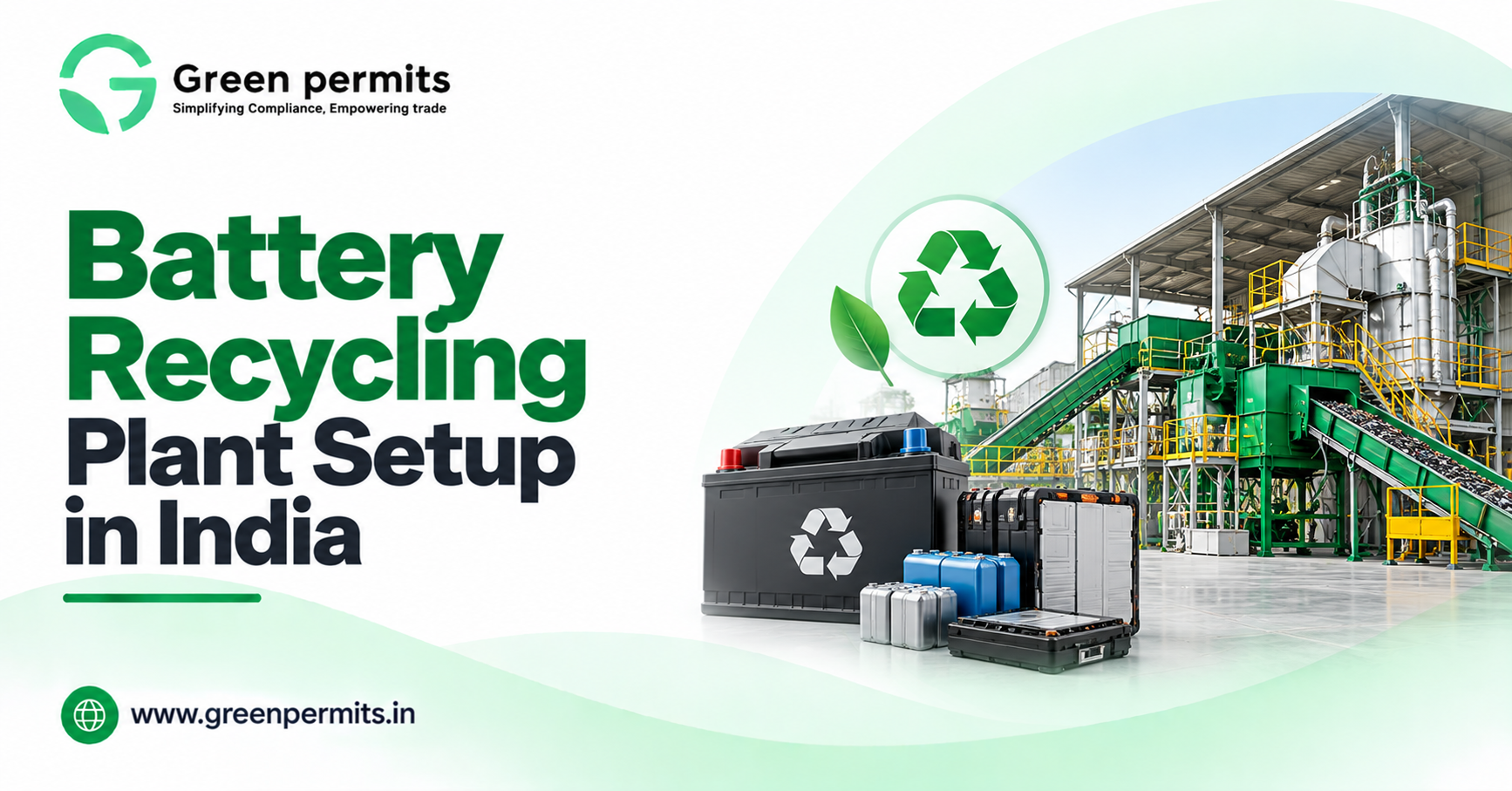
A Battery Recycling Plant Setup in India can be a strong opportunity for entrepreneurs, recyclers and industrial investors as electric vehicles, energy storage systems, consumer electronics and industrial battery applications continue to expand.
However, a battery recycling project should not be planned only around machinery. Its commercial success depends on battery chemistry, secured feedstock, recovery technology, plant capacity, recovered-material buyers, environmental approvals, EPR compliance and working capital.
Green Permits Consulting supports investors with battery recycling plant feasibility studies, DPR preparation, feedstock mapping, technology selection, site assessment, CTE/CTO support, recycler registration, CAPEX-OPEX analysis and complete implementation planning.
What is a Battery Recycling Plant?
A battery recycling plant receives used, rejected or end-of-life batteries and processes them to recover valuable materials that can return to the manufacturing supply chain.
The plant design depends heavily on the battery chemistry. A lithium-ion battery recycling facility has a very different process from a lead-acid battery recycling plant.
For lithium-ion batteries, the process may broadly follow:
Collection → Safe Storage → Discharge / Dismantling → Shredding → Separation → Black Mass → Further Metal Recovery
Depending on the project model, the plant may sell black mass directly or continue into hydrometallurgical recovery to produce lithium, nickel, cobalt or manganese compounds.
Step 1: Select the Battery Chemistry
Battery chemistry should be defined before machinery is selected.
Lithium-ion batteries can include LFP, NMC, NCA, LCO and other chemistries, while lead-acid batteries require a completely different recycling line.
Each chemistry has a different material value.
For example, NMC batteries may contain valuable nickel and cobalt, while LFP batteries have a different economic profile because nickel and cobalt content is much lower or absent.
The project should therefore begin with:
Battery Chemistry → Recoverable Materials → Technology → Final Product → Buyer
This prevents the plant from being designed around unrealistic recovery assumptions.
Step 2: Assess Battery Feedstock
Feedstock availability is one of the most important factors in project viability.
Possible sources include battery manufacturers, EV companies, battery-pack assemblers, service centres, warranty returns, industrial users, energy-storage projects and authorised collection networks.
Manufacturing scrap can also be important because large volumes of end-of-life EV batteries may take years to enter the recycling stream.
The feedstock study should evaluate:
Source → Chemistry → Quantity → Purchase Price → Location → Collection Cost
Plant capacity should be based on material that can realistically be secured rather than only future projections for EV growth.
Step 3: Choose the Recycling Business Model
Battery recycling projects can be developed at different levels.
A mechanical processing plant may focus on dismantling, shredding and separation to recover copper, aluminium, steel and black mass.
A more integrated facility may process black mass further through hydrometallurgical recovery.
The two models can be understood as:
Battery → Mechanical Processing → Black Mass
or
Battery → Mechanical Processing → Black Mass → Hydrometallurgy → Recovered Metal Compounds
Integrated recovery can create higher-value products, but it also requires greater capital investment, chemical handling, wastewater treatment and technical expertise.
The right model should match both feedstock availability and buyer demand.
Step 4: Prepare a Material Balance
Battery recycling economics depend on what can actually be recovered from every tonne of incoming batteries.
The basic relationship is:
Battery Input = Recoverable Materials + Residues + Process Loss
A project should estimate recovery by chemistry instead of using one average recovery figure for every battery.
A simple revenue model is:
Battery Feedstock × Recoverable Material × Recovery Efficiency × Selling Price = Recovery Revenue
This gives a more realistic financial picture than calculating revenue only from incoming tonnage.
Step 5: Decide Plant Capacity
Capacity should follow secured feedstock.
A plant designed for 10,000 tonnes per year can face serious financial pressure if only 4,000 tonnes are available.
Capacity planning should therefore consider:
Available Feedstock → Operating Days → Daily Throughput → Recovery Output → Buyer Demand
A phased approach can often reduce risk.
For example, the investor may begin with mechanical processing and add advanced metal-recovery technology after feedstock supply and product markets are established.
Step 6: Select the Plant Location
Battery recycling requires careful site selection because logistics, safety and environmental compliance can significantly affect project cost.
The site should ideally provide industrial land, good road connectivity, suitable power and water infrastructure, sufficient storage and access to downstream buyers.
A site assessment should review:
Feedstock Distance + Land + Utilities + Logistics + Safety + Buyer Distance + Expansion Potential
The layout should separately provide for incoming batteries, safe storage, dismantling, mechanical processing, chemical processing where applicable, finished products and residues.
Fire and Safety Planning
Lithium-ion batteries can create serious fire and thermal-runaway risks when damaged or handled incorrectly.
Safety therefore needs to be built into the project from the beginning.
The plant should consider safe receiving, segregation, controlled storage, temperature monitoring, suitable firefighting arrangements and emergency-response procedures.
Battery dismantling and shredding should also be designed around the characteristics of the incoming material.
Safety infrastructure should form part of the original plant layout and CAPEX, not be added after commissioning.
Environmental and Regulatory Approvals
Battery recycling facilities require a structured compliance roadmap.
Depending on the project, approvals can include Consent to Establish, Consent to Operate, applicable waste authorisations and registration under the battery waste management framework.
A broad project sequence may be:
Site Finalisation → CTE → Plant Installation → Pollution-Control Systems → CTO → Recycler Registration → Commercial Operations
The exact approval route depends on the battery type, recycling process and location.
Plant capacity, machinery and recovered-product information should remain consistent across the technical and regulatory documents.
Pollution Control and Wastewater
Mechanical processing can generate dust and fine particles, while hydrometallurgical recycling can generate wastewater and process residues.
The pollution-control system therefore depends on the selected technology.
For chemical recovery plants, the project should prepare a detailed water and chemical balance:
Process Water → Chemical Treatment → Wastewater → Treatment → Reuse / Disposal
ETP requirements, chemical storage, ventilation, dust control and residue handling should be included while calculating total project investment.
Identify Buyers Before Production
Recovered material has value only when it meets the buyer's specification.
Potential outputs may include black mass, copper, aluminium and recovered lithium, nickel, cobalt or manganese compounds.
Buyer assessment should therefore consider:
Product → Purity → Moisture → Impurities → Quantity → Selling Price
For black mass, buyers may evaluate chemistry and metal concentration before pricing.
For higher-purity recovered compounds, quality specifications can be much more demanding.
Buyer mapping should therefore be completed before final technology selection.
CAPEX, OPEX and Working Capital
Battery recycling investment varies significantly depending on the processing depth.
The total project cost may include:
Land + Civil Works + Machinery + Utilities + Pollution Control + Fire Safety + Laboratory + Working Capital
OPEX can include feedstock purchase, electricity, chemicals, labour, maintenance, logistics, quality testing and waste disposal.
Working capital is particularly important because batteries may need to be purchased before the recovered products are processed and sold.
A DPR should therefore include monthly cash-flow planning, not only annual profitability.
EPR and Battery Recycling Revenue
Registered recyclers can participate in the applicable battery EPR framework.
However, EPR-related income should not be treated as the only reason to invest in the plant.
A stronger business model is built around:
Secured Feedstock + High Recovery Efficiency + Quality Product + Reliable Buyer
EPR can strengthen the overall project economics, but the underlying recycling business should remain commercially sound even when certificate values change.
How Green Permits Helps with Battery Recycling Plant Setup
Green Permits Consulting supports entrepreneurs, recyclers and industrial investors with battery recycling feasibility studies, DPR preparation, feedstock mapping, chemistry assessment, machinery and technology planning, site selection, CTE/CTO support, recycler registration and CAPEX-OPEX modelling.
We help connect feedstock, technology, recovered products, buyers, regulatory approvals and financial viability before major investment is committed.
Learn More About Battery Recycling Plant Setup
A successful battery recycling project should begin with battery chemistry, secured feedstock, realistic recovery assumptions and confirmed downstream buyers. Proper feasibility and DPR preparation help determine the right capacity, technology and investment structure before machinery is purchased.
Read more about recycling plant setup and DPR consulting services here:
👉 https://www.greenpermits.in/04/battery-recycling-plant-setup-india-cpcb-guide/
📞 Get Expert Assistance for Battery Recycling Plant Setup in India
If you need support for a Battery Recycling Plant Setup in India, Green Permits Consulting can assist with feasibility study, DPR preparation, feedstock assessment, technology planning, CTE/CTO, recycler registration and complete project implementation support.
🌐 Website: www.greenpermits.in
📞 Phone: +91 78350 06182
📧 Email: wecare@greenpermits.in
 Romaian
 English
 Arabic
 French
 Spanish
 Portuguese
 Deutsch
 Turkish
 Dutch
 Italiano
 Russian
 Portuguese (Brazil)
 Greek