
BIS License Consultant in India
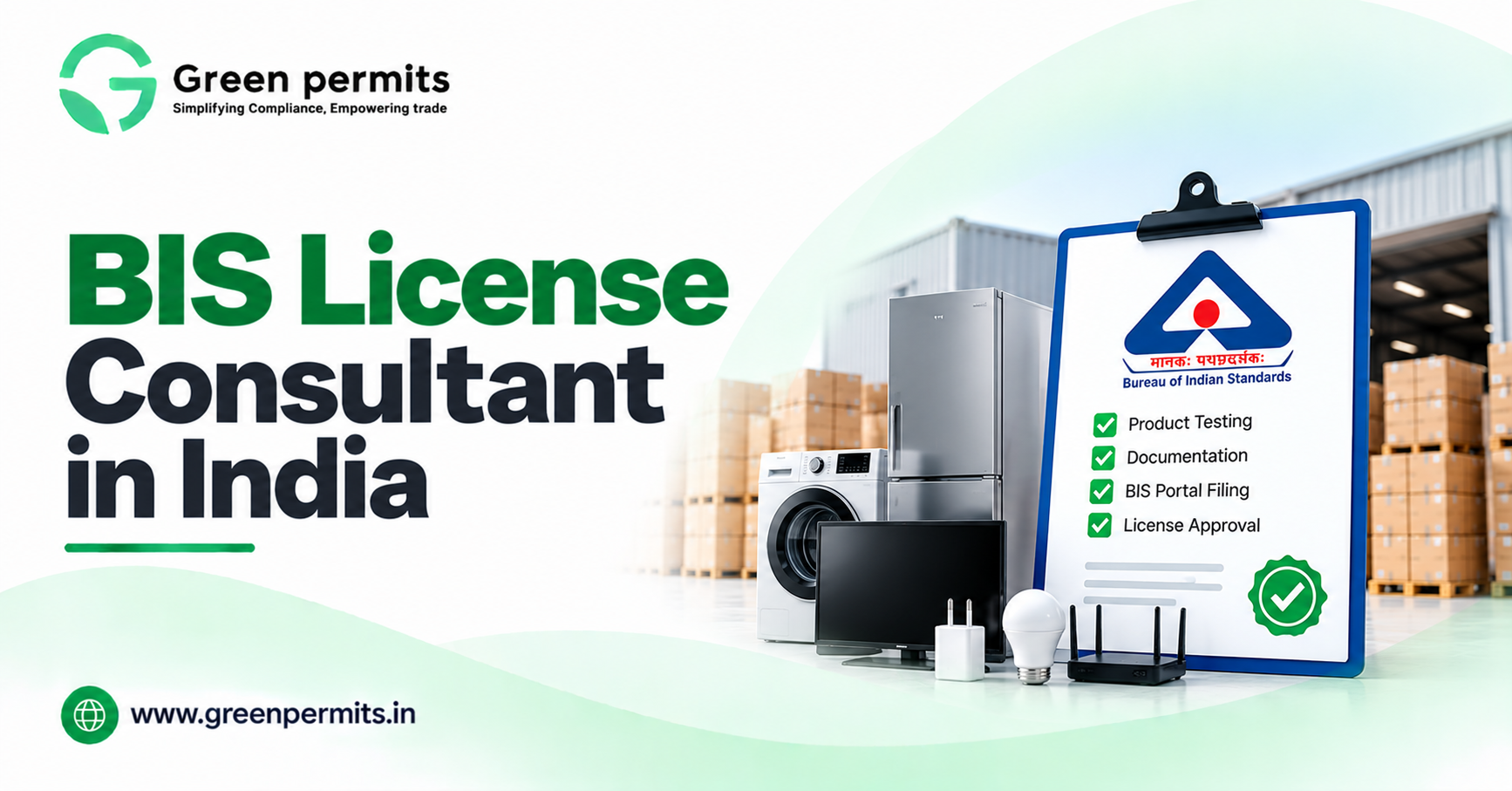
A BIS License Consultant in India helps manufacturers, importers and foreign companies understand whether their products require approval from the Bureau of Indian Standards and guides them through the correct certification route.
BIS licensing is product-specific. The process can depend on the applicable Indian Standard, product category, manufacturing location, testing requirements, factory readiness and certification scheme. Starting with the wrong standard or certification route can lead to repeated testing, document changes and avoidable delays.
Green Permits Consulting supports businesses with BIS applicability assessment, ISI Mark Certification, CRS Registration, FMCS support, product testing coordination, factory readiness, application documentation and complete BIS licence assistance.
What is a BIS License?
A BIS licence is an approval issued under the applicable Bureau of Indian Standards conformity assessment framework for products that need certification before they can be commercially manufactured or supplied in India.
Different products can follow different routes. Many products may require certification under the BIS product certification framework associated with the ISI Mark, while certain electronics and IT-related products may fall under the Compulsory Registration Scheme, or CRS.
Foreign manufacturers may also need an appropriate certification route such as FMCS depending on the product.
The correct starting point is:
Product → Indian Standard → Mandatory Status → BIS Scheme → Testing → Certification
Who Needs a BIS License?
BIS requirements can apply to Indian manufacturers as well as foreign manufacturers supplying regulated products into India.
Depending on the applicable standard and regulatory notification, certification may be relevant for products in sectors such as electrical equipment, steel, cables, chemicals, household goods, construction materials and other industrial categories.
Importers should also assess BIS before placing major overseas orders.
The review should consider:
Product → Manufacturer → Factory Location → Indian Standard → BIS Requirement
This helps avoid situations where products are already produced or shipped before the required certification has been completed.
Step 1: Identify the Correct Indian Standard
The first technical step is identifying the Indian Standard applicable to the product.
This can depend on product construction, rating, material, dimensions, grade, performance and intended use.
Commercial product names alone may not be sufficient.
Two similar-looking products can fall under different standards because of technical differences.
The correct sequence is:
Technical Product Review → Indian Standard → Certification Requirement
This assessment should happen before formal testing begins.
Step 2: Check the Applicable BIS Scheme
Not every BIS-regulated product follows the same certification process.
Some products may require ISI Mark Certification, while others may fall under CRS or another applicable route.
Foreign manufacturers may need to follow a foreign-manufacturer certification process where relevant.
The correct route depends on:
Product Category + Indian Standard + Regulatory Requirement + Manufacturing Location
A consultant helps confirm the right scheme before the business spends money on product testing, factory preparation or application documents.
Step 3: Conduct Product Testing
Testing is an important stage in many BIS certification processes.
The sample should represent the actual commercial product intended for the Indian market.
A practical sequence is:
Indian Standard Review → Product Gap Assessment → Sample Preparation → Testing → Certification Process
If the product does not meet the applicable requirement, changes may be needed before retesting.
For businesses with several models or grades, the complete product range should be reviewed before testing so that certification scope is planned correctly.
Step 4: Prepare the Factory
For BIS certification routes involving factory assessment, the manufacturing facility should be properly prepared.
The factory may need suitable production machinery, testing facilities, calibration records, quality-control procedures and trained technical personnel.
A readiness review should cover:
Manufacturing Process → Machinery → Testing Equipment → Calibration → Quality Records
The actual factory should match the information shown in the certification documents.
If there are differences between the application and the real production setup, clarification or corrective action may be required.
BIS License for Indian Manufacturers
Indian manufacturers should consider BIS requirements during the product-development and plant-setup stage.
Waiting until the factory is ready for commercial production can delay the product launch if additional testing equipment, product modifications or certification steps are required.
A better sequence is:
Product Development → BIS Applicability → Standard Review → Factory Preparation → Testing → Certification → Production
For new plants, BIS planning can also be integrated with machinery selection, quality-laboratory setup and production planning.
BIS License for Foreign Manufacturers
Foreign manufacturers planning to sell regulated goods in India should assess BIS requirements before commercial shipment.
Depending on the product, the overseas factory may need to provide manufacturing information, testing capability, quality-control records and technical documentation.
Factory inspection may also form part of the applicable certification process.
The planning flow can be:
Product → Indian Standard → Factory Review → Testing → BIS Process → Certification → Export to India
Indian importers should therefore verify the exact overseas factory before placing major orders.
BIS License for Importers
Importers should understand that BIS approval is generally linked to the manufacturer under the relevant scheme.
The sourcing review should include:
Brand → Manufacturer → Factory Address → Product → Model → BIS Status
If an importer sources the same product from two different factories, approval linked to one manufacturing location should not automatically be assumed to cover the other.
This is particularly important when purchasing through trading companies.
BIS compliance should therefore be treated as part of supplier due diligence.
Product Models and Certification Scope
Manufacturers often produce multiple models, sizes, ratings or grades under one product family.
The certification strategy should therefore review the full commercial range.
A useful model matrix is:
Product Family → Models / Grades → Technical Differences → Testing → Certification Scope
Poor planning can result in certification being obtained for only one part of the product range while commercially important variants remain outside the approval.
The complete portfolio should therefore be reviewed before the application is filed.
Documents Required for BIS Licensing
The exact documentation depends on the product and applicable BIS scheme.
Typical information may include manufacturer details, factory address, product specifications, manufacturing-process flow, machinery list, testing facilities, raw-material information and authorised-signatory documents.
The most important requirement is consistency.
The following details should remain aligned throughout the process:
Manufacturer Name + Factory Address + Product + Model / Grade + Indian Standard
Even small inconsistencies can create avoidable clarification queries.
Common Reasons for BIS Licence Delays
BIS certification can be delayed when the wrong Indian Standard is selected, testing fails, factory systems are incomplete or documentation contains inconsistent information.
Another common mistake is beginning certification after commercial commitments have already been made.
The better sequence is:
Applicability → Standard → Product Review → Testing → Factory Readiness → Application → Inspection / Review → Certification
Early planning gives the manufacturer time to correct technical or factory-related gaps before they affect the product launch.
How a BIS License Consultant Helps
A professional BIS License Consultant in India helps coordinate the technical, testing and procedural parts of certification.
The consultant can identify the applicable Indian Standard, determine the correct BIS scheme, coordinate product testing, review factory readiness, prepare documentation and support inspection or clarification requirements.
The objective is to keep:
Product + Standard + Factory + Testing + Documentation
properly aligned throughout the certification project.
How Green Permits Helps with BIS Licensing
Green Permits Consulting supports Indian manufacturers, importers and foreign companies with BIS applicability assessment, ISI Mark Certification, CRS Registration, FMCS support, Indian Standard identification, testing coordination, factory readiness and application assistance.
We also help businesses review the complete product and manufacturing scope so that the certification strategy matches the actual commercial requirement.
Learn More About BIS Licensing and Product Compliance
If you are planning to manufacture, import or launch a regulated product in India, BIS requirements should be checked before commercial production or shipment. Early planning helps identify the correct Indian Standard, testing route, factory requirements and certification scope from the beginning.
Read more about certification and regulatory consulting services here:
👉 https://www.greenpermits.in/07/bis-certification-consultant-in-india/
📞 Get Expert Assistance for BIS License in India
If you need a BIS License Consultant in India for ISI Mark Certification, CRS Registration, FMCS, product testing, factory inspection preparation or application support, Green Permits Consulting can assist with complete certification coordination.
🌐 Website: www.greenpermits.in
📞 Phone: +91 78350 06182
📧 Email: wecare@greenpermits.in
 Romaian
 English
 Arabic
 French
 Spanish
 Portuguese
 Deutsch
 Turkish
 Dutch
 Italiano
 Russian
 Portuguese (Brazil)
 Greek