
Scope 1, 2 & 3 Emissions Consultant in India
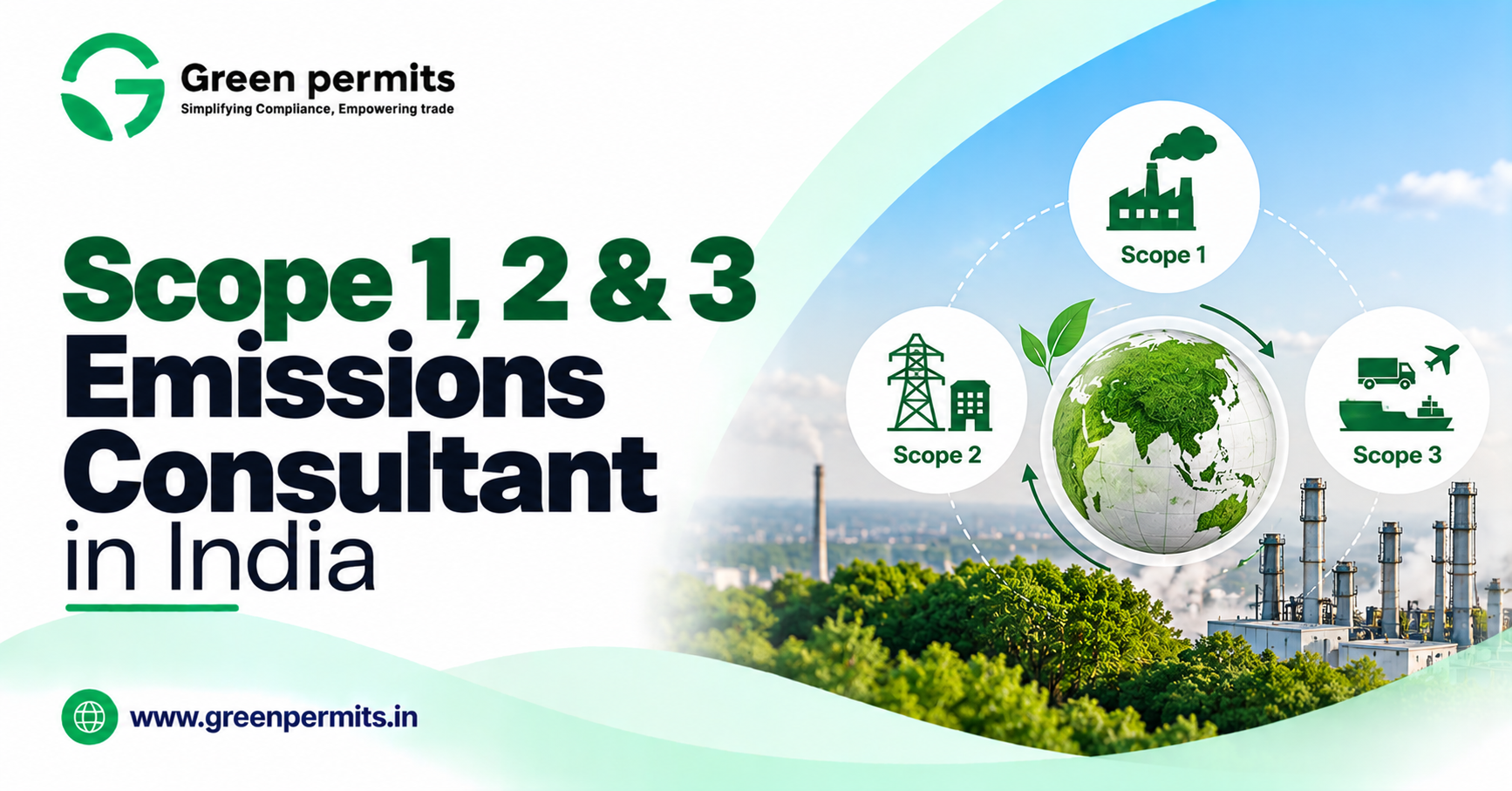
A Scope 1, 2 & 3 Emissions Consultant in India helps businesses identify, calculate, document, and manage greenhouse gas emissions across their own operations and wider value chain.
For manufacturers, exporters, corporates, and suppliers, carbon accounting is becoming increasingly important for ESG reporting, BRSR, customer sustainability questionnaires, decarbonisation planning, supply-chain requirements, and international business.
The biggest challenge is not simply producing a carbon number. Businesses need to define reporting boundaries, identify emission sources, collect reliable activity data, apply appropriate emission factors, and maintain supporting records that allow the calculations to be reviewed each year.
Green Permits Consulting supports businesses with Scope 1, Scope 2 and Scope 3 emissions assessment, GHG accounting, carbon inventory development, ESG reporting, BRSR readiness, supplier emissions assessment, and decarbonisation planning.
What Are Scope 1, Scope 2 and Scope 3 Emissions?
Greenhouse gas emissions are commonly divided into three scopes to help businesses understand where emissions originate.
Scope 1 covers direct emissions from sources owned or controlled by the company.
Scope 2 covers indirect emissions associated with purchased electricity or other purchased energy.
Scope 3 covers other indirect emissions across the company’s value chain.
A practical carbon-accounting structure is:
Business Boundary → Emission Sources → Activity Data → Emission Factors → CO2e Calculation → Reporting
This framework helps companies develop a consistent carbon inventory.
What Are Scope 1 Emissions?
Scope 1 emissions are direct greenhouse gas emissions generated by sources controlled by the business.
Depending on the company, these may include:
Fuel Combustion → Boilers → Furnaces → DG Sets → Company Vehicles → Process Emissions → Refrigerants
For example, if a factory consumes diesel in a generator, those emissions may form part of its Scope 1 inventory.
The basic calculation can be represented as:
Fuel Consumed × Applicable Emission Factor = Scope 1 Emissions
The company should maintain supporting records such as fuel invoices, meter readings, logbooks, or production records.
What Are Scope 2 Emissions?
Scope 2 emissions are associated with purchased electricity or other purchased energy used by the organisation.
For many businesses in India, electricity can be one of the largest contributors to the corporate carbon footprint.
A simplified calculation is:
Purchased Electricity × Applicable Emission Factor = Scope 2 Emissions
The consultant should collect data from electricity bills, meter records, and site-level consumption reports.
For companies operating several plants, warehouses, or offices, all relevant locations should be included consistently within the reporting boundary.
What Are Scope 3 Emissions?
Scope 3 covers indirect emissions occurring across the wider value chain.
These emissions may arise from activities such as purchased materials, transport, business travel, employee commuting, waste, capital goods, supplier operations, and downstream product activities.
Scope 3 is generally more complex because much of the required information is held by suppliers, logistics providers, employees, or customers.
The process may follow:
Value Chain Mapping → Relevant Categories → Data Collection → Estimation → Improvement
Businesses do not necessarily need perfect supplier-level information from day one.
They can begin by identifying the largest relevant emission sources and improve data quality over time.
Why Scope 1, 2 and 3 Emissions Matter
Understanding emissions by scope gives management a clearer picture of where carbon impact exists.
Without this breakdown, a company may focus heavily on electricity savings even though purchased raw materials or logistics create a much larger footprint.
The analysis helps identify:
Direct Operations → Purchased Energy → Wider Value Chain
This supports more effective carbon-reduction planning.
It also provides structured information for investors, customers, lenders, ESG reports, and internal sustainability strategies.
Step 1: Define the Organisational Boundary
The first step is deciding which operations will be included in the carbon inventory.
This may involve factories, offices, warehouses, company-owned vehicles, or other controlled facilities.
The consultant should prepare a clear structure:
Legal Entity → Site → Activity → Included Source → Excluded Source
Boundary setting is important because inconsistent coverage can distort the final emissions inventory.
For example, electricity from one factory should not be included while fuel consumption from the same facility is accidentally excluded.
Step 2: Identify Emission Sources
Each facility should have an emission-source register.
For a manufacturing business, this may include:
Electricity → Diesel → Natural Gas → LPG → Refrigerants → Process Emissions → Transport
A service company may have fewer direct emissions but significant emissions from electricity, travel, commuting, and purchased services.
The consultant should identify both obvious and less visible sources.
This creates the foundation for accurate carbon accounting.
Step 3: Collect Activity Data
Activity data is the measurable information used to calculate emissions.
Examples include:
Litres of Fuel
kWh of Electricity
Kilometres Travelled
Tonnes of Material Purchased
Kilograms of Refrigerant
Each data point should have a clear owner.
A useful system is:
KPI → Department → Source Document → Calculation Method → Review
This creates traceability and reduces the risk of reporting unsupported estimates.
Step 4: Apply Emission Factors
After activity data is collected, appropriate emission factors are applied.
The basic formula is:
Activity Data × Emission Factor = GHG Emissions
The calculation methodology should document the source, unit, and year of the emission factor used.
This is important because inconsistent factors can make year-on-year comparisons unreliable.
The company should maintain a calculation file that another reviewer can understand and reproduce.
Step 5: Convert Emissions into CO2e
Different greenhouse gases have different warming impacts.
For reporting purposes, emissions are commonly converted into carbon dioxide equivalent, or CO2e.
The final inventory may therefore present:
Scope 1 CO2e
Scope 2 CO2e
Scope 3 CO2e
and
Total Organisational Emissions
This creates a common basis for performance tracking.
Scope 1, 2 and 3 for Manufacturers
Manufacturing businesses often have a more complex carbon profile.
The consultant may need to review:
Raw Materials → Production → Electricity → Fuel → Process → Waste → Transport
The company can also calculate carbon intensity.
For example:
Total GHG Emissions ÷ Tonnes Produced = Emissions Intensity
Intensity metrics can help management compare performance even when annual production changes.
Scope 1, 2 and 3 for Exporters
Indian exporters increasingly receive sustainability and carbon-data requests from international customers.
Buyers may ask for:
Scope 1 Emissions
Scope 2 Emissions
Scope 3 Information
Renewable Energy Share
Carbon Reduction Targets
Businesses with a structured emissions inventory can respond to these requests more quickly and consistently.
This can also support wider ESG and supply-chain sustainability requirements.
Scope Emissions and BRSR
For companies preparing BRSR or wider ESG disclosures, reliable carbon data is important.
The focus should not only be on the final emissions figure.
Businesses should maintain an evidence trail:
Reported Figure → Calculation → Activity Data → Invoice / Meter / Record
This improves data quality and makes sustainability reporting easier to manage.
A repeatable carbon-accounting process is more valuable than recalculating emissions from scratch every year.
Scope Emissions and CBAM
Corporate Scope 1, Scope 2 and Scope 3 accounting can also support businesses preparing for carbon-related export requirements such as CBAM.
However, the two should not be treated as identical.
Corporate emissions accounting looks at the wider organisation and value chain, while CBAM can require more specific product and installation-level embedded-emissions information.
The systems can still share important source data, including:
Electricity + Fuel + Production + Material Inputs
Building strong carbon data therefore supports multiple sustainability requirements.
Identifying Carbon Hotspots
Once the carbon inventory is complete, the consultant can identify the largest emission sources.
The process can follow:
Emission Source → Contribution → Reduction Potential → Cost → Priority
For one company, purchased electricity may dominate.
For another, raw materials or logistics may represent the largest Scope 3 contribution.
Reduction planning should focus first on the sources that create the greatest impact and are reasonably controllable.
From Carbon Accounting to Reduction
Scope 1, 2 and 3 accounting should lead to action.
After establishing the baseline, businesses can evaluate measures such as:
Energy Efficiency → Renewable Electricity → Fuel Switching → Process Optimisation → Waste Reduction → Supplier Engagement
A practical carbon-reduction cycle is:
Baseline → Hotspots → Target → Project → Investment → Monitoring
This allows businesses to connect emissions reporting with actual operational improvements.
Common Scope 1, 2 and 3 Accounting Problems
One common mistake is collecting data before defining the reporting boundary.
Another is mixing corporate emissions with product-level carbon calculations without clearly separating the methodologies.
Other problems include missing facilities, inconsistent emission factors, weak Scope 3 assumptions, and insufficient supporting records.
The better approach is:
Boundary First → Sources Second → Data Third → Calculation Fourth → Review Fifth
This creates a more reliable emissions inventory.
How a Scope 1, 2 & 3 Emissions Consultant Helps
A professional Scope 1, 2 & 3 Emissions Consultant in India helps businesses build a structured and repeatable greenhouse gas inventory.
The consulting process can follow:
Boundary Setting → Source Mapping → Data Collection → Emission Factors → Calculation → Validation → Reporting → Reduction Planning
The goal is not simply to calculate emissions.
The goal is to build a carbon-management system that management can use for reporting, decision-making, and decarbonisation.
How Green Permits Helps with Scope 1, 2 and 3 Emissions
Green Permits Consulting supports manufacturers, exporters, corporates, and growing businesses with Scope 1, Scope 2 and Scope 3 emissions assessment, GHG accounting, carbon inventory development, ESG reporting, BRSR readiness, supplier emissions assessment, and decarbonisation planning.
We help businesses connect activity data, carbon calculations, source documents, reporting requirements, and reduction targets within one structured system.
Learn More About Scope 1, 2 and 3 Emissions
A reliable carbon inventory begins with clear boundaries, accurate activity data, documented calculation methods, and consistent reporting. Businesses that build these systems early are better prepared for ESG reporting, customer requirements, carbon reduction planning, and future sustainability expectations.
Read more about ESG, carbon, and sustainability consulting services here:
https://www.greenpermits.in/07/ghg-accounting-consultant-in-india-scope-1-2-and-3/
📞 Get Expert Assistance from a Scope 1, 2 & 3 Emissions Consultant in India
If you need a Scope 1, 2 & 3 Emissions Consultant in India, Green Permits Consulting can assist with greenhouse gas accounting, carbon inventory development, ESG reporting, BRSR readiness, supplier emissions analysis, and decarbonisation planning.
🌐 Website: www.greenpermits.in
📞 Phone: +91 78350 06182
📧 Email: wecare@greenpermits.in
 Greek
 English
 Arabic
 French
 Spanish
 Portuguese
 Deutsch
 Turkish
 Dutch
 Italiano
 Russian
 Romaian
 Portuguese (Brazil)