
Vehicle Scrapping Plant DPR in India
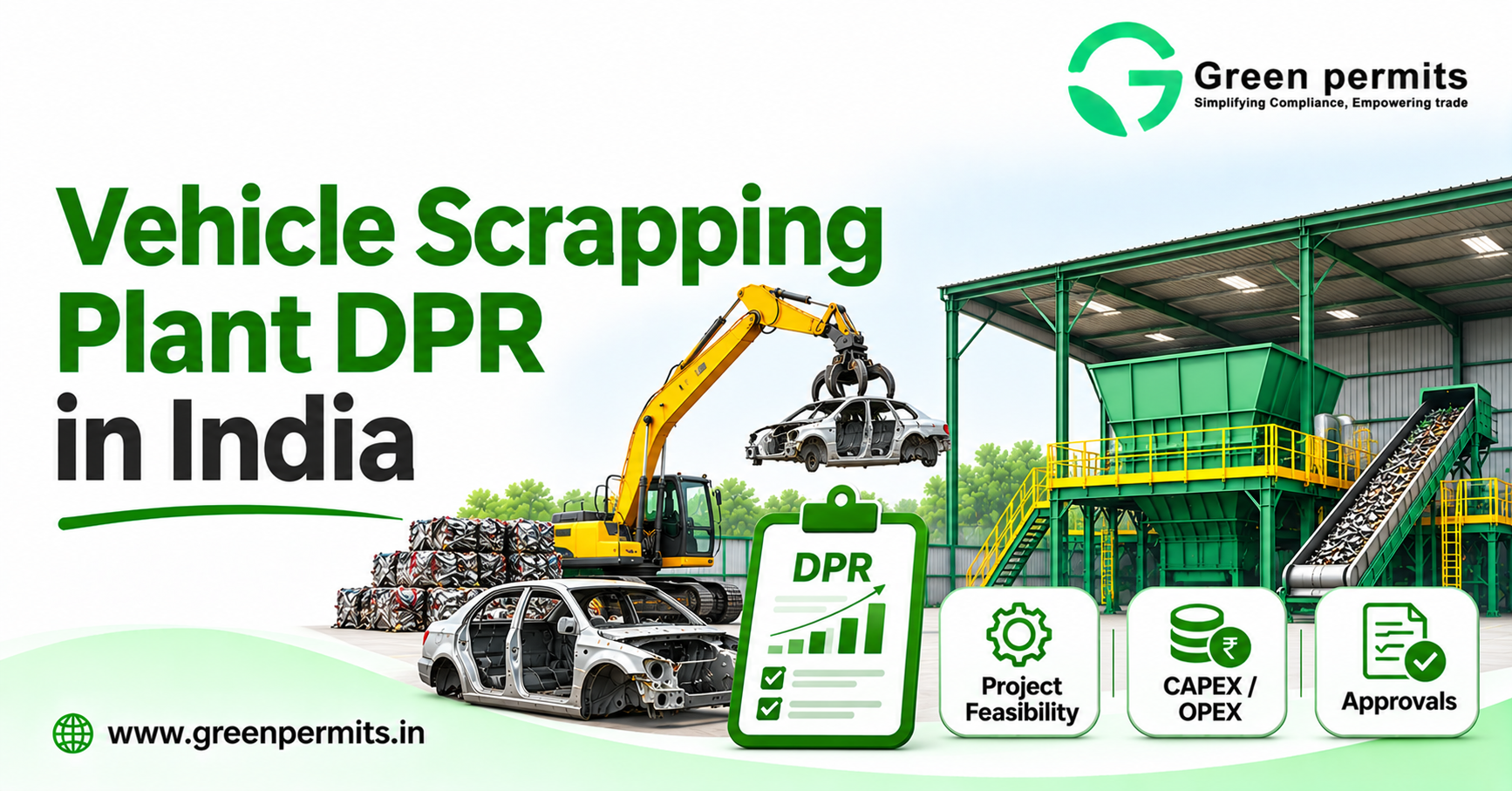
A Vehicle Scrapping Plant DPR in India helps investors evaluate the technical, regulatory and financial feasibility of setting up a Registered Vehicle Scrapping Facility or RVSF.
A vehicle scrapping project involves much more than buying dismantling machinery. The investor needs to understand ELV availability, plant capacity, land requirement, depollution systems, dismantling equipment, recovered material value, environmental approvals, operating cost, working capital and expected return on investment.
A properly prepared DPR connects all of these factors into one project model so that the promoter can decide whether the proposed RVSF is commercially practical before committing major capital.
Green Permits Consulting supports investors with RVSF DPR preparation, feasibility studies, site assessment, machinery planning, CAPEX and OPEX estimation, regulatory approvals and complete vehicle scrapping plant setup support.
What is a Vehicle Scrapping Plant DPR?
DPR stands for Detailed Project Report.
For an RVSF, the DPR is a structured document that explains how the proposed vehicle scrapping facility will operate, how much investment it will require and whether the project can generate sustainable returns.
A vehicle scrapping DPR generally connects:
ELV Supply → Plant Capacity → Land → Machinery → Depollution → Material Recovery → Approvals → CAPEX → OPEX → Revenue → ROI
The DPR should not be prepared only as a bank document.
It should also act as the technical and commercial roadmap for project implementation.
Why is a DPR Important Before Setting Up an RVSF?
A common mistake in vehicle scrapping projects is finalizing land or machinery before studying vehicle availability and project economics.
For example, an investor may select machinery capable of processing 50 vehicles per day.
But if the practical sourcing network can provide only 10 to 15 vehicles per day, the plant can remain underutilized.
A DPR helps identify such risks before the investment is made.
It can answer questions such as:
- How many vehicles can realistically be sourced?
- What plant capacity should be selected?
- What land area is required?
- Which machinery is actually needed?
- What will the total project cost be?
- How much working capital is required?
- What materials can be recovered?
- What will operating cost look like?
- What is the expected revenue?
- What are the risks to ROI?
This makes the DPR one of the most important planning documents for an RVSF project.
Market Study for Vehicle Scrapping Plant
The DPR should begin with an assessment of the vehicle scrapping market.
The study can examine:
- Vehicle population in the target region
- Vehicle age profile
- Commercial vehicle concentration
- Fleet ownership
- Scrappage potential
- Existing RVSFs
- Scrap metal demand
- Steel recycling market
- Non-ferrous metal demand
- Policy and regulatory environment
The objective is to understand whether the proposed region can support another RVSF.
A plant should not be selected only because vehicle scrapping is considered a growing sector.
The actual local supply and competition should be studied.
ELV Availability Study
End-of-Life Vehicle availability is one of the most important assumptions in the DPR.
Potential sourcing channels can include:
- Individual vehicle owners
- Transport companies
- Logistics companies
- Taxi operators
- Bus fleets
- Corporate fleets
- Government departments
- Insurance companies
- Banks and financial institutions
- Automobile dealers
The study should estimate how many eligible vehicles can be sourced within a practical radius.
Vehicle availability should then be compared with the proposed processing capacity.
RVSF Capacity Planning
Capacity should be determined after the sourcing study.
Important parameters can include:
- Vehicles per day
- Vehicles per year
- Average vehicle weight
- Vehicle type
- Working days
- Number of shifts
- Plant utilization
- Maintenance downtime
A project may be planned for passenger vehicles, commercial vehicles or a mix.
The vehicle mix matters because a truck, car and two-wheeler have very different weights and material recovery values.
The DPR should therefore avoid using only "number of vehicles" without considering total weight.
Site Selection in RVSF DPR
Site suitability should form a separate section in the DPR.
Important parameters can include:
- Industrial land availability
- Road connectivity
- Distance from vehicle sources
- Scrap market access
- Electricity
- Water
- Fire access
- Environmental suitability
- Land-use permissions
- Future expansion
The location should balance both compliance and logistics.
A cheap site located far from the vehicle sourcing market can increase transportation cost and reduce profitability.
Land Requirement
The DPR should explain how the proposed land will be used.
An RVSF may need dedicated areas for:
- Vehicle receiving
- Vehicle parking
- Weighbridge
- Depollution
- Dismantling
- Reusable components
- Steel scrap
- Aluminium
- Copper and wiring
- Plastics
- Glass
- Tyres
- Batteries
- Used oil
- Hazardous waste
- Office
- Utilities
- Internal roads
- Fire movement
The required land depends heavily on daily vehicle throughput and inventory holding time.
RVSF Process Flow in DPR
A clear process flow should explain how an ELV moves through the facility.
A typical flow can be:
Vehicle Receipt → Verification → Weighing → Depollution → Dismantling → Component Removal → Material Segregation → Baling / Processing → Storage → Dispatch
Each stage should be linked with the relevant machinery and manpower.
The process note should also explain how hazardous materials are safely removed before further dismantling.
Depollution Section
Depollution is a critical part of RVSF planning.
The DPR should explain how the facility will remove and store:
- Fuel
- Engine oil
- Gear oil
- Coolant
- Brake fluid
- Refrigerant
- Battery
- Other automotive fluids
The DPR should also cover:
- Spill prevention
- Fluid collection
- Storage tanks
- Oil handling
- Hazardous waste storage
- Emergency response
Depollution infrastructure should be included in both machinery cost and plant layout.
Machinery Requirement
The DPR should include an equipment list based on the selected plant capacity.
Typical machinery can include:
- Weighbridge
- Vehicle lifts
- Depollution unit
- Fuel drainage equipment
- Oil drainage equipment
- Refrigerant recovery system
- Engine removal tools
- Hydraulic cutters
- Tyre removal equipment
- Forklift
- Cranes
- Material-handling equipment
- Scrap baler
- Hydraulic shear
- Car flattener
Advanced projects may also consider shredding and separation systems.
The DPR should explain whether these machines are technically and commercially justified.
Shredder or No Shredder?
This is an important project decision.
A basic RVSF may dismantle the vehicle, recover components and bale the stripped body shell.
A more advanced facility may install:
- Heavy-duty shredder
- Magnetic separator
- Eddy current separator
- Conveyor systems
- Dust extraction
The second option requires significantly higher investment and higher throughput.
The DPR should compare both models before recommending equipment.
Material Recovery Analysis
A vehicle contains several recoverable materials.
These can include:
- Steel
- Aluminium
- Copper
- Brass
- Plastics
- Glass
- Rubber
- Wiring
- Reusable components
The DPR should estimate recovery by vehicle category and total throughput.
A simplified material balance can look like:
ELV Input → Ferrous Metal + Non-Ferrous Metal + Plastics + Rubber + Glass + Reusable Components + Waste
The revenue model should be based on this material balance.
Scrap Price Assumptions
Recovered material prices have a major impact on project profitability.
The DPR should use current or recent market references for:
- Steel scrap
- Aluminium scrap
- Copper scrap
- Brass
- Plastics
- Batteries
- Tyres
- Used components
The model should not assume one fixed price throughout the project period.
Sensitivity analysis should be used to test price changes.
RVSF EPR Revenue
Under the ELV EPR framework, registered RVSFs may generate EPR certificates based on eligible steel recovery.
This can create an additional revenue stream.
However, EPR revenue should be treated carefully in the DPR.
A stronger financial model should test:
Base Case: Revenue from recovered materials only
Upside Case: Recovered materials + EPR certificate income
This helps prevent the project from depending entirely on future EPR prices.
CAPEX in Vehicle Scrapping DPR
Capital expenditure should include the complete project cost.
Major CAPEX heads can include:
Land
Site Development
Civil Construction
Plant & Machinery
Depollution Equipment
Pollution-Control Infrastructure
Fire & Safety Systems
Electrical Infrastructure
IT and Traceability Systems
Installation & Commissioning
Pre-operative Expenses
Contingency
A machinery quotation alone is not the project CAPEX.
OPEX in Vehicle Scrapping DPR
Operating cost should be estimated separately.
Major OPEX heads can include:
- ELV procurement
- Transportation
- Labour
- Electricity
- Maintenance
- Consumables
- Waste disposal
- Insurance
- Administration
- Compliance
- Security
- IT systems
Vehicle procurement is often one of the largest operating costs.
The DPR should therefore test different purchase prices.
Working Capital Requirement
Working capital can become a major funding requirement in an RVSF.
Funds may be required for:
- Purchasing vehicles
- Transporting ELVs
- Paying salaries
- Utilities
- Maintenance
- Consumables
- Scrap inventory
- Operating expenses
If the facility holds vehicles or recovered materials for long periods, working capital can increase further.
The DPR should therefore calculate the operating cycle rather than using an arbitrary percentage.
Revenue Model
Revenue can come from several streams.
These may include:
- Ferrous scrap
- Aluminium
- Copper
- Brass
- Tyres
- Batteries
- Plastics
- Glass
- Engines
- Gearboxes
- Reusable automotive components
- EPR certificates, where applicable
Each revenue stream should be linked with:
Quantity × Recovery Rate × Selling Price
This creates a more transparent financial model.
Profitability Analysis
The DPR should calculate profitability at different utilization levels.
For example:
- 40% capacity utilization
- 60% utilization
- 80% utilization
- 90% utilization
This is more realistic than assuming full capacity from the first year.
The project should also calculate:
- Gross profit
- EBITDA
- Net profit
- Cash flow
- Break-even
- DSCR
- ROI
- IRR
- Payback period
Break-Even Analysis
Break-even shows the minimum level of operations required for the project to cover its fixed and variable costs.
For an RVSF, break-even depends heavily on:
- ELV procurement cost
- Scrap selling price
- Recovery rate
- Fixed overhead
- Capacity utilization
A project with high machinery CAPEX may require a much higher throughput to reach break-even.
Sensitivity Analysis
Sensitivity analysis is essential for a vehicle scrapping DPR.
The financial model should test what happens if:
- ELV purchase price increases
- Steel scrap price falls
- Vehicle availability drops
- Plant utilization is lower
- Labour cost increases
- EPR income is lower than expected
A robust project should remain manageable under moderate downside scenarios.
Regulatory Approvals Section
The DPR should provide a clear approval roadmap.
Depending on project location and scope, approvals can include:
- RVSF registration
- EPR ELV portal registration
- Consent to Establish
- Consent to Operate
- Hazardous waste authorization
- Fire approval
- Building-related permissions
- Electrical approvals
- Labour and factory-related approvals, where applicable
The exact compliance list should be finalized according to the state and project configuration.
RVSF Registration Planning
RVSF registration should be integrated with the project design.
The facility should be planned around actual operating requirements such as:
- Vehicle receiving
- Depollution
- Dismantling
- Installed equipment
- Capacity
- Pollution-control systems
- Waste storage
- Safety
This reduces the risk of redesigning the plant after machinery installation.
Environmental Management Plan
The DPR should also include environmental management.
This may cover:
- Used oil handling
- Waste batteries
- Waste tyres
- Hazardous waste
- Wastewater
- Spill control
- Storm water
- Fire safety
- Storage
- Dust and noise
Different waste streams should be routed to appropriate authorized channels.
Manpower Planning
The DPR should estimate the manpower needed for the selected level of automation.
Possible roles can include:
- Plant manager
- Operations supervisor
- Depollution technicians
- Dismantling workers
- Machine operators
- Forklift operator
- Maintenance technician
- Electrician
- Store staff
- Safety officer
- Accounts staff
- Security
The manpower model should be linked with plant capacity and number of shifts.
Utility Requirement
Utilities should also be estimated realistically.
These may include:
- Electricity
- Water
- Compressed air
- DG backup
- Fire water
- Office utilities
The sanctioned electrical load should match the machinery requirement.
Utility cost should then be carried into OPEX.
Project Implementation Schedule
The DPR should provide a practical execution plan.
A typical sequence can be:
Feasibility → Land Finalisation → DPR → Approvals → Civil Work → Machinery Procurement → Installation → Pollution Control → Registration → Trial Operation → Commercial Operation
This helps the investor understand how different activities overlap.
Funding Requirement
The DPR can also be used for internal investment approval or bank financing.
Funding can be structured through:
- Promoter equity
- Term loan
- Working capital loan
- Strategic investor
- Internal accrual
- Other funding options
The DPR should clearly separate:
Fixed Asset Funding and Working Capital Funding
This improves financial planning.
Common Mistakes in Vehicle Scrapping DPR
A DPR can appear detailed but still be weak if the assumptions are unrealistic.
Common problems include:
- Overestimating ELV availability
- Assuming full utilization immediately
- Using outdated scrap prices
- Ignoring vehicle procurement cost
- Underestimating working capital
- Using generic machinery lists
- Ignoring depollution cost
- Depending heavily on EPR income
- No sensitivity analysis
- No clear waste-management plan
A strong DPR should connect every assumption logically.
How Green Permits Prepares an RVSF DPR
Green Permits Consulting can prepare a project-specific Vehicle Scrapping Plant DPR based on the proposed location, plant capacity, vehicle mix and investment plan.
The study can include:
- ELV market assessment
- Site feasibility
- Capacity planning
- Machinery requirement
- Plant layout
- Material balance
- Regulatory approvals
- CAPEX
- OPEX
- Working capital
- Revenue model
- Profitability
- ROI
- Payback
- Sensitivity analysis
- Implementation roadmap
The objective is to provide investors with a practical decision-making document rather than a generic project report.
How Green Permits Helps with Vehicle Scrapping Plant Setup
Green Permits Consulting supports investors planning RVSF projects across India with end-to-end project advisory.
Our services can include DPR preparation, feasibility study, vehicle sourcing assessment, machinery planning, plant layout, environmental approvals, RVSF registration and EPR compliance.
We help connect:
Market → ELV Supply → Capacity → Land → Machinery → Approvals → CAPEX → OPEX → Revenue → ROI
This helps investors understand the complete project before major capital is committed.
Learn More About RVSF Plant Setup
If you are planning a Registered Vehicle Scrapping Facility in India, a detailed DPR should be prepared before finalizing land, machinery and project funding.
A well-prepared DPR can help identify the right plant capacity, investment requirement, operating cost, material recovery and expected financial performance.
Read more about recycling plant setup consulting services here:
👉 https://www.greenpermits.in/06/vehicle-scrapping-plant-setup-in-india-rvsf-license/
📞 Get Expert Assistance for Vehicle Scrapping Plant DPR in India
If you need a Vehicle Scrapping Plant DPR in India, Green Permits Consulting can assist with feasibility studies, RVSF DPR preparation, machinery planning, CAPEX and OPEX estimation, regulatory approvals and complete project setup support.
🌐 Website: www.greenpermits.in
📞 Phone: +91 78350 06182
📧 Email: wecare@greenpermits.in

 Arabic
 French
 Spanish
 Portuguese
 Deutsch
 Turkish
 Dutch
 Italiano
 Russian
 Romaian
 Portuguese (Brazil)
 Greek