
Mechanical Principle Behind Corrugating Roller Operation
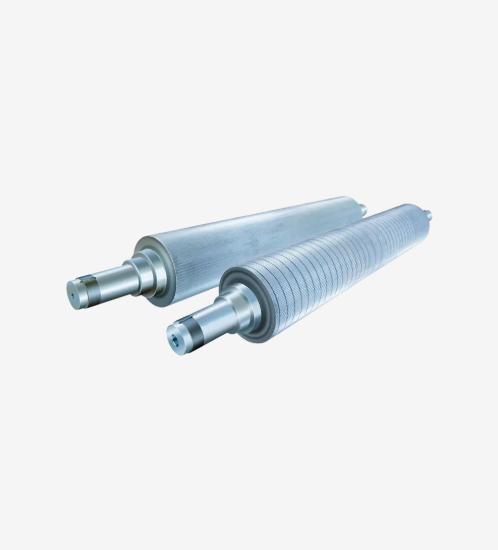
The Corrugating Roller plays a central role in the single facer section of corrugated cardboard production. Its main function is to transform flat paper medium into a structured fluted shape that increases rigidity and strength.
The working process begins when preheated paper enters the corrugating zone. The upper and lower Corrugating Rollers rotate in opposite directions, pulling the paper through a narrow gap known as the nip. Inside this zone, a combination of heat and pressure reshapes the fibers.
Typical operating conditions include:
Steam temperature: 160–200°C
Steam pressure: 0.8–1.3 MPa
Production speed: 120–300 m/min depending on machine design
As the paper passes through the roller teeth, it is compressed into specific flute geometries. The most common flute profiles include:
A flute: 4.8–5.0 mm height (high cushioning strength)
B flute: 2.5–3.0 mm (printing surface optimization)
C flute: 3.5–4.0 mm (balanced performance)
E flute: 1.0–1.8 mm (light packaging)
After shaping, adhesive is applied to flute tips before bonding with linerboard to form single-faced corrugated board.
The precision of the Corrugating Roller directly affects bonding strength, flute uniformity, and paper breakage rate. Any deviation in tooth profile or temperature distribution can lead to production defects.
Modern systems use automated pressure control and thermal feedback to maintain consistency, ensuring that each meter of corrugated board meets structural requirements.
 Portuguese (Brazil)
 English
 Arabic
 French
 Spanish
 Portuguese
 Deutsch
 Turkish
 Dutch
Dutch
 Italiano
 Russian
 Romaian
 Greek
Greek