
The Relationship Between Material and Spring Life
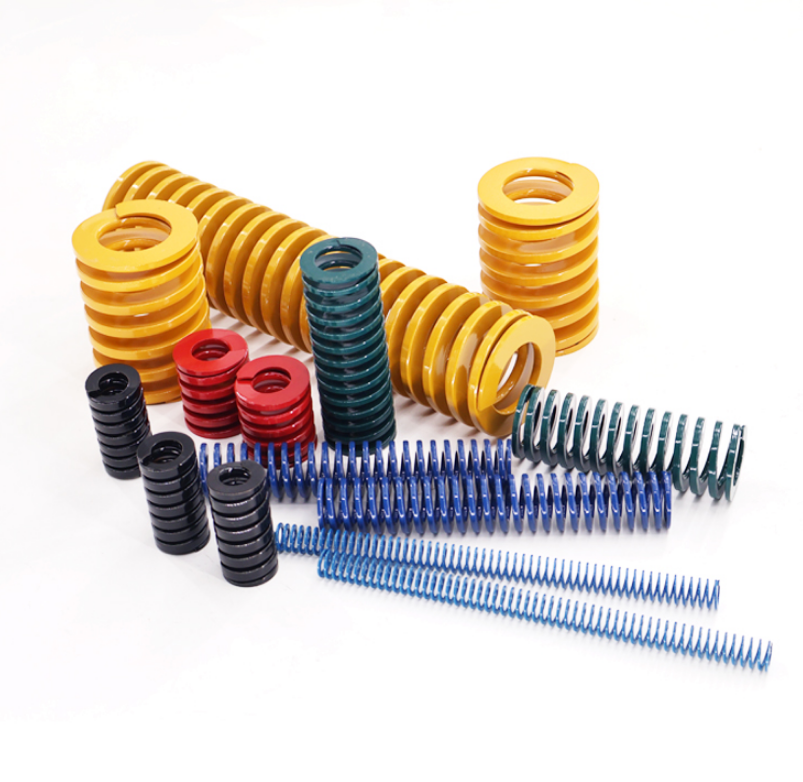
The performance of a compression spring depends heavily on the material used in its construction. Material selection determines elasticity, fatigue resistance, corrosion behavior, and temperature tolerance.
High-carbon steel is one of the most common materials due to its excellent strength and cost efficiency. It provides good fatigue resistance under normal operating conditions and is widely used in automotive and industrial applications.
Stainless steel is selected when corrosion resistance is required. In humid or chemical environments, stainless steel maintains performance where standard steel would degrade. It also performs well under moderate temperature variations.
For high-load or high-temperature applications, alloy steels and specialized heat-treated materials are used. These materials maintain structural integrity even under extreme mechanical stress or elevated temperatures.
A compression spring works by storing energy through torsional stress in the wire as it is compressed. This means the material must be capable of repeated elastic deformation without permanent distortion.
Fatigue life is another important consideration. Springs often operate in cyclic loading environments, where repeated compression and release occur thousands or even millions of times. Improper material selection can lead to early failure due to micro-cracks or plastic deformation.
Surface treatments such as shot peening can also improve fatigue resistance by introducing compressive residual stress on the surface layer of the wire.
In summary, selecting the correct material for a compression spring is a critical engineering decision that directly impacts durability, performance, and safety.

 Arabic
 French
 Spanish
 Portuguese
 Deutsch
 Turkish
 Dutch
Dutch
 Italiano
 Russian
 Romaian
 Portuguese (Brazil)
 Greek
Greek