
AR SDK Software Market Forecast to 2034: Market Size, Drivers, and Competitive Landscape
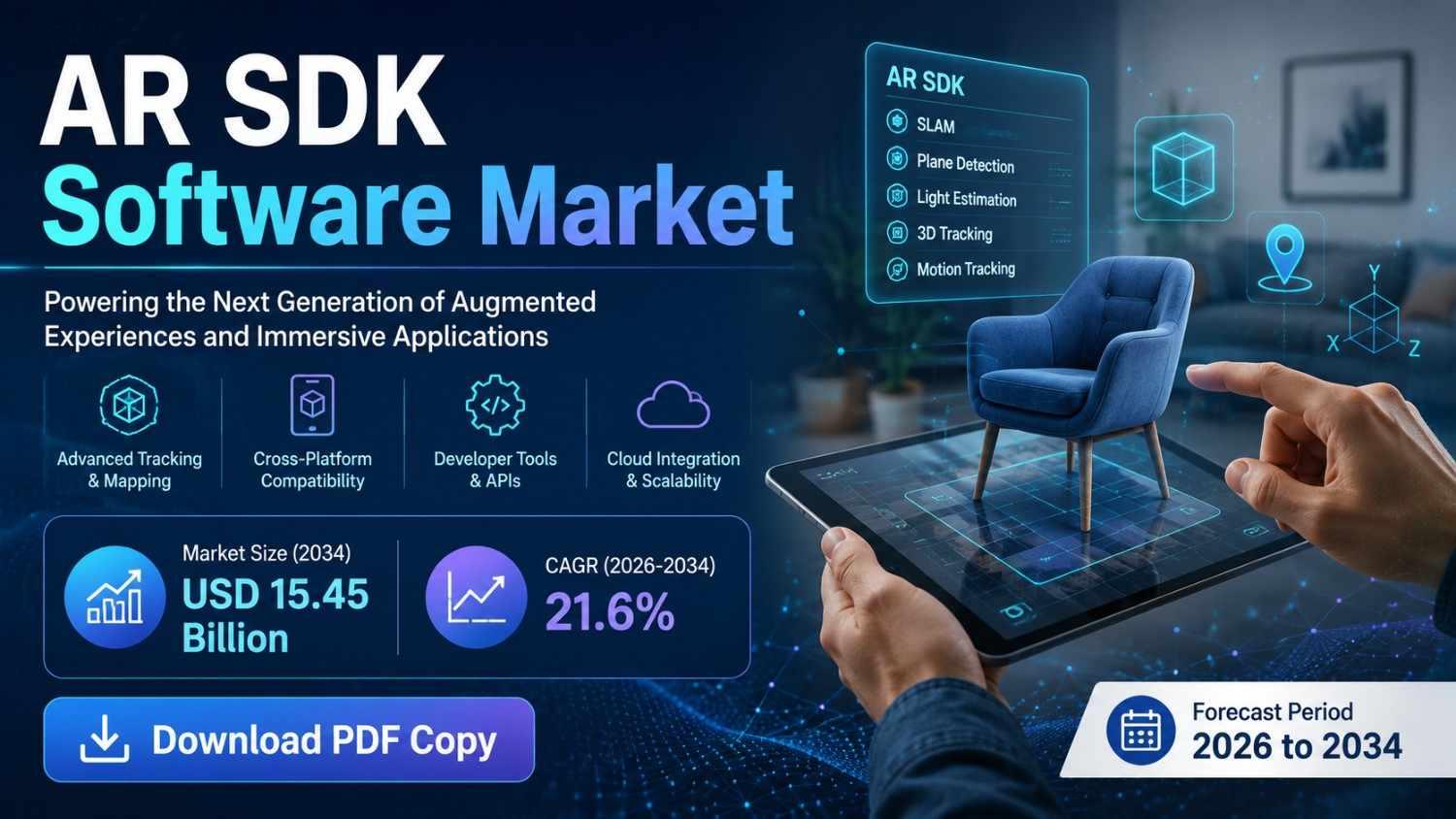
The global Augmented Reality (AR) Software Development Kit (SDK) market is experiencing transformative expansion as immersive digital experiences transition from consumer novelties into essential business tools. AR SDKs serve as the underlying software frameworks that enable developers to build, render, track, and deploy interactive 3D content across smartphones, tablets, smart glasses, and enterprise hardware.
The global AR SDK Software Market size is projected to reach US$ 8.88 billion by 2034 from US$ 4.02 billion in 2025. The market is anticipated to register a CAGR of 10.40% during the forecast period 2026-2034.
Key Drivers
- Widespread Enterprise Adoption for Workflow Optimization: Enterprises across manufacturing, logistics, automotive, and healthcare are deploying AR applications to enhance operational productivity. Field technicians and assembly line workers utilize AR overlays for step-by-step guidance, reducing operational errors and significantly shortening workforce training cycles.
- Expansion of 5G Networks and Edge Computing: The rollout of ultra-low latency 5G infrastructure and edge processing allows complex spatial rendering to occur instantly at network endpoints. This infrastructure eliminates noticeable lag and bandwidth bottlenecks, making real-time collaborative AR possible across distant geographical locations.
- Surging Integration in E-Commerce and Retail: Retailers leverage AR SDKs to offer "try-before-you-buy" visualizers for furniture, fashion, and cosmetics. Interactive 3D visualization improves customer engagement, boosts online conversion rates, and reduces product return rates.
- Growth in Gaming, Social Media, and Wearable Hardware: The popularity of location-based AR gaming, interactive camera filters, and next-generation smart glasses continues to expand the end-user base, encouraging developers to build robust AR SDK integrations.
Market Opportunities
- AI-Driven Augmented Reality Software: Combining generative artificial intelligence with AR SDKs allows software tools to recognize objects faster, predict user intent, and dynamically generate context-aware 3D assets in real time.
- Industrial WebAR and Cross-Platform Integration: Lightweight, browser-based WebAR SDKs eliminate the friction of native app downloads. This creates immense opportunities for marketing, interactive learning, and instant field support across diverse operating systems.
- Healthcare and Remote Medical Navigation: Advanced spatial mapping capabilities enable high-fidelity anatomical simulations and surgical guidance, unlocking high-value avenues in medical education and remote diagnostic care.
Market Segmentation
The global AR SDK software market is segmented based on component, platform, deployment mode, and end-use vertical:
- By Component / Technology Type:
- Marker-Based AR SDKs
- Markerless AR SDKs (SLAM - Simultaneous Localization and Mapping)
- Location-Based AR SDKs
- WebAR SDKs
- By Platform / Operating System:
- iOS (Apple ARKit)
- Android (Google ARCore)
- Cross-Platform / Wearable OS
- By Deployment Mode:
- Cloud-Based
- On-Premise
- By End-Use Vertical:
- Retail and E-Commerce
- Healthcare and Lifesciences
- Manufacturing and Automotive
- Gaming and Media
- IT, Telecom, and Aerospace
Market News and Recent Developments
- Cross-Platform Spatial Computing SDK Upgrades: Leading platform vendors have updated SDK frameworks to support real-time occlusion, dynamic lighting, and persistent spatial anchors across both mobile devices and wearable spatial head-mounted displays.
- Generative AI Integration: Vendors are integrating AI vision models directly into SDK development pipelines, enabling automatic 3D mesh reconstruction from 2D camera feeds and smarter environment mapping.
- Strategic Partnerships in Telecom: Major AR SDK developers are partnering with global 5G operators to construct low-latency edge computing corridors tailored for remote industrial assistance and multi-user spatial collaboration.
Market Analysis and Competitive Landscape
The competitive landscape of the AR SDK software market features a strategic mix of operating system owners and specialized augmented reality developers. Ecosystem owners control a sizable share of mobile deployments due to deep hardware and OS-level integration. However, third-party and specialized SDK providers remain essential for cross-platform support, industrial hardware integration, and enterprise CAD visualization. Market players compete on features such as tracking precision, cross-platform compatibility, developer documentation, and cloud spatial mapping scalability.
Top Key Players
- Apple Inc. (ARKit)
- Google LLC (ARCore)
- PTC Inc. (Vuforia Engine)
- Unity Technologies
- Niantic, Inc. (Lightship ARDK)
- Qualcomm Technologies, Inc. (Snapdragon Spaces / Wikitude)
- Maxst Co., Ltd.
- Ultraleap Ltd.
- Epic Games / Unreal Engine
- ZapWorks / Zappar Ltd.
Future Outlook
Looking toward 2034, the AR SDK software market will evolve into the backbone of spatial computing. As wearable AR smart glasses gain mainstream traction alongside smartphones, AR SDKs will increasingly leverage persistent cloud anchors, artificial intelligence, and edge networks to deliver seamless, real-time spatial intelligence across enterprise and consumer environments.
Frequently Asked Questions (FAQs)
Q1: What is an AR SDK software and why is it important?
An Augmented Reality Software Development Kit (AR SDK) is a set of software tools, libraries, and APIs that enables developers to build digital 3D overlays on real-world camera feeds. It handles complex underlying tasks like motion tracking, surface detection, and light estimation so developers do not have to program spatial algorithms from scratch.
Q2: Which industries are driving the growth of the AR SDK market through 2034?
Manufacturing, healthcare, retail, e-commerce, automotive, and gaming are the primary drivers. Enterprise verticals use AR SDKs for workforce training and remote maintenance, while retail and gaming leverage them for interactive shopping and consumer entertainment.
Q3: What is the difference between marker-based and markerless AR SDKs?
Marker-based AR SDKs rely on specific visual cues or physical target images (such as QR codes or printed logos) to anchor virtual content. Markerless AR SDKs use Simultaneous Localization and Mapping (SLAM) technology to recognize physical environments (floors, walls, tables) without requiring predetermined target markers.
The Insight Partners provides comprehensive syndicated and tailored market research services in the healthcare, technology, and industrial domains. Renowned for delivering strategic intelligence and practical insights, the firm empowers businesses to remain competitive in ever-evolving global markets.
• Email: sales@theinsightpartners.com
• Website: theinsightpartners.com
• Phone: +1-646-491-9876
Also Available in: Korean|German|Japanese|French|Chinese|Italian|Spanish
 Dutch
 English
 Arabic
 French
 Spanish
 Portuguese
 Deutsch
 Turkish
 Italiano
 Russian
 Romaian
 Portuguese (Brazil)
 Greek