
Google Business Profile Audit Checklist for SEO Agencies and Consultants
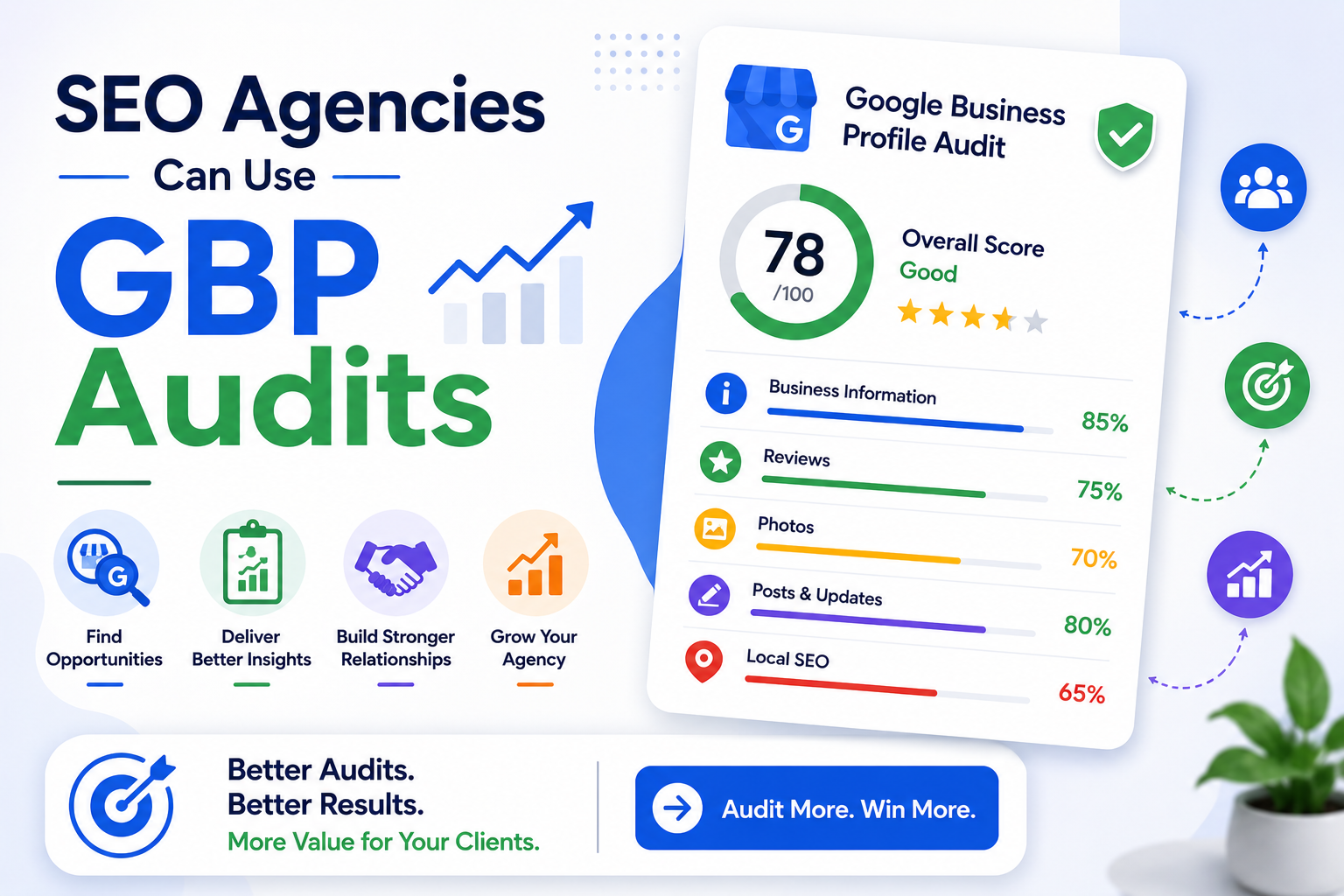
Managing Local SEO for clients requires more than checking whether their Google Business Profile is verified. A profile may appear complete while still containing outdated information, category issues, missing services, weak reviews, or other gaps that deserve attention.
For SEO agencies and consultants, a structured Google Business Profile audit checklist creates consistency. It helps teams review each client using the same process, identify genuine Local SEO opportunities, and turn findings into prioritized recommendations.
The purpose of an audit is not to make unnecessary changes. It is to understand how accurately the profile represents the business, how it compares with local competitors, and where improvements may support better customer discovery and engagement.
1. Verify the Core Business Information
Every GBP audit should begin with accuracy.
Check the business name, address, phone number, website, opening hours, and service area where applicable. Do not simply assume these details are correct because the profile has been active for years.
Businesses relocate, change phone numbers, launch new websites, and adjust operating hours. These changes can easily create outdated profile information.
Agencies should also test important customer touchpoints. Call the phone number, open the website, and verify the map location. If potential customers cannot contact or find the business correctly, other optimization work becomes less valuable.
2. Review the Primary Business Category
The next checkpoint is category selection.
The primary category should accurately describe the client's main business activity. Additional categories should represent genuine secondary activities.
SEO consultants should avoid treating categories as keywords. Adding numerous loosely related categories does not automatically create better optimization.
Competitor research can provide context. Review categories used by businesses consistently appearing for important local searches and determine whether any relevant category has been overlooked.
However, only recommend a change when the category genuinely applies to the client's business.
3. Audit Products and Services
Next, compare the profile with the client's current offerings.
Are important services missing? Are discontinued services still displayed? Have new services been introduced but never added to GBP?
This part of the audit can also reveal broader content opportunities. If an important service has limited information on both GBP and the client's website, the agency may need to improve more than the business profile.
Service information should remain clear, specific, and useful to customers. Avoid repetitive keyword-heavy descriptions written purely for search engines.
Make Your Initial GBP Check Faster
When auditing multiple client profiles, a structured tool can help identify areas requiring deeper investigation.
Run a Google Business Profile Audit:
https://www.fly-social.com/tools/gmb-audit
Use automated findings as a starting point, then manually verify important issues. A third-party audit score should not be presented as an official Google ranking score or treated as a guarantee of search performance.
4. Analyse Customer Reviews
Reviews deserve their own section in every agency audit.
Start with the overall rating and total review count, but do not stop there. Examine how frequently the business receives new reviews, whether customers receive responses, and what recurring themes appear in the feedback.
Then add competitive context.
A client may have 100 reviews, which sounds strong until you discover that its major competitors have 500 or more and continue receiving new feedback regularly.
That does not prove reviews alone explain the ranking difference. It does, however, identify a potential reputation gap.
Agencies can then recommend an ethical process for consistently requesting genuine customer feedback and responding professionally.
5. Examine Photos and Visual Quality
Photos help customers understand what they can expect from a business.
Review whether the profile contains current, authentic images. Depending on the industry, these could include the storefront, interior, team, facilities, products, services, or completed work.
An agency may discover that a client's most recent useful photos are several years old even though the location has been renovated.
The recommendation should not simply be "upload more photos." Explain which types of images would genuinely improve the profile experience.
Quality, accuracy, and relevance matter more than uploading images simply to increase activity.
6. Check for Duplicate and Outdated Listings
Search Google Maps using different combinations of the client's business name, address, and phone number.
Look for profiles associated with previous locations, old names, outdated contact information, or possible duplicates.
Duplicate analysis requires care. Individual practitioners, departments, and separate eligible locations may sometimes legitimately have their own profiles.
SEO agencies should therefore verify the situation before recommending removal, merging, or other action.
This is particularly important for multi-location businesses, healthcare organizations, professional services, and companies that have recently relocated.
7. Compare GBP Information With the Website
A business profile audit should not exist separately from website analysis.
Compare the client's GBP information with the official website. Check whether the name, phone number, address, opening hours, services, and other important information are accurate.
Then review what happens after someone clicks from GBP to the website.
Does the page clearly explain the business? Can mobile users navigate it easily? Are the most important services visible? Is there an obvious way to call, book, request a quote, or make an enquiry?
Sometimes GBP successfully generates interest while the website creates the conversion problem.
8. Perform a Competitor Gap Analysis
For agencies and consultants, competitor analysis is one of the most valuable parts of the audit.
Select three to five genuine competitors that repeatedly appear for relevant local searches.
Compare categories, services, reviews, photos, websites, and overall online presence.
Do not copy whatever the highest-ranking competitor is doing. Instead, search for patterns.
Perhaps several successful competitors have significantly more recent reviews. Maybe they have stronger websites or clearer service information.
These patterns help agencies identify areas deserving further investigation rather than making assumptions based on one competitor.
9. Evaluate Geographic Visibility
Google Maps visibility can vary significantly depending on the searcher's location.
A client might perform strongly near its physical location but appear much lower several kilometers away. This does not automatically indicate poor optimization.
Agencies should consider geography when evaluating ranking reports.
Instead of telling a client, "You rank number eight," provide context about where that ranking was measured.
Geographic analysis can reveal strong and weak visibility areas while preventing unrealistic expectations about ranking in the top positions across an entire city.
10. Review Website and Local SEO Strength
If the business profile looks strong but competitors continue to outperform the client, investigate broader local SEO factors.
Review the client's service pages, location information, organic search visibility, content quality, internal linking, and relevant backlinks.
A competitor may have a similar GBP but a significantly stronger overall web presence.
This is an important opportunity for SEO consultants because the solution may require website improvements rather than additional profile edits.
A good GBP audit should therefore help determine when the problem is outside GBP.
11. Analyse Customer Actions
Visibility alone should not define success.
Agencies should review whether customers are taking meaningful actions after discovering the profile.
Depending on the business and available performance data, examine website clicks, calls, direction requests, bookings, and other relevant interactions.
Suppose visibility is growing while customer actions remain flat. That may suggest the problem exists further down the customer journey.
Reviews may not create enough confidence, services may be unclear, or the website may be difficult to use.
Connecting GBP visibility with customer behavior makes agency reporting much more meaningful.
12. Check Profile Management and Policies
Agencies should also review who has access to the Business Profile.
Remove former employees or agencies that no longer require access and ensure appropriate client stakeholders retain ownership or management permissions.
At the same time, check whether profile information follows Google's Business Profile guidelines.
Avoid recommendations that attempt to manipulate rankings through inaccurate business names, irrelevant categories, fake locations, or other misleading information.
Short-term tactics that violate platform policies can create much larger problems for clients later.
Turn Audit Findings Into an Action Plan
A professional GBP audit should not end with a long list of problems.
Prioritize recommendations.
Correct inaccurate information and serious profile issues first. Next, address relevance through categories and services. Then work on reviews, photos, and customer experience.
Longer-term recommendations can include website SEO, reputation development, competitor gaps, and broader online visibility.
This makes the report easier for clients to understand and gives the agency a clear implementation roadmap.
Expand the Audit Beyond GBP
Sometimes the checklist reveals that the client's profile is already in good condition.
That is useful information because it prevents unnecessary optimization.
The agency can then investigate website SEO and other digital visibility opportunities.
Explore more SEO and digital marketing tools:
https://www.fly-social.com/tools
The objective should always be identifying the real constraint rather than finding something to change simply because an audit was performed.
Conclusion
A Google Business Profile audit checklist for SEO agencies and consultants should cover much more than profile completeness.
A thorough review examines business information, categories, services, reviews, photos, duplicate profiles, website consistency, competitors, geographic visibility, customer actions, and broader Local SEO strength.
Most importantly, agencies should convert audit findings into priorities.
Fix genuine inaccuracies first, strengthen relevance and customer experience next, and investigate website or broader SEO opportunities when the profile itself is already strong.
This approach turns a GBP audit from a simple checklist into a useful Local SEO strategy—one that helps agencies show clients what needs attention, why it matters, and what should be improved next.
 Spanish
 English
 Arabic
 French
 Portuguese
 Deutsch
 Turkish
 Dutch
Dutch
 Italiano
 Russian
 Romaian
 Portuguese (Brazil)
 Greek
Greek