
How a GBP Audit Helps Agencies Build Better Local SEO Strategies
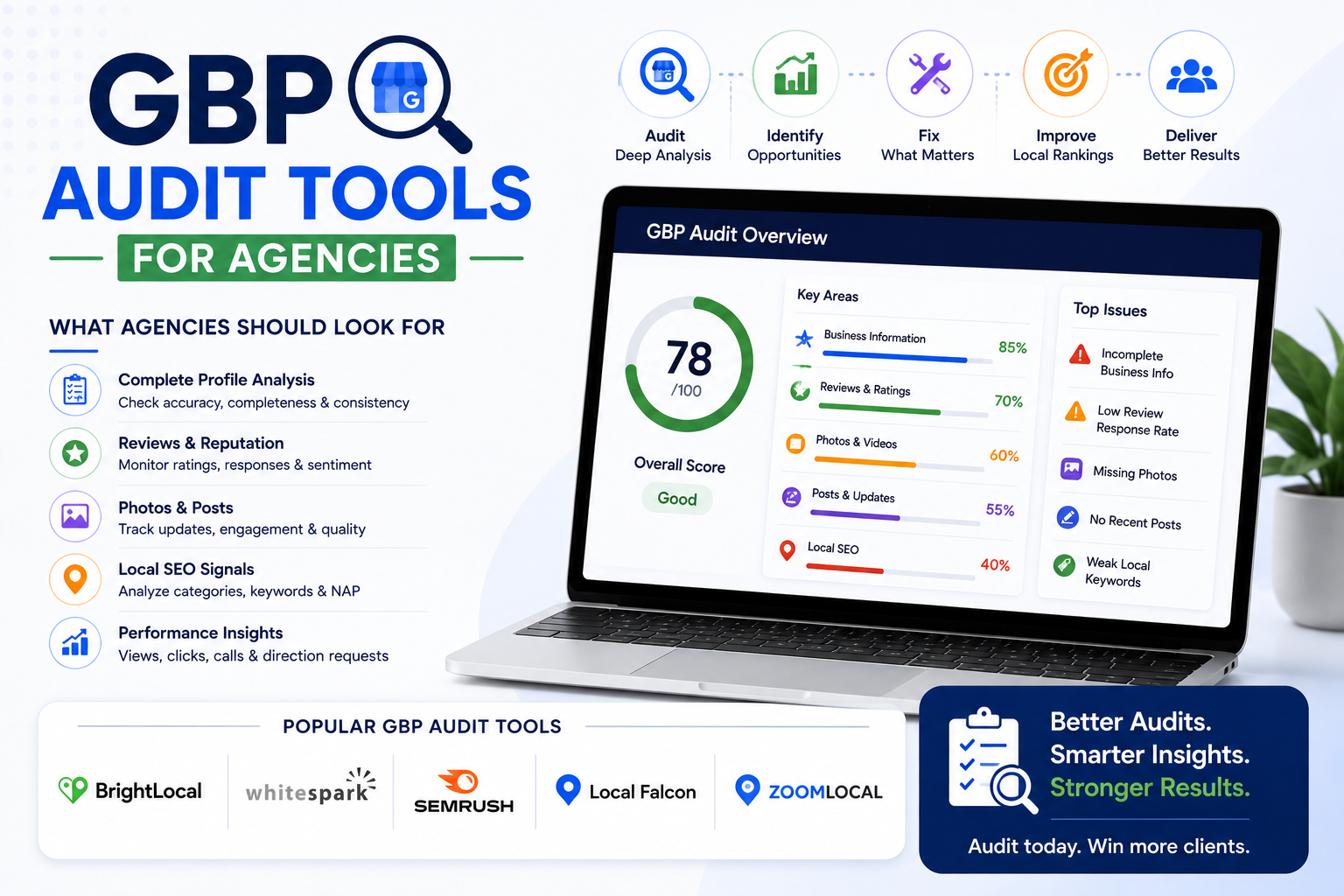
Local SEO strategies are more effective when they begin with evidence rather than assumptions. For agencies, one of the best places to start is a Google Business Profile (GBP) audit.
A GBP audit gives an agency a clearer picture of how a client's business is represented on Google Search and Maps. It can uncover inaccurate information, category gaps, missing services, review weaknesses, competitor differences, and customer-experience issues.
More importantly, an audit can show whether the problem actually exists inside Google Business Profile or whether the agency needs to investigate the website, reputation, competition, or wider local search presence.
Instead of immediately making profile changes, agencies can use audit findings to build a Local SEO strategy around the areas that genuinely need attention.
A GBP Audit Creates a Clear Starting Point
Every Local SEO campaign needs a baseline.
Without one, agencies may spend time optimizing areas that are already working while overlooking more important problems.
Imagine a client says, "We're not ranking well on Google Maps."
There could be many reasons. The profile may contain inaccurate information. The primary category may not accurately represent the business. Important services could be missing. Competitors may have stronger reviews or websites. Geographic distance could also affect visibility.
A GBP audit helps organize these possibilities.
Once agencies understand the current profile condition, they can decide which areas deserve deeper investigation.
It Identifies Basic Profile Problems First
Before developing an advanced Local SEO strategy, agencies should make sure the fundamentals are correct.
Review the client's business name, address or service area, phone number, website, opening hours, categories, and services.
Test important information rather than simply reading it.
Does the phone number connect correctly? Does the website URL work? Is the map location accurate? Are the opening hours current?
These checks may seem simple, but they directly affect customers.
There is little value in increasing visibility if customers find an outdated phone number or arrive when the business is closed.
Fixing accuracy problems creates a stronger foundation for everything that follows.
It Helps Agencies Understand Relevance
One important area revealed by a GBP audit is how clearly the profile represents the business.
Start with the primary category.
Does it accurately describe the client's main business activity?
Then examine additional categories and services.
The objective is not to add as many categories or keywords as possible. It is to make the profile accurately reflect what the business offers.
For agencies, this creates a relevance strategy.
If an important service is missing from the profile, add it when appropriate. If a category does not accurately represent the business, review whether a better option exists.
Every recommendation should be based on the real business rather than an attempt to manipulate rankings.
Start With a Structured GBP Audit
For agencies handling several clients, having a repeatable audit process saves time and makes analysis more consistent.
A structured audit can help identify potential areas requiring attention before deeper manual research begins.
Run a Google Business Profile Audit:
https://www.fly-social.com/tools/gmb-audit
Use the audit findings as a starting point rather than the complete Local SEO strategy.
Automated checks can identify possible gaps, but agencies still need to verify the findings, understand the client's business, analyze competitors, and determine which improvements should be prioritized.
It Turns Missing Services Into Content Opportunities
A service gap in GBP can reveal a much larger SEO opportunity.
Suppose an agency discovers that a client provides an important service that is missing from their Business Profile.
The first action might be updating the service information.
But the analysis should continue.
Does the client's website have useful information about that service?
If not, the audit has uncovered a potential website content opportunity as well.
The agency may recommend strengthening service pages, improving internal links, expanding useful information, or reviewing how the service is represented throughout the website.
This is where GBP auditing becomes part of a broader local SEO strategy instead of a standalone profile exercise.
It Reveals Reputation Gaps
Customer reviews are another valuable part of the audit.
Do not evaluate only the client's average rating.
Look at total reviews, recent review activity, owner responses, recurring customer feedback, and competitor differences.
For example, a client may have a 4.8-star rating with 60 reviews. That looks positive.
However, three major competitors may have 300, 400, and 550 reviews while continuing to receive new customer feedback.
This does not prove that review volume alone explains their visibility.
It does reveal a reputation difference worth investigating.
The agency can then build review generation and response management into the Local SEO strategy instead of treating reviews as an occasional task.
It Makes Competitor Analysis More Useful
Local SEO does not happen in isolation.
A client's profile needs to be evaluated within its competitive environment.
Select three to five genuine businesses that regularly appear for searches related to the client's services.
Compare their categories, services, reviews, photos, websites, and overall online presence.
Look for patterns rather than copying individual tactics.
If several strong competitors have significantly more recent reviews, reputation may be an opportunity.
If competitors have stronger service pages and organic visibility, website SEO may deserve greater attention.
If competitors are physically closer to the search location, geography may explain part of the ranking difference.
This context makes agency recommendations more realistic.
It Helps Separate SEO Problems From Distance
Google Maps visibility can change depending on the searcher's location.
This is particularly important when clients expect to rank in the top positions across an entire city.
A business may perform strongly close to its location but appear much lower when the same search is conducted several kilometers away.
That does not automatically mean the GBP needs more optimization.
Agencies should consider geographic visibility when interpreting ranking results.
Understanding where the client performs well, where visibility declines, and which businesses dominate different areas can produce a much better strategy than repeatedly changing profile information.
It Shows When the Website Is the Bigger Opportunity
One of the most valuable GBP audit outcomes is discovering that the profile is already in good condition.
The business information may be accurate. Categories may be appropriate. Services may be current. Reviews may be healthy.
Yet competitors still perform better.
This is when agencies should look beyond GBP.
Compare the client's website with competing sites.
Review service content, location information, organic visibility, internal linking, technical performance, and relevant backlinks.
If competitors have much stronger websites and broader online authority, making minor GBP edits may not solve the real problem.
The Local SEO strategy should shift toward the area with greater opportunity.
It connects rankings with customer behavior.
Ranking reports tell agencies where a business appears.
They do not always explain what happens after someone finds it.
A good Local SEO strategy should therefore connect visibility with customer actions.
Depending on the business and available performance information, agencies can review website clicks, calls, direction requests, bookings, and other interactions.
Suppose a client receives high GBP visibility but relatively few enquiries.
The issue may be conversion rather than ranking.
Review services, reviews, photos, contact options, and the website experience.
The full journey matters:
Search → GBP → Interaction → Website or Call → Enquiry → Customer
This helps agencies focus on business outcomes rather than rankings alone.
It Helps Agencies Prioritize Local SEO Work
Clients rarely benefit from receiving a report containing dozens of recommendations with no priority.
A GBP audit helps agencies organize work logically.
Start with factual problems that can affect customers, such as incorrect contact information, websites, addresses, or hours.
Next, address relevance through categories and services.
Then focus on reviews, photos, reputation, and customer experience.
Finally, investigate website SEO, competitors, geographic visibility, backlinks, and broader online presence.
This transforms audit findings into a practical Local SEO roadmap.
It Creates Better Client Reporting
Audits can also improve communication.
Instead of telling a client, "We need to optimize your GBP," agencies can explain exactly what was discovered.
For example:
The profile information is accurate, but review activity is significantly weaker than major competitors.
Or:
The GBP is healthy, but several important services have limited website support.
Specific findings make recommendations easier for clients to understand.
They also create a useful baseline for future reporting because agencies can compare improvements against the condition of the profile at the beginning of the campaign.
It Prevents Unnecessary GBP Changes
Not every ranking fluctuation requires a profile edit.
Changing categories, services, website URLs, and other profile elements repeatedly can make Local SEO management unnecessarily reactive.
An audit encourages agencies to investigate before changing anything.
Fix clear inaccuracies immediately. For other optimization opportunities, understand the problem, make justified improvements, and monitor the results.
A strategy based on evidence is more sustainable than responding to every ranking movement.
Expand the Strategy Beyond Google Business Profile
Once GBP-level opportunities have been investigated, agencies should evaluate the client's wider digital presence.
Explore additional SEO and digital marketing tools:
https://www.fly-social.com/tools
Website SEO, search visibility, competitor analysis, reputation, and other areas can reveal opportunities that a Business Profile audit alone cannot identify.
A strong agency strategy should understand how these different elements work together.
Conclusion
A GBP audit helps agencies build better Local SEO strategies because it replaces assumptions with structured analysis.
It can reveal inaccurate information, relevance gaps, missing services, weak review activity, competitor advantages, geographic limitations, website problems, and customer-conversion opportunities.
But the audit itself is only the beginning.
The real value comes from interpreting those findings, comparing them with competitors, connecting them with customer behaviour, and deciding what deserves attention first.
Sometimes the answer will be better GBP optimization. Other times it will be reputation management, website SEO, content improvement, or broader local visibility work.
That is what makes a Google Business Profile audit valuable for agencies: it helps them stop asking "What can we change?" and start asking "What should we improve to build a stronger Local SEO strategy?"
FAQs
How does a GBP audit help with Local SEO strategy?
It identifies profile gaps, review weaknesses, service opportunities, competitor differences, and other areas that may require improvement.
Should agencies audit GBP before starting Local SEO?
Yes. Establishing a baseline helps agencies understand existing problems before deciding where to invest time and resources.
Can a GBP audit identify website opportunities?
Yes. Missing services, competitor differences, and visibility issues can reveal content and broader website SEO opportunities.
Does every GBP audit require profile optimization?
No. Sometimes GBP is already strong, and the larger opportunities exist in reviews, website SEO, reputation, or broader Local SEO.
 Portuguese
 English
 Arabic
 French
 Spanish
 Deutsch
 Turkish
 Dutch
Dutch
 Italiano
 Russian
 Romaian
 Portuguese (Brazil)
 Greek
Greek