
Sudoku: A Simple Puzzle That Builds Powerful Thinking Skills
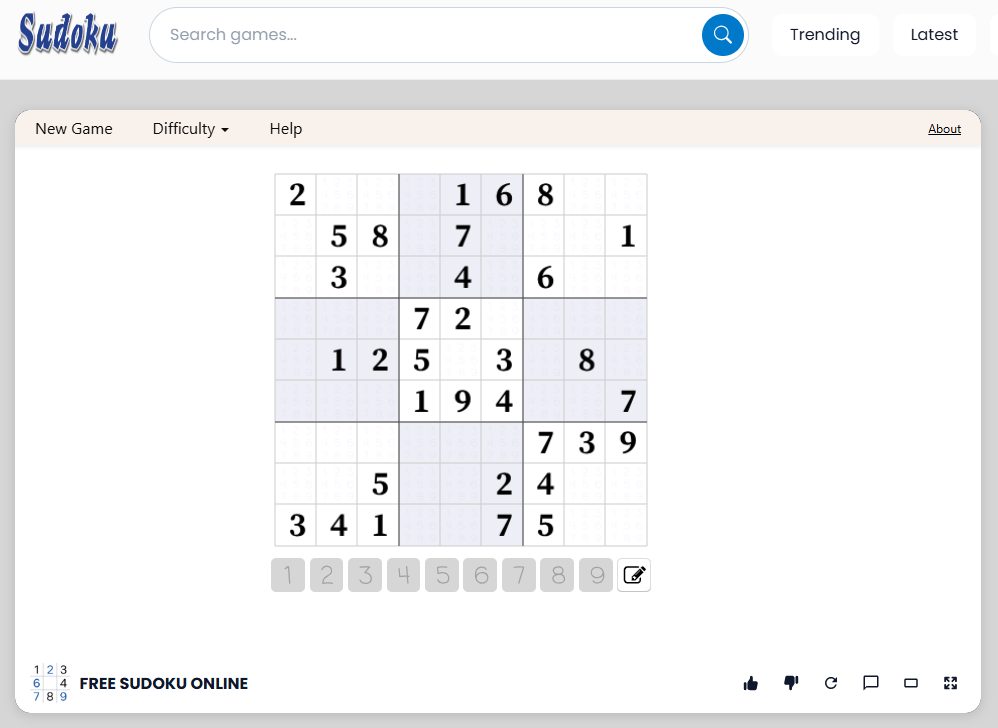
Sudoku is one of the most popular logic puzzles in the world. The game looks simple because it uses only numbers, yet solving a challenging Sudoku puzzle can require concentration, logical thinking, memory, and careful planning. Players do not need advanced mathematics to enjoy Sudoku. Instead, the main goal is to place numbers in the correct positions while following a clear set of rules.
Sudoku works well for people of many ages and skill levels. A beginner can start with an easy puzzle, while an experienced player can spend a long time solving an advanced grid. With regular practice, players can learn useful solving techniques and develop a more organized approach to difficult problems.
What Is Sudoku?
Sudoku is a logic-based number puzzle played on a grid containing 81 cells. The standard format has nine rows, nine columns, and nine smaller 3×3 boxes. Some numbers are already placed in the grid, while the remaining cells must be completed by the player.
The classic Sudoku format uses numbers from 1 to 9. Each number must appear exactly once in every row, every column, and every 3×3 box. These simple rules create a surprisingly complex puzzle.
Basic Sudoku Rules
The main rule is easy to understand. Every row must contain the numbers 1 through 9 without repetition. Every column must also contain the numbers 1 through 9 without repetition. The same requirement applies to each 3×3 box.
A number can only be placed in a cell when that placement does not create a duplicate in the same row, column, or box. Players gradually use the existing numbers to eliminate impossible choices until the correct solution becomes clear.
Why Sudoku Is Not a Mathematics Game
Although Sudoku uses numbers, mathematical calculations are not required. Players do not need to add, subtract, multiply, or divide numbers to complete a puzzle.
Sudoku is mainly a game of logic and deduction. Each number represents a symbol that helps identify possible and impossible positions. This makes Sudoku accessible to people who may not enjoy traditional mathematical puzzles.
How to Solve Sudoku More Effectively
A good Sudoku strategy begins with simple observations. Instead of randomly placing numbers, players should examine the grid and search for cells with limited possibilities.
Start With Easy Numbers
The best starting point is usually a row, column, or box that already contains many numbers. When only one or two numbers are missing, it becomes easier to determine what belongs in the empty cells.
For example, if a row contains every number except 4, the empty cell must contain 4. This basic technique is called a single and is one of the most useful methods for beginners.
Use Candidate Numbers
When a cell cannot be solved immediately, players can identify possible numbers for that position. These possibilities are called candidates.
A candidate must satisfy all three Sudoku conditions. It cannot already appear in the same row, column, or 3×3 box. Writing small candidate numbers can make difficult puzzles easier to understand and reduce unnecessary guessing.
Look for Hidden Singles
Sometimes a number can fit into several empty cells at first glance, but only one position within a row, column, or box can actually contain that number.
This situation is known as a hidden single. Finding hidden singles is an important step toward solving medium and difficult Sudoku puzzles because the correct position may not be obvious from the number of empty cells alone.
Advanced Sudoku Techniques
As puzzle difficulty increases, basic strategies may no longer be enough. Advanced techniques help players discover relationships between candidates and eliminate incorrect possibilities.
Naked Pairs
A naked pair occurs when two cells in the same row, column, or box contain exactly the same two candidates. Because those two numbers must occupy those two cells, the same candidates can be removed from other cells in that group.
This technique can reveal new singles and create additional opportunities for deduction.
Pointing Pairs
A pointing pair occurs when a particular number can only appear in two cells within a 3×3 box, and both cells are located in the same row or column. That means the number cannot appear elsewhere in that row or column outside the box.
This method connects the smaller boxes with the larger rows and columns, making it easier to eliminate candidates.
X-Wing Strategy
X-Wing is a more advanced Sudoku technique. It involves finding a number that appears as a candidate in exactly two positions across two different rows, with those positions aligned in the same columns.
When the pattern is correct, the number can be eliminated from other candidate positions in those columns. X-Wing may seem difficult at first, but it becomes easier with repeated practice.
Benefits of Playing Sudoku
Sudoku provides entertainment, but regular puzzle solving may also support several useful mental skills. The game encourages players to concentrate on details while maintaining an understanding of the entire grid.
Better Concentration
Sudoku requires continuous attention. A small mistake can affect several later decisions, so players need to remain focused while checking rows, columns, and boxes.
This type of focused activity can make Sudoku an enjoyable way to spend quiet time without relying on fast reactions or physical movement.
Stronger Logical Thinking
Every correct Sudoku placement should have a reason behind it. Players learn to compare possibilities, eliminate incorrect options, and make decisions based on available evidence.
This logical process is one of the main reasons Sudoku remains popular among people who enjoy challenging brain games.
Improved Problem Solving
A difficult Sudoku puzzle can contain several stages. One correct number may create another opportunity, which can then lead to another discovery. Players gradually learn how individual decisions influence the wider puzzle.
This process encourages patience and structured problem solving rather than random guessing.
Choosing the Right Sudoku Difficulty
Sudoku puzzles are commonly available in several difficulty levels. Beginners should start with easy grids that contain many useful clues. These puzzles provide an opportunity to learn basic rules without becoming overwhelming.
Easy Sudoku for Beginners
Easy Sudoku is ideal for learning singles, candidate elimination, and basic scanning techniques. New players can focus on understanding the structure of the grid and developing a consistent solving routine.
Medium and Hard Sudoku
Medium Sudoku requires more candidate analysis and often introduces techniques such as hidden singles, pairs, and box-line interactions. Hard Sudoku can require several advanced strategies and much greater concentration.
The most important factor is not speed. Accuracy and logical reasoning matter more than completing a puzzle quickly.
How to Improve Sudoku Skills
Improvement comes from regular practice and careful analysis. Players should avoid guessing whenever possible because logical deduction provides a more reliable path to the solution.
After making an incorrect move, it can be helpful to return to the last point where the logic was certain. Reviewing the puzzle can reveal where an assumption became incorrect. Over time, this process helps players recognize patterns more quickly.
Playing different puzzle difficulties can also build confidence. Starting with simple grids and gradually moving toward advanced challenges allows players to develop techniques naturally.
Why Sudoku Remains Popular
Sudoku continues to attract players because the basic concept is easy to learn while the potential challenge is almost unlimited. A puzzle can be completed in a few minutes or require extended concentration depending on difficulty.
The game also works well in many formats. People can solve Sudoku in newspapers, puzzle books, websites, and mobile applications. No special equipment is required beyond a grid and a way to enter numbers.
Conclusion
Sudoku is much more than a simple number puzzle. It combines clear rules with deep logical challenges, making it suitable for beginners and experienced players alike. Basic methods such as singles and candidate elimination provide an easy starting point, while techniques such as naked pairs and X-Wing offer greater challenges for advanced players.
With regular practice, Sudoku can become an engaging daily activity that encourages concentration, logical reasoning, patience, and structured problem solving. Whether played for relaxation or competition, Sudoku offers a rewarding challenge every time a new grid appears.
 Dutch
Dutch
 English
 Arabic
 French
 Spanish
 Portuguese
 Deutsch
 Turkish
 Italiano
 Russian
 Romaian
 Portuguese (Brazil)
 Greek
Greek