
PESO Approval for Explosive Storage Magazine
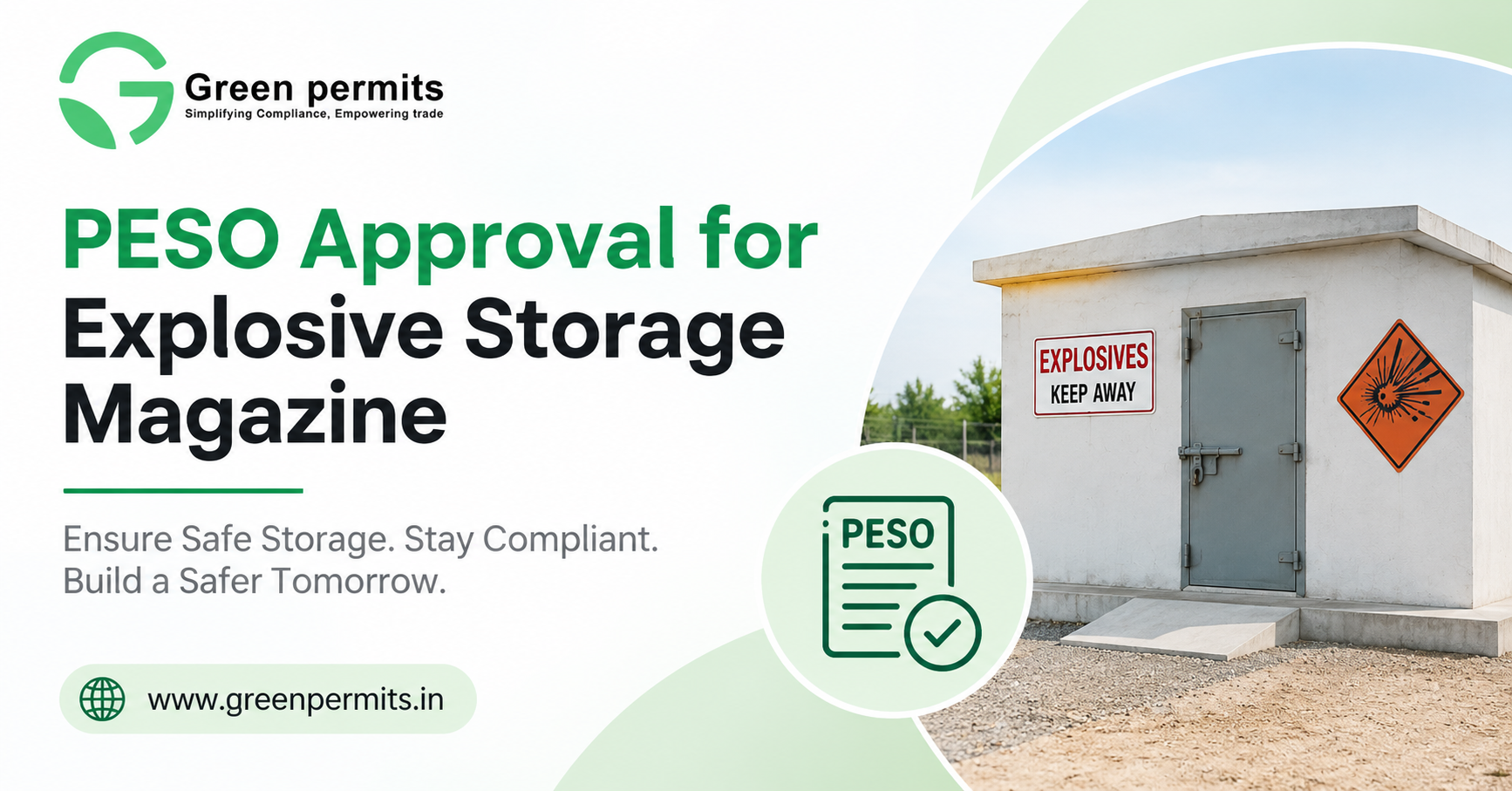
PESO Approval for Explosive Storage Magazine is required for businesses that intend to store specified explosives in an approved magazine for industrial, commercial, mining, infrastructure, construction, quarrying, or other authorised purposes in India.
Explosive storage is regulated primarily under the Explosives Act, 1884 and the Explosives Rules, 2008, as amended from time to time. The Petroleum and Explosives Safety Organisation (PESO), under the Department for Promotion of Industry and Internal Trade, administers the applicable licensing framework. PESO also published further amendments to the Explosives Rules in 2025.
For a typical magazine intended to possess explosives of applicable Classes 1 to 7 for sale or use, Form LE-3 is an important licence form under the Explosives Rules. The application process can involve site and magazine plans, prescribed safety distances, Form DE-1, approval of the proposed premises, District Magistrate NOC where applicable, completion documentation, and final licensing.
A PESO Explosive Magazine Consultant can help businesses assess the correct licence category, review the proposed site, prepare drawings and regulatory documents, coordinate the application process, respond to observations, and support the project from initial planning through final magazine licensing.
What is an Explosive Storage Magazine?
An explosive magazine is a specially approved premises used for lawful storage of explosives within the quantity, category, and conditions permitted under the applicable licence.
It is not simply a conventional warehouse or locked storage room.
The proposed facility must be evaluated with regard to factors such as:
- Type of explosive
- Explosive classification
- Maximum storage quantity
- Purpose of possession
- Site surroundings
- Safety distances
- Magazine layout
- Access
- Security
- Operational controls
The exact requirements depend on the proposed activity and explosives being stored.
What is PESO?
PESO stands for the Petroleum and Explosives Safety Organisation.
It functions under the Department for Promotion of Industry and Internal Trade, Ministry of Commerce and Industry, Government of India.
PESO administers regulatory requirements relating to areas such as:
- Explosives
- Petroleum
- Compressed gases
- Gas cylinders
- Pressure vessels
- Certain hazardous installations
For explosive storage magazines, PESO and the competent licensing authorities under the Explosives Rules play an important role in approval and licensing.
What is an LE-3 Licence?
For typical industrial magazine storage, LE-3 is the licence form used for specified possession of explosives under the Explosives Rules, 2008.
The form covers, among other specified cases:
- Possession for sale of explosives of Classes 1 to 7 in a magazine
- Possession for use of explosives of Classes 1 to 7 in a magazine
The exact licence article depends on the purpose and activity. PESO's official Explosives Rules identify Form LE-3 for these magazine-storage cases.
A business should not select the licence form merely because it wants to "store explosives." The proposed explosive type, quantity, use, and business activity should first be assessed.
Who May Need PESO Approval for an Explosive Magazine?
Explosive magazine approval may be relevant to businesses involved in sectors such as:
- Mining
- Quarrying
- Infrastructure construction
- Road construction
- Tunnelling
- Hydropower projects
- Dam construction
- Cement and limestone operations
- Large civil engineering projects
- Explosive distribution
- Industrial blasting
- Other authorised activities involving explosives
The exact licence depends on what the company intends to possess and why.
Explosive Magazine for Possession and Use
Companies using explosives for permitted industrial operations may require an approved storage magazine before maintaining explosive stock at the project location.
A typical compliance chain can be understood as:
Project Requirement → Explosive Assessment → Site Selection → Magazine Approval → Construction → NOC / Completion Requirements → LE-3 Licence → Authorised Storage
Storage should begin only after the applicable regulatory permissions have been completed.
Explosive Magazine for Possession and Sale
Businesses dealing commercially in explosives may require a licence that specifically permits possession for sale.
This is different from a company storing explosives solely for its own authorised industrial use.
The application should therefore clearly identify whether the intended activity is:
Possession for Use
or
Possession for Sale
Incorrectly describing the commercial activity can lead to an inappropriate licence application.
Why Site Selection is Critical
One of the most important stages of an explosive magazine project is selecting an appropriate site.
The location cannot be finalised only on the basis of land price or proximity to the worksite.
The site assessment needs to consider:
- Available open area
- Surrounding structures
- Roads
- Public buildings
- Property boundaries
- Other installations
- Access
- Required safety distances
- Magazine capacity
The Explosives Rules require prescribed safety distances around licensed magazines, and PESO's licence conditions require these distances to be maintained.
For this reason, site feasibility should be assessed before construction.
Safety Distance for Explosive Magazine
Safety distance is a core regulatory consideration for magazine approval.
PESO requires the proposed layout to identify the distances available around the magazine. The official application documentation includes Form DE-1, described by PESO as the distance form used to show clear distances around a proposed explosive or fireworks magazine or explosives factory.
The applicable distance depends on regulatory factors such as:
- Explosive classification
- Licensed capacity
- Magazine arrangement
- Surrounding structures
- Applicable Schedule III requirements
Businesses should not assume a standard distance for every project.
What is Form DE-1?
Form DE-1 is an important document in the magazine approval process.
It records the clear distances available around the proposed explosive-storage facility.
The information should correspond with the site drawing and actual surroundings.
The site plan and DE-1 should therefore be prepared using accurate measurements rather than approximate information.
Magazine Capacity Assessment
The required storage capacity should be determined before preparing the application.
The company should consider:
- Expected daily consumption
- Frequency of supply
- Maximum inventory
- Project requirements
- Explosive type
- Security and operational controls
Applying for unnecessarily high storage capacity can complicate site selection because regulatory safety considerations are linked to the permitted storage configuration.
At the same time, an undersized magazine may create operational difficulties.
The objective should be to identify a commercially practical and regulatorily suitable capacity.
Step 1: Determine the Explosive to Be Stored
The first step is preparing complete information about the explosive.
This may include:
- Product description
- Explosive classification
- Manufacturer
- Proposed quantity
- Purpose
- Intended use
- Supply arrangement
The licence application should correspond with the actual product intended to be stored.
Step 2: Determine the Purpose of Possession
The consultant should determine whether explosives will be possessed for:
- Own use
- Sale
- Another permissible purpose
This is important for selecting the correct licence article and application structure.
Step 3: Determine Maximum Storage Quantity
The applicant should identify the maximum quantity expected to be present at the magazine at any one time.
The licensed magazine cannot simply exceed the approved capacity when operational.
The standard LE-3 licence conditions specify that the quantity stored on the premises must not exceed the licensed capacity.
Step 4: Conduct Site Feasibility Assessment
Before preparing drawings, the proposed location should be assessed for:
- Available area
- Surrounding development
- Approach road
- Safety distances
- Nearby structures
- Land possession
- Practical security
- Future development
Selecting an unsuitable site is one of the costliest mistakes in an explosive magazine project.
Step 5: Prepare Site and Magazine Plans
For LE-3 magazine applications for possession for sale or use, PESO's prescribed documentation includes plans of the proposed magazine and site showing information such as:
- Approach road
- Mounds
- Safety distances
- Licensed capacity
along with Form DE-1.
The drawing should accurately represent the site being proposed for approval.
Step 6: Prepare Form AE-3 Application
PESO lists Form AE-3 as the application form for approval, grant, amendment, or transfer of licences relating to possession and sale of explosives, possession and use of explosives, and certain related storage activities.
For relevant LE-3 magazine applications, Form AE-3 forms part of the prescribed documentation.
The application should be supported by accurate technical and legal information.
Step 7: Obtain Initial Approval for the Proposed Magazine
The application package for the proposed magazine is evaluated before final construction.
At this stage, the applicant should ensure that the approved:
- Site
- Magazine location
- Capacity
- Approach
- Safety distances
are followed during implementation.
Changing the project materially after approval can result in further regulatory requirements.
Step 8: Construct the Magazine According to Approved Plans
Once the required approval has been obtained, the magazine should be developed according to the approved drawings and licence framework.
Construction should not be improvised based on a generic warehouse design.
The completed premises should correspond with the regulatory plan submitted for approval.
Step 9: District Magistrate NOC
For applicable LE-3 magazine licences involving possession for sale or use, the Explosives Rules list a No Objection Certificate with approved plan from the District Magistrate among the documents required at the licence-grant stage.
PESO also publishes Form AE-12 as the application form for grant of an NOC under the Explosives Rules, 2008.
The precise NOC workflow should be followed according to the current rules and project jurisdiction.
Step 10: Prepare Completion Documentation
After construction, the applicant needs to demonstrate that the magazine has been completed according to the approved proposal.
PESO's Schedule IV documentation for relevant LE-3 cases includes a completion certificate at the licensing stage.
The completed site should therefore be checked against the approved drawings before moving forward.
Step 11: Submit Final Licence Application
The licence-grant stage can involve documents such as:
- Form AE-3
- Completed magazine plans
- Site plan
- DE-1
- Occupier-related documents
- Completion certificate
- District Magistrate NOC with approved plan
- Applicable prescribed fee
depending on the exact licence article.
The document set should remain consistent throughout the application.
Step 12: Regulatory Inspection and Verification
The competent authority may assess whether the completed facility satisfies the applicable requirements.
The site should therefore be ready with:
- Approved layout
- Magazine
- Safety arrangements
- Access
- Required clear distances
- Regulatory documentation
Any deviation should be resolved before explosives are stored.
Step 13: Obtain LE-3 Licence
After satisfactory completion of the applicable licensing process, the competent authority may issue the LE-3 licence.
The licence should be reviewed carefully for:
- Licence holder
- Premises
- Explosive categories
- Approved quantity
- Purpose
- Conditions
Commercial operations should remain within this approved scope.
Documents for PESO Explosive Magazine Approval
Depending on the project, documentation can include:
- Form AE-3
- Proposed magazine drawing
- Site plan
- Approach-road details
- Safety-distance details
- Form DE-1
- Occupier details
- Proof of nomination of occupier
- Land-related documents
- Entity documents
- Approved plans
- Completion certificate
- District Magistrate NOC
- Applicable fees
- Other documents required by the licensing authority
The exact checklist should be confirmed according to the proposed licence article.
What is an Occupier for PESO Explosive Licence?
The explosive licence framework requires responsibility to be assigned to the appropriate person connected with the licensed premises.
PESO's prescribed documentation for relevant magazine approvals includes passport-size photographs of the occupier along with documentary evidence regarding nomination as occupier.
Companies should therefore determine the appropriate responsible person early in the application process.
Magazine Layout and Approach Road
The approach to the magazine is part of regulatory planning.
The proposed plans submitted for relevant LE-3 approvals are expected to show the approach road along with the magazine, mounds, safety distances, and capacity.
This highlights why the entire site needs to be considered, not just the magazine building itself.
Safety Mounds
Depending on the applicable magazine design and regulatory requirements, the site plan may need to show safety mounds.
Their regulatory purpose and design should follow the approved PESO framework.
Businesses should not independently change approved safety features after drawing approval.
Magazine Security
Explosives require strict control against unauthorised access.
Operational planning should therefore address:
- Controlled access
- Responsible personnel
- Security arrangements
- Stock records
- Prevention of unauthorised handling
- Compliance with licence conditions
The exact arrangements should follow the conditions applicable to the licensed magazine.
Storage of Different Explosives
Businesses sometimes plan to store more than one type of explosive within the same licensed premises.
This should be assessed carefully.
The standard LE-3 conditions state that permitted different descriptions of explosives should be separated in a manner that prevents fire or explosion in one from communicating to another.
Compatibility and permitted storage should therefore be confirmed before finalising the inventory plan.
Activities Not Permitted Inside the Magazine
An explosive magazine is primarily a controlled storage facility.
The LE-3 licence conditions specify restrictions on activities such as opening packages and weighing or packing explosives inside the magazine.
Businesses should therefore develop separate operational procedures rather than treating the magazine as a general explosive-handling workspace.
Explosive Magazine for Mining Projects
Mining operations may require explosives for authorised blasting.
A mine or associated contractor may need to plan:
- Explosive requirement
- Magazine capacity
- Site location
- Safety distances
- Licence
- Supply arrangements
- Blasting-related permissions
The magazine licence is only one part of the wider explosives compliance framework.
The complete project should be assessed according to the actual mining and blasting activity.
Explosive Magazine for Quarrying
Stone, granite, limestone, and other quarrying projects may use explosives for authorised blasting.
The storage magazine should be planned according to:
- Quarry production
- Explosive consumption
- Supply frequency
- Available safety distance
- Site topography
- Project duration
A large magazine should not be proposed solely for convenience if the project only requires limited inventory.
Explosive Magazine for Infrastructure Projects
Major infrastructure projects may require controlled explosives for:
- Tunnels
- Roads
- Hydropower
- Dams
- Excavation
- Large civil works
In temporary or project-based operations, planning should also consider:
- Project duration
- Construction schedule
- Site changes
- Explosive consumption
- Licence validity
- Closure or surrender requirements
Regulatory planning should begin before blasting operations are scheduled.
Explosive Magazine for Construction Projects
Certain construction projects involving rock excavation may require blasting.
Before explosives are brought to the site, the contractor should determine:
- Whether on-site magazine storage is needed
- Maximum required quantity
- Location feasibility
- Applicable explosives licence
- Blasting personnel requirements
- Transport arrangements
Possession, storage, transport, and use should be assessed separately where different permissions apply.
PESO Magazine Approval vs Explosive Transport Licence
Approval to store explosives does not automatically authorise every form of transportation.
Explosive movement is separately regulated.
PESO's official forms include Form AE-7 for approval or grant, amendment, or transfer of a licence for transport of explosives in a road van.
Businesses should therefore evaluate:
Storage Compliance + Transport Compliance + Use Compliance
rather than relying on one licence for every activity.
PESO Magazine Approval vs Blasting Permission
A magazine licence permits the approved possession of explosives at the licensed premises.
It should not automatically be treated as permission to conduct blasting wherever the licence holder chooses.
Blasting activities may involve separate:
- Competency requirements
- Site permissions
- Shot-firer certification
- Operational controls
- Local requirements
For example, PESO's forms include an application for a shot-firer's certificate for blasting in areas outside the Mines Act framework.
The overall project should therefore identify every applicable licence.
Modification of an Existing Explosive Magazine
An existing licence holder may later want to change:
- Capacity
- Magazine layout
- Explosive category
- Premises details
- Business details
- Licence holder
Such changes should be assessed before implementation.
The old licence should not automatically be assumed to cover a materially modified facility.
Transfer of Explosive Magazine Licence
Business restructuring, ownership changes, or transfer of premises can create licensing implications.
Form AE-3 itself is prescribed for approval, grant, amendment, or transfer of applicable possession licences.
The correct transfer procedure should be completed rather than merely continuing operations in the previous licence holder's name.
Renewal of PESO Explosive Magazine Licence
PESO publishes Form RE-1 for renewal or revalidation of licences or certificates under the Explosives Rules.
Before renewal, the licence holder should review:
- Licence validity
- Approved explosive type
- Quantity
- Premises
- Site conditions
- Compliance records
- Changes since previous licence
Renewal preparation should begin before the existing licence reaches expiry.
Common Mistakes in PESO Explosive Magazine Projects
Common compliance problems include:
- Selecting land before checking safety distance
- Beginning construction before regulatory approval
- Applying under the wrong licence article
- Incorrect explosive classification
- Unrealistic storage quantity
- Inaccurate site measurements
- DE-1 not matching the site plan
- Approach road not properly reflected
- Constructed magazine differing from approved drawing
- District Magistrate NOC not coordinated
- Storage exceeding licensed capacity
- Adding new explosive types without regulatory review
- Treating magazine licence as transport or blasting permission
- Allowing licence validity to expire
Early regulatory planning can prevent many of these issues.
Why Site Feasibility Should Come Before Construction
For an explosive magazine, the available safety distance can determine whether a project is feasible.
A recommended sequence is:
Land Identification → Safety Distance Assessment → Capacity Planning → Regulatory Drawing → PESO Approval → Construction
and not:
Construction → PESO Application → Discover Site Does Not Meet Requirements
Site feasibility can therefore save significant project cost.
Benefits of Hiring a PESO Explosive Magazine Consultant
Professional consulting can assist with:
- Explosive licence applicability assessment
- LE-3 licence assessment
- Storage capacity planning
- Site feasibility review
- Safety-distance assessment
- DE-1 preparation support
- Site and magazine drawing coordination
- AE-3 application support
- District Magistrate NOC coordination
- Completion documentation
- PESO query response
- Final licence support
- Licence renewal
- Amendment and transfer
- Explosive regulatory compliance
This helps businesses coordinate the technical and administrative parts of the approval process.
Why Choose Green Permits for PESO Explosive Magazine Compliance?
Green Permits Consulting supports mining companies, infrastructure contractors, quarry operators, manufacturers, industrial businesses, and project developers with PESO and industrial regulatory compliance.
Green Permits can assist with:
- PESO Approval for Explosive Storage Magazine
- LE-3 Licence Support
- Explosive Magazine Site Assessment
- Form AE-3 Documentation
- Form DE-1 Coordination
- Magazine Drawing Review
- Safety-Distance Assessment
- District Magistrate NOC Coordination
- PESO Application Support
- Licence Amendment
- Licence Renewal
- Industrial Regulatory Compliance
Our approach connects site feasibility, explosive quantity, magazine planning, safety distances, documentation, NOC requirements, and PESO licensing so the facility is planned around regulatory requirements from the beginning.
Learn More About PESO Approval for Explosive Storage Magazine
If your company is planning an explosive storage magazine for mining, quarrying, infrastructure, construction, industrial use, or authorised sale of explosives, evaluating the site and required storage capacity before construction can help determine the appropriate licence, safety-distance requirements, documentation, and regulatory pathway.
Read more about PESO and industrial regulatory compliance services here:
👉 https://www.greenpermits.in/09/peso-explosives-storage-licence-le-3-in-india/
📞 Get Expert Assistance for PESO Explosive Magazine Approval
If you need help with PESO Approval for Explosive Storage Magazine, LE-3 licence assessment, Form AE-3, DE-1, site feasibility, magazine drawings, District Magistrate NOC coordination, licence amendment, or renewal, Green Permits Consulting can assist you.
🌐 Website: www.greenpermits.in
📞 Phone: +91 78350 06182
📧 Email: wecare@greenpermits.in
 Greek
Greek
 English
 Arabic
 French
 Spanish
 Portuguese
 Deutsch
 Turkish
 Dutch
Dutch
 Italiano
 Russian
 Romaian
 Portuguese (Brazil)