
Waste Tyre Recycling Plant Raw Material & Feedstock Supply Chain
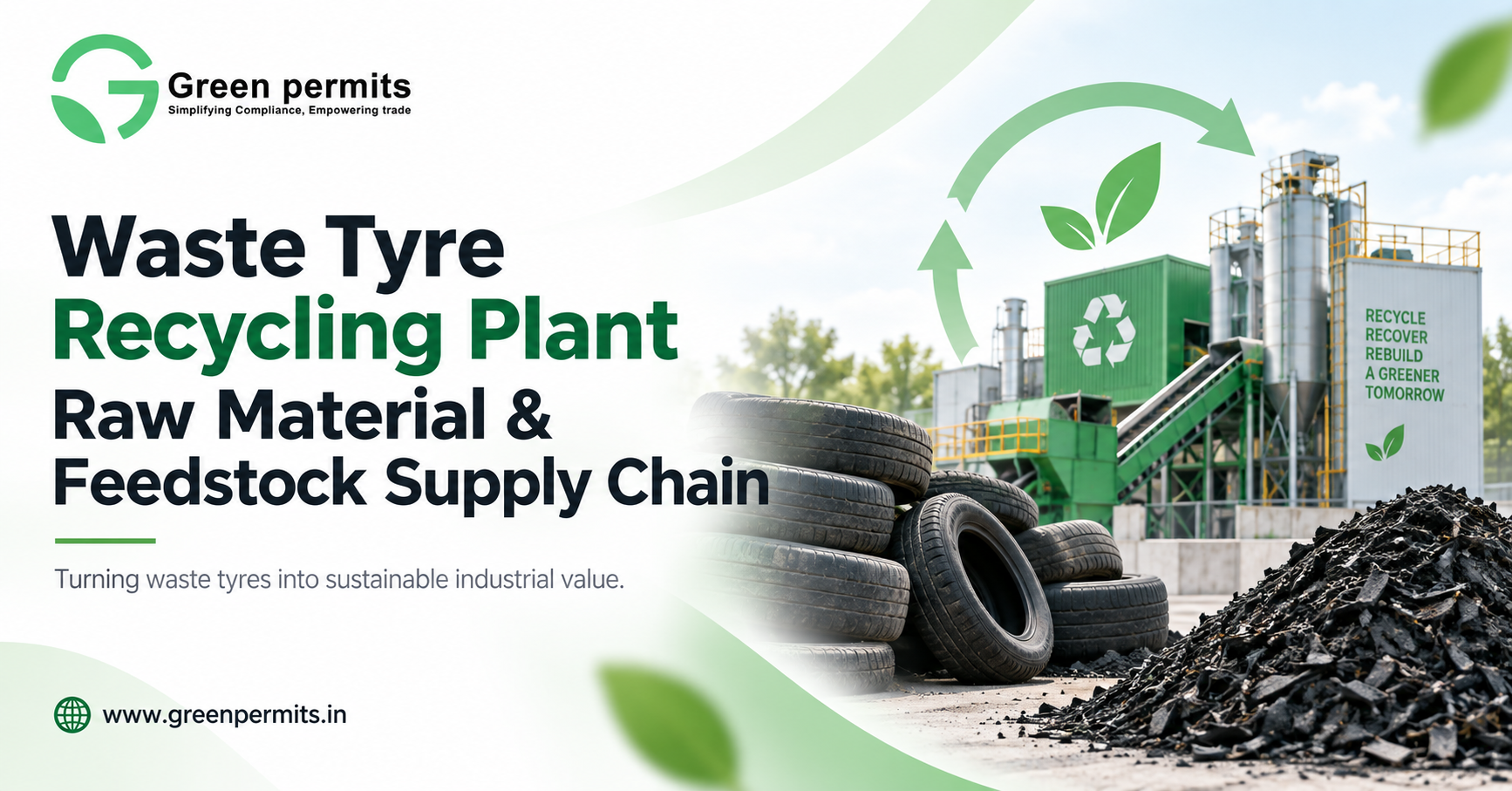
A successful waste tyre recycling plant depends as much on a reliable raw material supply chain as it does on machinery. Many projects focus first on shredders, granulators or crumb-rubber equipment, but the plant cannot operate profitably if sufficient waste tyres are not available at a predictable price.
For an investor planning a tyre recycling facility in India, the key questions are: Where will the tyres come from? How many tonnes can be collected every month? What will transportation cost? What type of tyres will be received? And how much usable rubber, steel and fibre can be recovered?
Green Permits Consulting supports investors with waste tyre feedstock studies, sourcing analysis, market assessment, DPR preparation, plant-capacity planning, machinery evaluation and regulatory approvals.
Why Feedstock Supply is Critical
Waste tyre recycling is a volume-based business. The plant needs a consistent flow of end-of-life tyres to maintain machinery utilisation and control production cost.
A plant designed for 20 tonnes per day but receiving only 8 to 10 tonnes regularly may face high fixed costs per tonne.
This is why plant capacity should follow the feedstock study.
The correct sequence is:
Feedstock Availability → Collection Network → Transport Cost → Plant Capacity → Machinery → Recycled Product
Starting with machinery and searching for tyres later creates much greater commercial risk.
Main Sources of Waste Tyres
Waste tyres can come from several parts of the automotive and transport ecosystem.
Important sources include tyre dealers, replacement centres, transport fleets, logistics companies, bus operators, workshops, retreaders, scrap dealers, industrial vehicle operators and tyre aggregators.
Vehicle scrapping facilities can also become an important source as end-of-life vehicles are dismantled.
For larger plants, relying on only one source is risky. A stronger sourcing model combines several channels so that the plant can maintain supply even when one supplier provides less material.
Tyre Dealers and Replacement Centres
Tyre dealers generate a regular flow of used tyres because customers often replace old tyres when purchasing new ones.
A recycler can develop collection agreements with dealers across a defined geographical area.
This source can provide relatively predictable material, but collection logistics matter. Picking up small quantities from many locations can become expensive.
A market study should therefore calculate the quantity collected per trip and transportation cost per tonne.
Commercial Fleets and Transport Companies
Truck, bus and logistics fleets can be valuable feedstock sources because they replace tyres in large volumes.
Large fleet operators may generate more consistent quantities than individual retail dealers.
For a recycling plant, direct arrangements with transport companies can improve feedstock visibility and reduce dependence on multiple intermediaries.
The recycler should understand replacement cycles, monthly tyre generation and whether the fleet sends tyres for retreading before final disposal.
Retreading Industry as a Feedstock Source
Not every used tyre goes directly to recycling.
Many truck and commercial tyres may first be sent for retreading if the casing is still suitable.
Tyres that are damaged, worn beyond retreading or rejected by retreaders can then become recycling feedstock.
This means a waste tyre market study should not count every replaced tyre as immediately available for recycling.
The more realistic chain can be:
Used Tyre → Retreading Assessment → Reusable Casing / Rejected Tyre → Recycling
Understanding this flow helps avoid overestimating feedstock.
Scrap Dealers and Aggregators
Scrap aggregators play an important role because they collect tyres from many small generators and consolidate them into larger lots.
For a recycler, buying from aggregators can simplify procurement.
However, the purchase price may be higher because the aggregator has already incurred collection and transportation costs.
The project should compare:
Direct Collection Cost vs Aggregator Purchase Price
In some locations, a mixed sourcing strategy may provide the best balance between cost and reliability.
Different Tyres Have Different Recycling Value
All waste tyres should not be treated as identical raw material.
Passenger-car tyres, truck tyres, bus tyres, two-wheeler tyres and off-road tyres can differ in size, rubber content, steel content and construction.
This affects processing, recovery yield and the value of recovered materials.
For example, tyre composition influences the amount of rubber crumb, steel and textile fibre that can be recovered.
A feedstock study should therefore analyse not only total tonnes available but also the type and mix of tyres entering the plant.
Feedstock Radius and Transportation Cost
Waste tyres occupy considerable volume compared with their weight, making transportation an important cost.
A plant may find large quantities of tyres in another state, but transporting loose tyres over long distances may reduce profitability.
The ideal supply radius depends on tyre purchase price, truck utilisation, road distance and collection model.
For most projects, it is better to map the feedstock around the proposed site before land is finalised.
A good location should balance:
Tyre Availability + Transport Distance + Buyer Access + Industrial Infrastructure
Cheap land far from the waste source may not result in a cheaper project.
Collection and Transportation Planning
The feedstock supply chain should define how tyres will move from the generator to the recycling plant.
A recycler can use direct pickup vehicles, third-party transporters or aggregator networks.
The plant should estimate monthly transportation expense based on realistic routes rather than only cost per kilometre.
Vehicle loading efficiency is also important because loose tyres consume significant space.
Depending on the sourcing model, tyre cutting, baling or other logistics optimisation may be evaluated, subject to safe and compliant handling.
Storage of Waste Tyres
A recycling plant needs sufficient space to store incoming tyres without creating operational or fire-safety problems.
Storage should be organised so that incoming material can be inspected, segregated and moved efficiently to the processing line.
Excessive inventory ties up working capital and occupies land, while insufficient inventory can stop the plant when collections are delayed.
The project should therefore maintain an appropriate buffer stock based on daily consumption and supply reliability.
Feedstock Quality Inspection
Incoming tyres should be checked before they enter the recycling process.
The plant may need to separate tyres containing excessive mud, water, foreign objects or unsuitable material.
Tyres should also be classified according to size and type where this affects machinery operation.
Consistent feedstock improves production efficiency and makes the recovered output more predictable.
For a mechanical recycling plant, stable input quality can directly affect crumb-rubber quality and machine wear.
Waste Tyre Recycling Process
Once tyres arrive at the plant, the mechanical recycling process generally involves:
Receiving → Sorting → De-Beading → Cutting / Shredding → Granulation → Steel Separation → Fibre Separation → Size Classification
Depending on the final product, the plant may produce tyre chips, rubber granules, crumb rubber or rubber powder.
Recovered steel may also be sold separately, while textile fibre and other residues require appropriate management.
A tyre pyrolysis project follows a substantially different process and should be evaluated separately from mechanical recycling.
Feedstock and Plant Capacity
The machinery supplier may offer a 10 TPD, 20 TPD or larger production line, but the correct capacity should come from the sourcing study.
Suppose a promoter expects 15 tonnes per day from the market but only 9 tonnes can be secured through realistic supplier discussions.
Designing a 20-tonne-per-day plant can create unnecessary investment and low utilisation.
A better approach is to size the first phase around reliable feedstock and provide space for future expansion.
This reduces initial CAPEX and makes the business easier to stabilise.
Supplier Agreements and Feedstock Security
Before financial closure, the promoter should try to identify key waste tyre suppliers.
Supply arrangements may cover expected monthly quantity, tyre type, pricing method, collection responsibility and payment terms.
Not every supplier needs a long-term legal contract, but documented discussions and supply commitments can improve confidence in the feedstock model.
For lenders and investors:
Reliable Feedstock → Higher Plant Utilisation → More Predictable Revenue
This makes sourcing an important part of the project's bankability.
Working Capital for Tyre Procurement
Waste tyre procurement can require significant working capital.
The recycler may pay suppliers immediately while receiving payment from crumb-rubber or recovered-steel buyers later.
Cash can therefore remain tied up in raw material, processing inventory and customer receivables.
A DPR should estimate how much feedstock inventory the plant intends to maintain and how frequently suppliers need to be paid.
Working capital should be planned separately from machinery and civil construction costs.
EPR and Regulatory Compliance
Waste tyre recycling in India also operates within the applicable CPCB waste tyre EPR framework.
Eligible recycling facilities need to assess the applicable recycler registration and compliance requirements along with State Pollution Control Board permissions.
Depending on the project, Consent to Establish and Consent to Operate may also need to be obtained before commercial operations.
EPR-related income can support the business, but the plant should not rely only on EPR certificates.
The core business model should remain commercially viable through genuine tyre recycling and sale of recovered materials.
Buyer Market for Recycled Products
Feedstock planning should be connected with the output market.
A mechanical recycling plant may sell crumb rubber or granules to industries involved in rubber products, flooring, mats, moulded products, road-related applications or other suitable uses.
Recovered steel can enter the metal recycling market.
The project should evaluate:
Waste Tyre Purchase Price → Recovery Yield → Processing Cost → Selling Price
before deciding plant capacity.
This determines how much the recycler can afford to pay for incoming tyres while maintaining a viable margin.
DPR for Waste Tyre Recycling Plant
A Detailed Project Report - DPR should connect the feedstock market with plant economics.
The DPR can assess waste tyre availability, sourcing radius, tyre mix, plant capacity, machinery, recovery yield, land, utilities, approvals, project cost and working capital.
The financial section should calculate expected raw-material cost, production cost, recovered-product revenue, profitability, cash flow and break-even.
Sensitivity analysis is also useful because tyre procurement prices and recycled-rubber selling prices can change.
Common Feedstock Planning Mistakes
One of the biggest mistakes is estimating raw material availability using national waste tyre figures instead of checking the local supply network.
Another is assuming every used tyre will be available for recycling immediately, without considering retreading and reuse.
Projects may also underestimate transportation cost or build a large plant without securing suppliers.
A stronger approach is:
Supplier Mapping → Quantity Verification → Logistics Cost → Plant Capacity → DPR → Machinery
How Green Permits Helps with Waste Tyre Recycling Projects
Green Permits Consulting supports entrepreneurs, recyclers and investors with waste tyre feedstock studies, supplier mapping, market assessment, feasibility reports, DPR preparation, plant-capacity planning, machinery evaluation and environmental approval support.
The objective is to determine whether enough raw material can be secured at a commercially workable cost before major investment.
Learn More About Waste Tyre Recycling Plant Feedstock & Supply Chain
If you are planning a waste tyre recycling facility, feedstock availability, tyre mix, sourcing radius, procurement cost and recycled-product buyers should be evaluated before plant capacity and machinery are finalised.
Read more about recycling plant setup and DPR consulting services here:
👉 https://www.greenpermits.in/09/waste-tyre-sourcing-for-recycling-plants-in-india/
📞 Get Expert Assistance for Waste Tyre Recycling Plant Setup
If you need help with a Waste Tyre Recycling Plant feedstock study, supplier mapping, feasibility report, DPR preparation, machinery planning or project approvals, Green Permits Consulting can assist you.
🌐 Website: www.greenpermits.in
📞 Phone: +91 78350 06182
📧 Email: wecare@greenpermits.in

 English
 Arabic
 Spanish
 Portuguese
 Deutsch
 Turkish
 Dutch
Dutch
 Italiano
 Russian
 Romaian
 Portuguese (Brazil)
 Greek
Greek