
Rare Earth Recovery Plant Raw Material & Feedstock Supply Chain
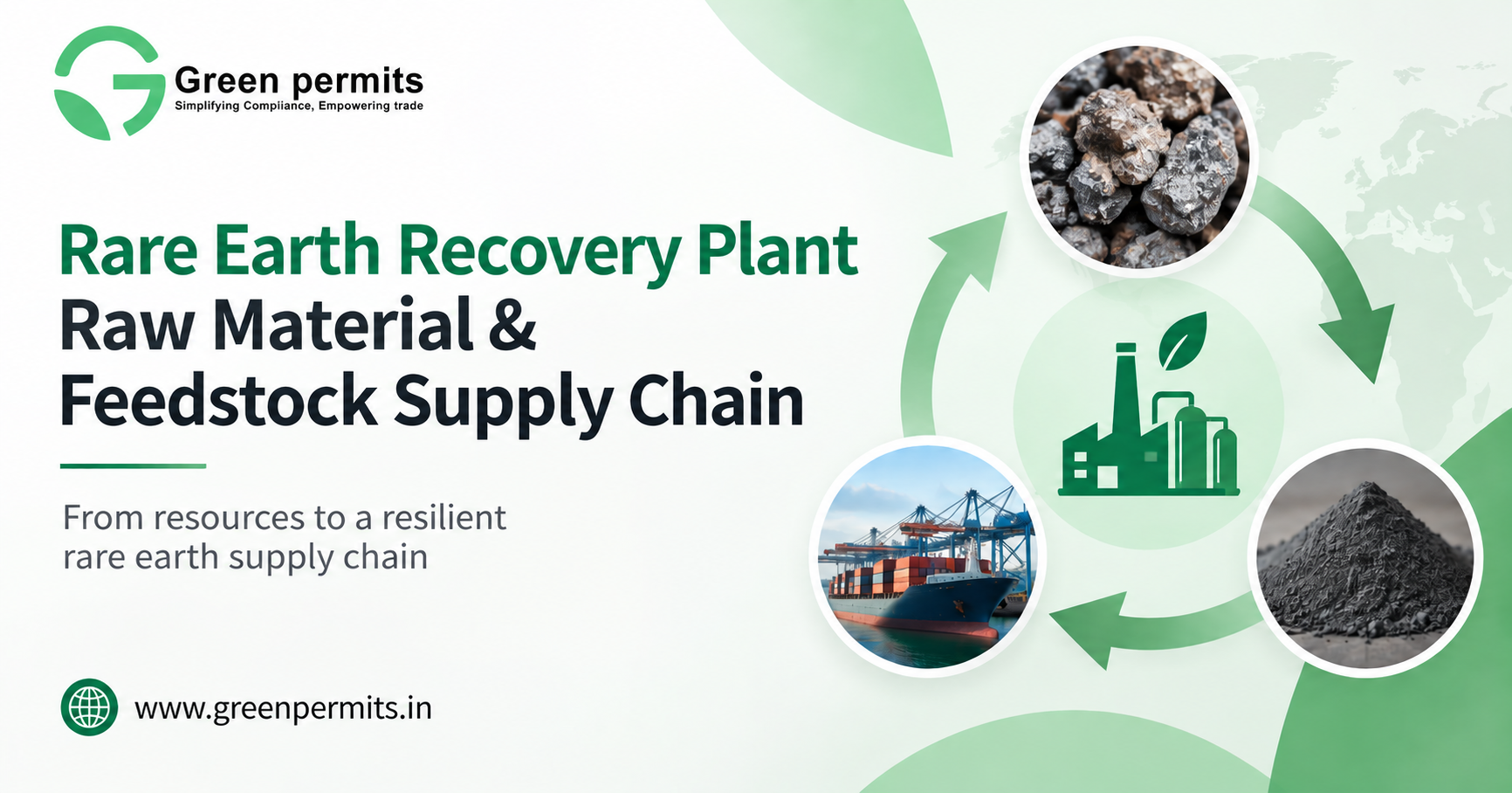
A Rare Earth Recovery Plant Raw Material & Feedstock Supply Chain study helps investors understand where recoverable rare-earth-bearing material will come from, how much can be sourced, what grade it contains, how far it must be transported and whether the recovered material has a reliable buyer.
Rare earth recovery projects can process feedstock from end-of-life magnets, electric motors, wind turbine components, electronics, industrial scrap, polishing waste, manufacturing residues and other rare-earth-bearing materials.
For investors, the biggest mistake is to start with recovery technology or machinery before confirming the raw material supply. A technically advanced plant cannot run profitably if the feedstock is inconsistent, low-grade or too expensive to collect.
Green Permits Consulting supports investors with rare earth feedstock studies, supplier mapping, market assessment, DPR preparation, plant-capacity planning, technology evaluation and environmental approval planning.
What Feedstock Can Be Used for Rare Earth Recovery?
Rare earth recovery plants can use different secondary raw materials depending on the selected technology and target metals.
One of the most important feedstock categories is permanent magnet scrap, particularly material containing neodymium, praseodymium, dysprosium or terbium.
Such magnets may be found in electric motors, industrial equipment, wind turbines, hard disk drives and other high-performance applications.
Manufacturing scrap can also be valuable because it may have more predictable composition than mixed end-of-life waste.
The basic supply chain can be understood as:
Waste Generator → Collection → Sorting → Pre-Processing → Rare Earth Recovery Plant → Recovered Material → Buyer
The commercial success of the plant depends on how efficiently this chain is built.
Feedstock Comes Before Plant Capacity
Plant capacity should be based on how much material can realistically be secured.
Suppose an investor plans a 10 TPD recovery plant, but supplier discussions show that only 4 to 5 tonnes per day of suitable rare-earth-bearing material can be sourced consistently.
In that situation, the larger plant may operate far below capacity.
The better planning sequence is:
Feedstock Availability → Feedstock Grade → Recovery Potential → Buyer Demand → Plant Capacity → Technology
This helps reduce over-investment.
End-of-Life Magnets as Feedstock
Permanent magnets are among the most attractive secondary sources for rare earth recovery.
They can come from electric motors, industrial machinery, generators, wind turbines, electronic devices and other equipment.
However, collection can be difficult because magnets are often embedded inside larger products.
This means the recovery supply chain may involve:
Equipment Collection → Dismantling → Magnet Removal → Sorting → Recovery
The cost of dismantling should therefore be included in the feedstock economics.
A magnet that contains valuable rare earths may still be unattractive if recovering it from the original equipment is too labour-intensive or expensive.
EV Motors and Automotive Scrap
The growth of electric mobility creates a long-term opportunity for rare earth recovery because some electric motors use permanent magnets containing rare-earth elements.
However, investors should not assume that every electric vehicle immediately becomes recycling feedstock.
Vehicles remain in service for years before reaching end-of-life.
The near-term supply chain may therefore depend more on motor manufacturing scrap, rejected components, warranty returns and production waste than on end-of-life EVs.
A market study should separate current feedstock from future potential.
Wind Turbine and Generator Scrap
Certain wind turbine generators use rare-earth permanent magnets.
As renewable energy infrastructure expands, manufacturing scrap, maintenance replacements and eventually decommissioned equipment may become useful recovery sources.
But these materials are geographically dispersed and can involve large equipment.
The logistics model should therefore evaluate whether dismantling happens at the project site or at a central recovery facility.
For large components, transport cost can significantly affect project viability.
Electronics and E-Waste
Electronics may contain rare-earth materials in magnets, displays, components and specialised devices.
However, rare earth concentration in mixed e-waste can be relatively low compared with more concentrated magnet scrap.
This makes pre-sorting and feedstock selection important.
A plant should not assume that large volumes of general e-waste automatically translate into large volumes of recoverable rare earths.
The market study should identify the specific product streams that contain commercially meaningful concentrations.
Manufacturing Scrap Can Be Better Than Mixed Waste
For a new recovery plant, industrial manufacturing scrap can often be more attractive than mixed post-consumer waste.
This is because manufacturing scrap may have:
Known Composition → Lower Contamination → Easier Sorting → More Predictable Recovery
Examples can include magnet manufacturing scrap, cutting residues, rejected components and process waste.
The material may cost more to purchase, but the higher recovery efficiency and lower pre-processing requirement can improve overall economics.
The project should therefore compare feedstock quality, not only purchase price.
Feedstock Grade is More Important Than Tonnage Alone
One tonne of rare-earth-bearing scrap is not equal to another tonne.
The value depends on the concentration of recoverable metals.
For example, a high-grade permanent magnet scrap stream may contain significantly more recoverable neodymium and praseodymium than a mixed electronic waste stream.
The financial model should therefore calculate:
Feedstock Quantity × Rare Earth Content × Recovery Efficiency = Recoverable Product
This gives a more realistic picture of potential revenue.
Using only total tonnage can lead to major errors in project economics.
Supplier Mapping
A strong rare earth recovery project needs a structured supplier network.
Potential suppliers may include magnet manufacturers, electric motor manufacturers, automotive companies, electronics manufacturers, wind-energy companies, dismantlers, recyclers, scrap aggregators and industrial waste generators.
The market study should identify where these suppliers are located and how much material they generate.
For each supplier, the project should understand:
Material Type → Monthly Quantity → Composition → Purchase Price → Distance → Supply Reliability
This creates a proper feedstock database before plant capacity is finalised.
Transportation and Collection Cost
Rare-earth-bearing materials can come from multiple industrial clusters.
The plant may therefore need to collect small quantities from many locations.
Transportation cost can become important, especially if the feedstock has low rare earth concentration.
The site should ideally be selected to reduce the combined cost of:
Feedstock Collection + Chemical Supply + Recovered Product Dispatch
A cheaper land parcel far away from suppliers may not result in a lower-cost project.
Pre-Processing Before Recovery
Incoming feedstock often requires pre-processing before chemical or metallurgical recovery.
Depending on the material, this may include dismantling, cutting, demagnetisation, crushing, shredding, sorting or physical separation.
The purpose is to create a concentrated and consistent material stream.
For permanent magnets, the project may first separate magnets from steel, copper, plastics or other surrounding materials.
The recovery plant should therefore be designed around the actual incoming feedstock rather than an ideal laboratory-grade material.
Storage and Inventory Planning
Rare-earth feedstock can be expensive, so excessive inventory can tie up significant working capital.
At the same time, maintaining too little material can cause production interruptions.
The project should define a reasonable raw material buffer based on supplier reliability and monthly plant consumption.
Working capital should consider:
Feedstock Inventory → Processing Time → Finished Material Inventory → Buyer Payment Period
This cash cycle can be a major part of total project financing.
Buyer Market for Recovered Rare Earth Materials
Feedstock planning should be connected with the final product.
Depending on the process, the plant may produce rare-earth concentrates, oxides, salts, metals or other intermediate products.
Potential buyers may include magnet manufacturers, specialty chemical companies, alloy manufacturers and other advanced-material businesses.
The plant should identify buyer specifications before selecting the final recovery process.
A material that is technically recoverable may not have strong commercial value unless it reaches the purity required by the buyer.
The project should therefore connect:
Feedstock Quality → Recovery Technology → Product Purity → Buyer Requirement
Raw Material Pricing Strategy
Rare-earth feedstock pricing can be complex because value depends on metal content and market prices.
Buying every batch at a fixed price per tonne may not be suitable.
For higher-value feedstocks, pricing may need to consider assay results or the recoverable content of key rare earths.
The project should also understand who bears the risk if the actual metal content differs from the expected grade.
Strong procurement controls can protect margins.
DPR for Rare Earth Recovery Plant
A Detailed Project Report - DPR should connect the feedstock supply chain with plant economics.
The DPR can evaluate supplier locations, feedstock composition, plant capacity, pre-processing, recovery technology, machinery, material balance, land, utilities and environmental requirements.
The financial model should calculate feedstock purchase cost, recovery yield, chemical and energy consumption, working capital, finished-product price and expected margins.
Sensitivity analysis should test what happens if feedstock cost rises, metal recovery falls or rare earth prices decline.
Common Feedstock Planning Mistakes
One common mistake is estimating the project only from India's future EV or wind-energy growth without checking the quantity of scrap actually available today.
Another is using mixed waste tonnage without analysing rare earth concentration.
Projects can also underestimate dismantling, sorting, transportation and working capital.
The better sequence is:
Supplier Mapping → Feedstock Testing → Buyer Study → Capacity → Technology → DPR → Plant Setup
How Green Permits Helps with Rare Earth Recovery Projects
Green Permits Consulting supports investors and recyclers with rare earth feedstock studies, supplier mapping, market assessment, feasibility reports, DPR preparation, plant-capacity planning, technology evaluation, financial modelling and environmental approval support.
The objective is to determine whether enough high-quality feedstock can be secured before major investment is committed.
Learn More About Rare Earth Recovery Plant Feedstock Supply Chain
If you are planning a rare earth recovery facility, the project should first be evaluated for raw material availability, rare earth content, collection cost, supplier reliability, recovery technology and buyer demand.
Read more about recycling plant setup and DPR consulting services here:
👉 https://www.greenpermits.in/09/rare-earth-recovery-feedstock-in-india-cost-sourcing/
📞 Get Expert Assistance for Rare Earth Recovery Plant Setup
If you need help with a Rare Earth Recovery Plant feedstock study, supplier mapping, feasibility report, DPR preparation or plant setup, Green Permits Consulting can assist you.
🌐 Website: www.greenpermits.in
📞 Phone: +91 78350 06182
📧 Email: wecare@greenpermits.in

 English
 Arabic
 French
 Spanish
 Portuguese
 Turkish
 Dutch
Dutch
 Italiano
 Russian
 Romaian
 Portuguese (Brazil)
 Greek
Greek