
Solar BESS Hybrid Project Market Study in India
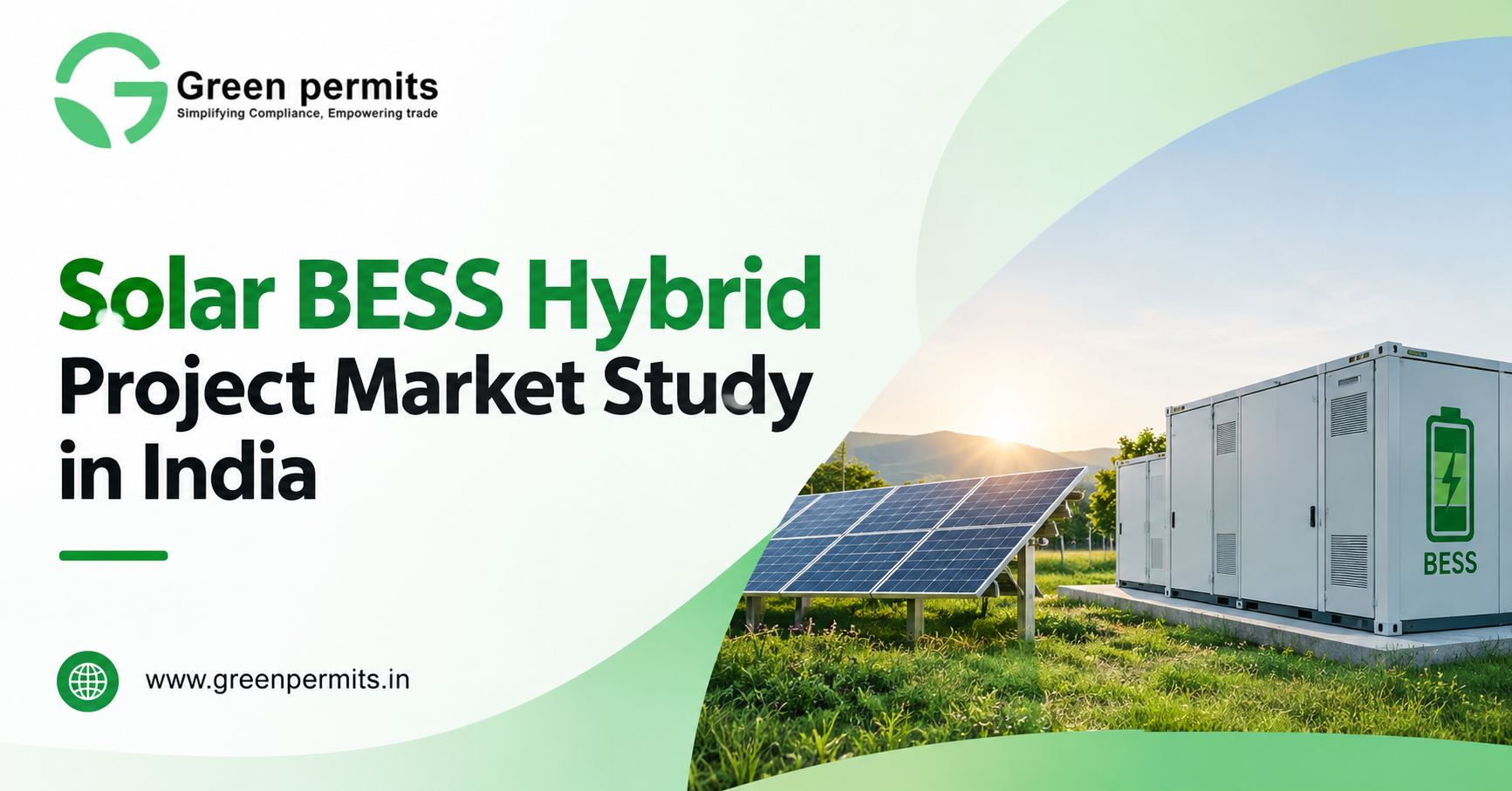
A Solar BESS Hybrid Project Market Study helps investors, renewable-energy developers, EPC companies and industrial promoters understand whether combining solar generation with Battery Energy Storage Systems can create a commercially viable project.
Solar power generates electricity mainly during daytime, while many industrial, commercial and grid requirements continue into evening and peak-demand hours. A BESS allows part of the solar electricity to be stored and supplied later, helping improve dispatchability, power availability and utilisation of renewable generation.
However, a solar-plus-storage project should not be planned only around battery capacity. The market study must evaluate solar resource, power demand, grid conditions, battery duration, charging pattern, customer profile, tariff structure, project cost and revenue model.
Green Permits Consulting supports developers with Solar BESS market studies, feasibility reports, DPR preparation, site assessment, battery sizing, financial modelling and project implementation planning.
What is a Solar BESS Hybrid Project?
A Solar BESS Hybrid Project combines a solar photovoltaic plant with a Battery Energy Storage System.
During periods of strong solar generation, electricity can either be supplied directly to the grid or customer, or stored in the battery for later use.
The basic energy flow is:
Solar Generation → Direct Supply + Battery Charging → Stored Energy → Evening / Peak-Hour Discharge
The project can be designed as a utility-scale grid-connected system, captive industrial project, commercial energy project or renewable-energy supply arrangement depending on the business model.
The battery size should be selected according to the purpose of the project rather than simply matching solar capacity.
Why Solar and BESS are Being Combined
Solar generation follows daylight hours, but electricity demand does not always follow the same pattern.
A solar plant may generate strongly during the afternoon, while demand peaks later in the evening.
Battery storage helps shift energy between these periods.
For example:
Afternoon Solar Surplus → Battery Charging → Evening Power Supply
This can make renewable power more useful for customers that require a more predictable electricity profile.
BESS can also support renewable smoothing, peak management, backup requirements and better utilisation of grid infrastructure depending on the project structure.
Market Study Should Start with the Use Case
The first question should not be "How many MWh of battery should be installed?"
The first question is:
What problem is the battery solving?
A project designed to supply evening electricity may require a different battery duration from one intended primarily for peak shaving.
Similarly, a grid-scale project participating in a tender can have completely different economics from an industrial captive solar-plus-storage project.
The market study should therefore define:
Customer Need → Charging Source → Discharge Requirement → Storage Duration → Commercial Model
Once the use case is clear, technical sizing becomes more meaningful.
Understanding the Target Market
Potential users of solar BESS projects can include renewable-energy developers, utilities, data centres, manufacturing facilities, commercial consumers and energy-intensive industries.
Different customers have different reasons for considering battery storage.
An industrial unit may want to reduce expensive peak-hour electricity purchases, while a renewable-energy developer may use storage to supply contracted electricity outside normal solar hours.
The market study should segment buyers according to:
Energy Consumption → Load Profile → Tariff → Reliability Requirement → Renewable-Energy Target
A company with a high evening load can represent a much stronger BESS opportunity than a facility whose demand is concentrated entirely during daylight hours.
Solar Plant and Battery Sizing
The solar and battery components should be sized together.
Suppose a project produces surplus solar electricity for approximately four hours during the day but requires only two hours of evening supply.
Installing a very large battery may increase CAPEX without generating enough additional revenue.
Battery sizing generally needs to consider both power and energy.
A 50 MW / 100 MWh BESS, for example, has approximately two hours of storage duration at the rated power, subject to operating limits and system efficiency.
The sizing logic should be:
Solar Generation Profile → Surplus Energy → Required Discharge → MW / MWh Selection
This provides a more commercially realistic configuration.
Standalone Solar vs Solar Plus BESS
A conventional solar plant is generally simpler and cheaper to develop because there is no storage component.
However, its electricity production is dependent on solar availability.
Adding storage increases project cost but can improve the timing and flexibility of electricity delivery.
The market study should therefore compare both cases.
It should examine whether the additional battery investment produces enough commercial benefit through higher-value power supply, improved contractual performance or other identified revenue opportunities.
The decision should be based on the complete lifecycle economics rather than only initial CAPEX.
Battery Technology and Project Economics
Lithium-ion batteries are widely considered for utility and commercial storage projects, with LFP chemistry commonly evaluated for stationary applications.
Battery selection should consider cycle life, degradation, safety, warranty, operating temperature, efficiency and supplier guarantees.
Battery degradation is particularly important.
A battery does not normally maintain the same usable capacity throughout the entire project life.
The market study should therefore evaluate:
Initial Battery Capacity → Annual Degradation → Required Capacity → Future Augmentation
Ignoring augmentation can underestimate long-term project cost.
Revenue Models for Solar BESS Projects
The commercial model depends on who is buying the power and how the project is structured.
Revenue may come from long-term electricity contracts, renewable-energy supply, peak-hour delivery, captive savings or other eligible grid-related services.
The important question is not simply how much electricity the project generates.
The study should determine:
When is electricity sold, at what value and under what contractual arrangement?
If the battery charges during low-value periods and discharges during higher-value periods, the difference must be sufficient to cover battery losses, degradation and capital cost.
The revenue model should therefore be linked directly with the operating strategy.
Round-Trip Efficiency and Energy Loss
A battery cannot return all the electricity used for charging.
Losses occur during charging, storage, conversion, cooling and discharge.
This means 100 units of solar electricity sent into the battery may result in fewer units being delivered later.
The market study should use realistic round-trip efficiency assumptions provided by the selected technology supplier.
This matters because project revenue should be calculated on delivered electricity rather than electricity initially sent for charging.
Site and Grid Connectivity
A good solar BESS project requires both a suitable solar site and strong grid connectivity.
The site assessment should evaluate solar resource, land availability, transmission access, substation capacity, evacuation distance and road connectivity.
For hybrid projects, the battery can sometimes use shared electrical infrastructure with the solar plant.
However, the project must confirm whether existing or proposed evacuation capacity is sufficient for the planned charging and discharge profile.
A nearby substation does not automatically mean sufficient grid capacity is available.
The market study should therefore consider both location and grid feasibility.
Solar BESS Project Cost
There is no fixed cost for every hybrid project.
Investment depends on solar capacity, battery MWh, storage duration, battery chemistry, PCS, transformers, grid connection, land and civil infrastructure.
The project cost should be evaluated as:
Solar Plant + Battery System + PCS + Transformer + Grid Infrastructure + Civil Works + Safety Systems + Development Cost
Battery replacement or augmentation should also be included in long-term financial modelling.
Only comparing the initial battery price can underestimate the actual lifecycle cost of the project.
Financial Feasibility
The financial model should connect the technical design with the commercial market.
It should calculate annual generation, battery charging, delivered energy, tariff, operating cost, degradation and augmentation requirements.
The model should then estimate revenue, EBITDA, cash flow, debt servicing and project returns.
Sensitivity analysis should test situations such as lower solar generation, higher battery cost, faster degradation or lower electricity prices.
A strong market study should evaluate:
Base Case → Downside Case → Project Cash Flow → Investment Viability
This gives investors a better understanding of risk before committing capital.
DPR for Solar BESS Hybrid Project
Once the market study identifies a viable opportunity, a Detailed Project Report - DPR can convert the concept into an implementation plan.
The DPR can cover project capacity, solar design, battery sizing, site requirement, grid connectivity, technology, CAPEX, OPEX, approvals and implementation schedule.
The financial model should be supported by realistic generation and battery assumptions rather than only equipment supplier estimates.
A strong project development sequence is:
Market Study → Site Assessment → Load / Offtake Study → Solar & BESS Sizing → DPR → Finance → Implementation
How Green Permits Helps with Solar BESS Projects
Green Permits Consulting supports renewable-energy developers and investors with Solar BESS market studies, feasibility assessment, site selection, DPR preparation, battery sizing, CAPEX and OPEX modelling, project finance documentation and approval planning.
The objective is to identify the right project configuration and commercial model before major investment is committed.
Learn More About Solar BESS Hybrid Project Market Study
If you are planning a solar-plus-storage project, the market study should evaluate customer demand, solar generation, battery duration, grid connectivity, project cost and revenue model before technology and equipment are finalised.
Read more about feasibility and project setup consulting services here:
👉 https://www.greenpermits.in/09/solar-bess-market-in-india-demand-offtake/
📞 Get Expert Assistance for Solar BESS Hybrid Projects
If you need help with a Solar BESS Hybrid Project Market Study, feasibility report, DPR preparation, battery sizing, site assessment or financial modelling, Green Permits Consulting can assist you.
🌐 Website: www.greenpermits.in
📞 Phone: +91 78350 06182
📧 Email: wecare@greenpermits.in

 English
 French
 Spanish
 Portuguese
 Deutsch
 Turkish
 Dutch
Dutch
 Italiano
 Russian
 Romaian
 Portuguese (Brazil)
 Greek
Greek