
Solar Module Manufacturing Plant Cost in India
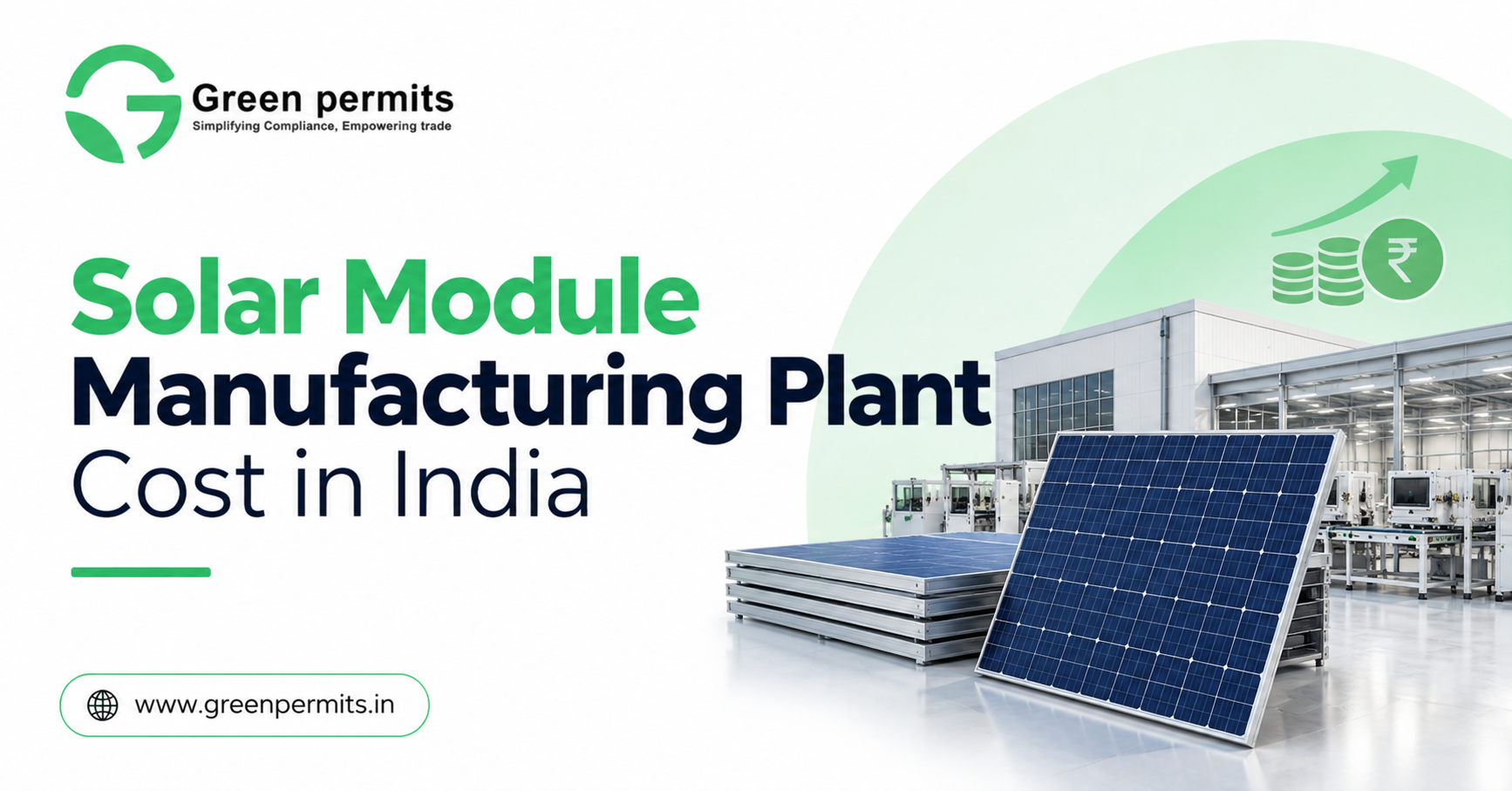
Setting up a Solar Module Manufacturing Plant in India can be an attractive opportunity as demand continues to grow from utility-scale solar projects, commercial and industrial installations, rooftop systems and renewable-energy developers. However, investors often underestimate the total project cost because they focus only on the price of the module manufacturing line.
The actual investment includes much more than stringers and laminators. A complete project requires land, factory building, automated production equipment, testing systems, utilities, warehousing, quality-control infrastructure, raw material inventory and working capital. The cost also changes considerably depending on whether the project is a module-only facility or an integrated solar cell and module manufacturing plant.
Green Permits Consulting supports investors with Solar Module Manufacturing Plant feasibility studies, DPR preparation, machinery planning, CAPEX and OPEX modelling, subsidy assessment and project implementation support.
How Much Does a Solar Module Manufacturing Plant Cost in India?
There is no single standard investment applicable to every solar module plant. Cost depends mainly on annual manufacturing capacity, level of automation, module technology, factory location and whether land and working capital are included.
For preliminary project planning, a module-only facility may broadly require investment in the following range:
Indicative CapacityApproximate Project Investment*100 MW per year₹10 crore - ₹25 crore500 MW per year₹30 crore - ₹60 crore1 GW per year₹60 crore - ₹100+ crore
*These are broad planning ranges for a module-manufacturing project and can vary significantly based on automation, imported machinery, building, utilities, land and working capital.
A highly automated project designed for advanced module formats can cost more. Working capital can also add a substantial amount because solar cells and other raw materials must be purchased before modules are manufactured and sold.
The correct calculation should therefore be:
Land + Building + Machinery + Utilities + Testing + Pre-operative Cost + Working Capital = Total Project Cost
Machinery Cost for Solar Module Manufacturing
Machinery is one of the major fixed investments in a module manufacturing plant. A modern line may include automatic tabber-stringers, layup stations, bussing equipment, laminators, framing machines, junction-box systems, curing equipment, EL testers, flash testers and automated material-handling systems.
A typical process is:
Solar Cell Inspection → Stringing → Layup → Lamination → Trimming → Framing → Junction Box → Testing → Packing
The machinery cost depends heavily on production speed and automation. A semi-automatic line for a smaller project can require significantly lower investment than a fully automated gigawatt-scale facility.
Investors should also check whether the line can manufacture the module technologies and sizes expected in the market over the next several years. Purchasing equipment only because it is inexpensive can become costly if the line cannot handle future module formats.
Factory Building and Infrastructure Cost
The production line requires a suitable industrial building with controlled manufacturing areas, raw material storage, finished-goods warehousing, testing laboratories and utility rooms.
Building cost depends on land location, factory size and construction specification. A larger automated project also requires sufficient space for material movement because solar glass, cells, aluminium frames and finished modules need organised storage and handling.
The factory may require electrical infrastructure, compressed air, HVAC where required, material-handling equipment, fire protection and backup power systems.
A DPR should therefore calculate machinery and civil infrastructure separately. The price quoted by a production-line supplier should never be considered the complete cost of establishing the plant.
Raw Material Cost is More Important Than Many Investors Expect
Once production begins, raw materials become the largest part of the operating cost.
A typical solar module requires solar cells, front glass, encapsulant, aluminium frames, junction boxes, ribbons and other components. Depending on module construction, backsheets or rear glass may also be required.
For a module-only manufacturer, solar cells are generally the most commercially important input. Changes in cell prices can quickly influence module manufacturing margins.
The operating model should therefore calculate:
Solar Cell Cost + Glass + Encapsulant + Frame + Junction Box + Other Material + Conversion Cost = Module Production Cost
Investors should not prepare a DPR using one fixed raw material price for several years. Solar technology and component pricing can change rapidly, so the financial model should include both favourable and downside scenarios.
Working Capital Requirement
Working capital can be one of the largest hidden requirements in a solar module manufacturing project.
A plant has to purchase cells, glass, frames and other materials before production starts. Finished modules may then remain in inventory before being supplied to customers, and customers may receive credit periods.
The business cycle becomes:
Raw Material Purchase → Manufacturing → Finished Inventory → Dispatch → Customer Payment
For a large plant, even a few weeks of raw material inventory can represent a significant amount of capital.
A project that estimates only machinery and building cost may therefore appear much cheaper than the actual amount required to operate the factory.
Working capital should be calculated separately according to production capacity, inventory days, supplier credit and customer payment terms.
1 GW Solar Module Manufacturing Plant Cost
A 1 GW solar module manufacturing plant represents a significantly larger industrial operation and normally uses a higher level of automation.
For preliminary planning, the fixed project investment for a module-only 1 GW facility may fall broadly in the range of ₹60 crore to ₹100 crore or more, depending on technology, factory infrastructure and equipment origin.
However, this does not mean ₹60-100 crore is the complete funding requirement. Land, financing expenses and working capital can increase the total substantially.
A plant using expensive imported automation, advanced testing systems and a larger factory configuration may require higher investment.
The financial model should therefore separate:
Fixed CAPEX + Working Capital + Financing Requirement
rather than presenting one machinery figure as the complete investment.
Module-Only vs Solar Cell and Module Manufacturing Cost
Investors should clearly understand the difference between module manufacturing and cell manufacturing.
A module factory purchases finished solar cells and assembles them into solar modules. A solar cell manufacturing facility involves processes such as wafer cleaning, texturing, diffusion, deposition, metallisation, firing, testing and several specialised utility systems.
Because of this, solar cell manufacturing requires substantially higher investment than module assembly.
An integrated project can follow:
Wafer → Solar Cell → Solar Module
Such projects can require investment running into several hundred crores or more per GW, depending on cell technology, integration level and factory scale.
Therefore, a promoter with a limited initial investment may begin with module manufacturing and evaluate backward integration later as the business grows.
Land Requirement and Location
Land cost also changes from state to state and should normally be evaluated separately from machinery cost.
The project needs enough area for production, warehouses, internal movement, utilities, parking, fire access and future expansion.
Location should not be selected only because industrial land is inexpensive. Access to power, highways, ports, raw material suppliers and major solar markets can materially affect operating costs.
A better site comparison is:
Land Cost + Logistics + Power + Labour + Incentives + Customer Access
For a large project, the right location can influence project economics for many years.
Subsidy and Incentives
Solar manufacturing projects may be able to evaluate central or state-level incentives depending on the project, investment size and prevailing scheme conditions.
India has implemented the Production Linked Incentive programme for high-efficiency solar PV modules, but investors should understand that PLI support is linked to selected beneficiaries and applicable scheme conditions. It should not be assumed that every new module manufacturing plant automatically receives a subsidy.
Different states may also provide industrial incentives related to eligible capital investment, electricity duty, stamp duty, employment or other areas.
A project should therefore first be financially evaluated without an assumed subsidy. Confirmed eligible incentives can then be added to understand how they improve project returns.
Financial Feasibility of a Solar Module Plant
The profitability of a module plant depends mainly on manufacturing cost, utilisation, selling price and working capital.
The basic revenue calculation is:
Annual Module Production × Selling Price per Watt = Gross Revenue
From this, the manufacturer must deduct cells and other materials, labour, electricity, maintenance, logistics, finance cost and overheads.
Capacity utilisation is especially important. A 1 GW plant operating at only 40% utilisation may have very different economics from the same factory operating at 80%.
The DPR should therefore use realistic production ramp-up instead of assuming full capacity from the first year.
DPR for Solar Module Manufacturing Plant
A professional Solar Module Manufacturing Plant DPR should assess market demand, proposed capacity, module technology, machinery, raw material sourcing, land, utilities, manpower, CAPEX, working capital and expected production cost.
It should also include revenue projections, cash flow, break-even, financing structure and sensitivity analysis.
A practical project-development sequence is:
Market Study → Capacity → Technology → Machinery → DPR → Site → Finance → Installation → Commercial Production
This allows investors to understand the complete project investment before placing major machinery orders.
How Green Permits Helps
Green Permits Consulting supports investors and manufacturers with Solar Module Manufacturing Plant feasibility studies, DPR preparation, machinery assessment, CAPEX and OPEX modelling, subsidy evaluation, site selection and project implementation support.
Read more about manufacturing plant and DPR consulting services here:
👉 https://www.greenpermits.in/09/solar-module-plant-cost-land-machinery-in-india/
📞 Get Expert Assistance for Solar Module Manufacturing Plant
If you are planning a Solar Module Manufacturing Plant in India, Green Permits Consulting can help with project cost estimation, feasibility study, DPR preparation, machinery planning, subsidy assessment and project finance.
🌐 Website: www.greenpermits.in
📞 Phone: +91 78350 06182
📧 Email: wecare@greenpermits.in
 Romaian
 English
 Arabic
 French
 Spanish
 Portuguese
 Deutsch
 Turkish
 Dutch
Dutch
 Italiano
 Russian
 Portuguese (Brazil)
 Greek
Greek