
Why HIL Software Testing Is Essential for Embedded Software Development
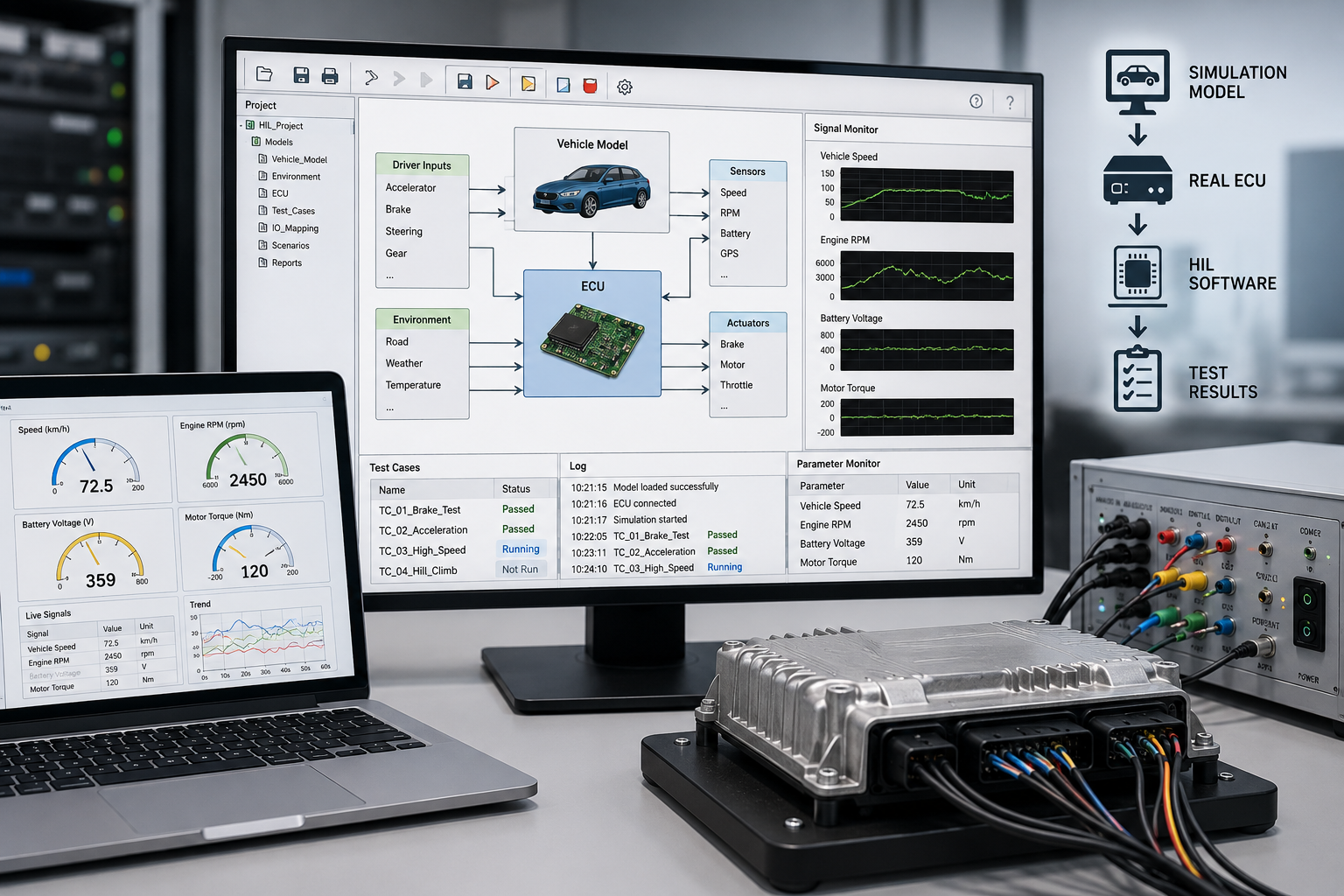
Embedded software is used in many modern products, including industrial machines, automotive electronics, medical equipment, robotics, and consumer devices. Unlike general-purpose software, embedded applications are designed to control specific hardware functions and often need to operate within strict timing and performance requirements.
Testing this software is important because even a small error can affect the behaviour of the complete system. HIL Software Testing provides a practical method for evaluating embedded applications by connecting real hardware controllers to simulated environments.
Understanding Embedded Software Testing
Embedded software controls the operation of electronic devices and systems. It receives inputs from sensors, processes information, and sends commands to other hardware components.
For example, an industrial motor controller receives speed and position information and adjusts motor operation according to programmed instructions.
Traditional software testing can verify individual functions, but it may not fully represent how software behaves when connected to actual hardware. This is where hardware-based testing approaches become valuable.
What Makes HIL Testing Different?
Hardware-in-the-Loop testing uses a physical controller connected to a real-time simulation system.
The simulation system represents the environment in which the controller operates. It generates input signals and processes the outputs produced by the physical hardware.
This arrangement allows engineers to evaluate software and hardware interactions without requiring the entire physical product.
It is particularly useful when the final machine is expensive, difficult to access, or still under development.
Key Stages of HIL Testing
A structured testing process generally includes the following stages.
Requirement Analysis: Engineers identify the expected software behaviour, operating conditions, and performance requirements.
Test Case Development: Test cases are created to evaluate normal operation, boundary conditions, and possible fault situations.
Simulation Model Development: A model of the physical system is prepared to generate realistic input signals.
Hardware Integration: The actual controller is connected to the simulator through appropriate interfaces.
Test Execution: Test cases are executed manually or through automation tools.
Result Analysis: Engineers compare the controller's actual responses with expected results and document any issues.
Benefits for Embedded Software Development
HIL testing provides several benefits to development teams.
First, it helps identify software problems before complete system integration. This can reduce the cost and complexity of correcting issues later.
Second, it allows repeatable testing. Engineers can run the same scenario multiple times and compare results under consistent conditions.
Third, it supports fault testing. Engineers can simulate sensor failures, communication problems, or unusual operating conditions to examine how the controller responds.
It also helps improve test coverage by allowing teams to evaluate different combinations of inputs and operating scenarios.
Common Tools and Technologies
HIL testing environments may use real-time simulators, data acquisition systems, signal-conditioning hardware, and test automation software.
Depending on the application, engineers may also use MATLAB and Simulink for modelling and simulation, along with specialised hardware platforms and communication interfaces.
The choice of tools depends on the controller, system requirements, testing objectives, and available hardware.
Challenges in Embedded HIL Testing
One of the main challenges is creating a simulation model that accurately represents the physical system. An incomplete or inaccurate model may produce results that do not reflect actual operating behaviour.
Engineers must also manage communication timing, signal accuracy, hardware compatibility, and test automation.
Maintaining clear test documentation is equally important. Each test should have defined inputs, expected outputs, execution conditions, and acceptance criteria.
Conclusion
HIL Software Testing is a valuable part of embedded software development because it helps engineers evaluate the interaction between real controllers and simulated environments. It supports repeatable testing, early problem identification, and improved confidence in system behaviour. As embedded technology continues to expand, HIL testing will remain an important engineering practice.
Frequently Asked Questions
1. What is the relationship between embedded software and HIL testing?
Embedded software operates on dedicated hardware controllers and manages specific system functions. HIL testing connects these controllers to a simulated environment to evaluate their behaviour. This helps engineers understand how the software interacts with hardware inputs and outputs under different operating conditions.
2. What types of faults can be tested using HIL systems?
Depending on the simulator and test setup, engineers can simulate sensor faults, incorrect input signals, communication interruptions, abnormal operating conditions, and other system-level failures. These tests help determine whether the controller responds according to the defined safety and functional requirements.
3. Is HIL testing suitable for real-time embedded systems?
Yes. HIL testing is particularly useful for real-time embedded systems because the simulator can exchange signals with the controller within defined timing constraints. This allows engineers to examine not only functional behaviour but also important timing-related responses.
4. How does test automation help HIL testing?
Test automation allows engineers to execute predefined test cases, collect results, and compare actual outputs with expected values. It can reduce repetitive manual work and improve consistency across test runs. Automation is especially helpful when large numbers of scenarios need to be evaluated.

 English
 French
 Spanish
 Portuguese
 Deutsch
 Turkish
 Dutch
 Italiano
 Russian
 Romaian
 Portuguese (Brazil)
 Greek