
Lithium Battery Recycling Machinery in India
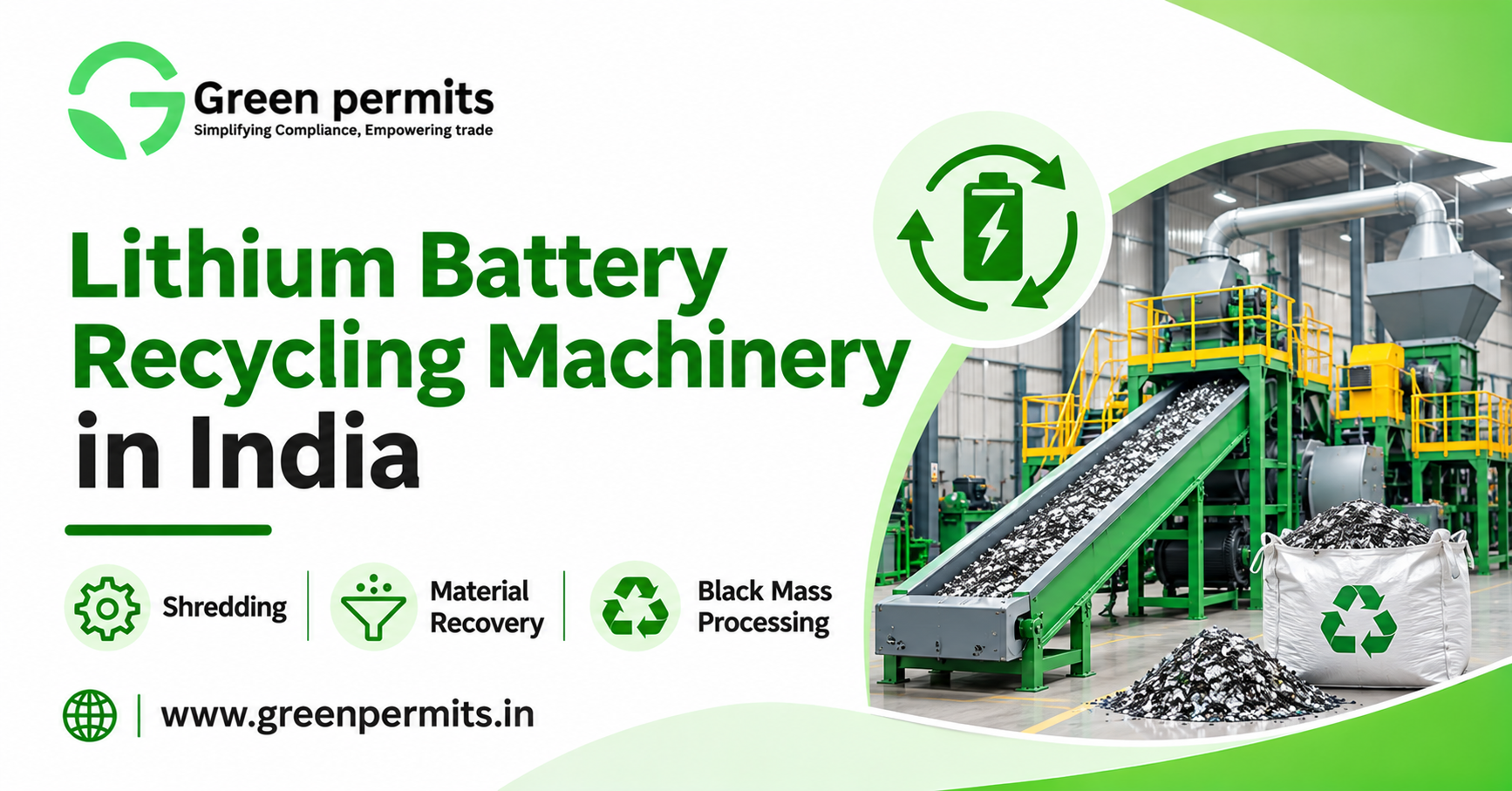
Choosing the right Lithium Battery Recycling Machinery in India is one of the most important decisions when planning a battery recycling plant. The machinery directly affects recovery efficiency, black mass quality, plant safety, power consumption, operating cost, product purity, and overall profitability.
However, lithium battery recycling machinery should not be selected only on the basis of machine capacity or supplier price. The right equipment depends on the battery chemistry, feedstock condition, desired recovered product, processing depth, plant capacity, safety requirements, and downstream buyer specifications.
A stronger planning sequence is:
Feedstock → Battery Chemistry → Recovery Target → Buyer → Technology → Machinery → Capacity
Green Permits Consulting supports entrepreneurs, recyclers, manufacturers, and investors with lithium battery recycling machinery selection, technology comparison, feasibility studies, DPR preparation, feedstock assessment, plant layout, CTE/CTO support, recycler registration assistance, CAPEX-OPEX modelling, and complete plant setup consulting.
What Machinery is Used in Lithium Battery Recycling?
A lithium battery recycling plant can use different machinery depending on whether the project focuses only on mechanical recycling or includes further chemical recovery.
A mechanical recycling line may involve battery receiving, safe handling, dismantling, shredding, screening, metal separation, dust control, and black mass recovery.
A more advanced integrated plant may also include hydrometallurgical equipment for leaching, purification, filtration, precipitation, and recovery of lithium, nickel, cobalt, manganese, or other materials.
A typical process may follow:
Battery Receiving → Sorting → Safe Handling → Dismantling → Shredding → Separation → Black Mass → Further Recovery
Not every plant requires all these stages.
The correct machinery configuration depends on the final product the business intends to sell.
Start with Battery Chemistry Before Selecting Machinery
Different lithium-ion battery chemistries behave differently during recycling.
Common chemistries can include LFP, NMC, NCA, LCO, and LMO.
Their material composition is different, and this changes the recovery economics.
For example, some battery chemistries may contain higher-value nickel and cobalt, while LFP has a different recovery profile.
A plant processing mixed battery chemistries should therefore not assume that one machine configuration and one recovery yield will work equally well for every feedstock.
The better approach is:
Battery Chemistry → Material Composition → Recovery Target → Machinery
This helps reduce both technical and financial risk.
Battery Receiving and Sorting Equipment
The recycling process starts before the material reaches the shredder.
Incoming batteries should be inspected, identified, weighed, and segregated according to chemistry, condition, size, and risk level.
The facility may require receiving platforms, weighing systems, safe storage bins, battery racks, handling equipment, and segregation areas.
Damaged, swollen, or unstable batteries should not be handled in the same way as normal feedstock.
For this reason, the receiving area is an important part of the machinery and plant-layout strategy.
A well-designed receiving system improves traceability and reduces safety risk.
Battery Discharge and Safe Handling Systems
Some lithium batteries may retain electrical charge when they arrive at the recycling plant.
This can create safety risks during dismantling and shredding.
Depending on the feedstock and process, the plant may require suitable systems or procedures for discharge, isolation, safe storage, and controlled handling before mechanical processing.
The exact solution depends on battery format and plant technology.
Safety should therefore be integrated into the equipment design rather than added later.
For lithium battery recycling, machinery selection is not only about recovery efficiency. It is also about controlling fire, electrical, and thermal hazards.
Dismantling Equipment
Dismantling can be manual, semi-automatic, or more mechanised depending on battery size and plant capacity.
The purpose is to remove battery casings, cables, electronics, modules, packs, and other components before size reduction.
EV battery packs may require substantially more dismantling than smaller consumer batteries.
A dismantling area may include specialised workstations, lifting equipment, insulated tools, storage bins, conveyors, and safe battery handling systems.
This stage can improve downstream recovery because different fractions can be separated before shredding.
The more organised the dismantling process, the easier it becomes to control feed quality entering the recycling line.
Lithium Battery Shredder
The shredder is one of the core pieces of equipment in a mechanical lithium battery recycling plant.
Its purpose is to reduce battery material into smaller particles so that different fractions can be separated.
However, battery shredding is not the same as ordinary scrap shredding.
Lithium batteries can present thermal-runaway, fire, and reaction risks.
The shredder and feeding system therefore need to be selected with safety in mind.
Machinery evaluation should consider throughput, battery format, particle size, power requirement, construction quality, containment, dust control, and emergency response systems.
The highest-capacity shredder is not automatically the best option.
Capacity should match actual feedstock availability.
Screening and Size Classification
After shredding, the material usually contains particles of different sizes.
Screening equipment can separate coarse and fine fractions to improve downstream recovery.
Different particle sizes may contain different concentrations of black mass, copper, aluminium, plastics, or other materials.
A screening system can therefore improve process control.
The plant should select screen size and configuration according to the desired output.
This stage is especially important where black mass quality and metal separation are commercially significant.
Magnetic and Non-Ferrous Metal Separation
Battery waste can contain ferrous and non-ferrous metals from casings, current collectors, terminals, and structural components.
Magnetic separation may be used to recover ferrous material.
Other separation systems can help recover aluminium, copper, and other metallic fractions.
The objective is to create cleaner product streams.
For example, reducing copper and aluminium contamination in black mass may improve its downstream value.
The plant should therefore evaluate separation equipment according to buyer specifications rather than only recovery percentage.
Product quality matters as much as quantity.
Black Mass Recovery Machinery
Black mass is one of the most important outputs of many lithium battery recycling plants.
It contains fine electrode materials and can include lithium, nickel, cobalt, manganese, graphite, and other compounds depending on the battery chemistry.
The mechanical line should be designed to recover black mass efficiently while minimising contamination.
Buyer requirements may include moisture level, metal content, chemistry, particle size, impurities, and consistency.
This means black mass machinery should be selected based on the final sale specification.
The right question is not only:
“How much black mass can the line produce?”
It should also be:
“What quality of black mass can the line consistently produce?”
Dust Collection and Air Handling Systems
Lithium battery processing can generate fine powders and dust during shredding, screening, and separation.
A proper dust extraction and air-handling system is therefore an important part of the machinery package.
Depending on the plant design, the system may include extraction points, ducts, filters, dust collectors, enclosed transfer systems, and ventilation.
Dust control supports worker safety, product quality, plant cleanliness, and compliance.
It can also reduce the uncontrolled spread of fine battery material inside the facility.
This equipment should be planned at the same time as the recycling line.
Hydrometallurgical Machinery
If the project intends to process black mass further, hydrometallurgical equipment may become necessary.
The process can involve leaching, solid-liquid separation, purification, precipitation, and recovery of selected chemical products.
The plant may require reactors, tanks, pumps, filtration equipment, chemical dosing systems, storage systems, and process-control equipment.
This increases both project complexity and investment.
A hydrometallurgical facility also needs stronger chemical-handling, wastewater-treatment, and laboratory systems.
For this reason, investors should first decide whether the project will sell black mass or move into deeper chemical recovery.
That decision has a major impact on CAPEX.
Effluent Treatment and Chemical Handling
Integrated battery recycling can generate process wastewater and chemical residues.
Where hydrometallurgy is involved, effluent-treatment systems can become a major component of the plant.
The project should prepare a complete water and chemical balance.
A simplified flow may be:
Process Water + Chemicals → Recovery Process → Wastewater → Treatment → Reuse / Disposal
Chemical storage, dosing, handling, and emergency-response systems should also be planned carefully.
Ignoring these supporting systems can result in a major difference between the machinery quotation and the actual installed project cost.
Fire Safety and Thermal-Runaway Protection
Fire safety is one of the most important differences between lithium battery recycling machinery and conventional recycling equipment.
Damaged or charged batteries can react during handling or shredding.
The plant may therefore require fire detection, thermal monitoring, controlled storage, isolation areas, ventilation, emergency-response systems, and suitable fire-protection infrastructure.
The exact design depends on battery type, process, and facility configuration.
Safety should be treated as part of the machinery package and plant CAPEX.
It should never be considered an optional expense.
How to Select the Right Machinery Capacity
Machinery capacity should be based on real feedstock availability.
A supplier may offer a high-throughput line, but a larger machine can also increase CAPEX, power demand, space requirement, maintenance cost, and working capital.
A practical calculation is:
Secured Feedstock ÷ Operating Days ÷ Operating Hours = Required Processing Capacity
For example, if the business expects limited feedstock in the first few years, installing a much larger line may reduce overall plant utilisation.
For new projects, phased expansion may be more practical.
The first phase can establish feedstock and buyer networks before higher capacity is added.
Machinery Selection Should Follow Buyer Requirements
The project should know what it intends to sell before machinery is finalised.
The output may include black mass, copper, aluminium, steel, plastics, or chemically recovered materials.
Different buyers have different requirements.
A black mass buyer may focus on chemistry, moisture, impurities, and metal content. A buyer of recovered salts or compounds may require much tighter specifications.
The better sequence is:
Buyer Specification → Product Quality → Process → Machinery
This prevents the project from producing material that is technically recyclable but commercially difficult to sell.
Power Consumption and Operating Cost
Power consumption can significantly affect long-term project economics.
Shredders, ventilation, separation equipment, pumps, dryers, and hydrometallurgical systems can create substantial electrical loads.
When comparing machinery suppliers, investors should therefore review both machine price and energy consumption.
A simple comparison is:
Machine Load × Operating Hours × Electricity Tariff = Estimated Energy Cost
A cheaper machine with high power consumption can become more expensive over time.
The DPR should therefore calculate the life-cycle economics of the machinery.
Domestic vs Imported Battery Recycling Machinery
Investors may evaluate both Indian and imported equipment.
Domestic machinery can offer advantages in spare parts, service support, communication, installation, and maintenance.
Imported machinery may be considered where the project requires specialised technology or higher automation.
However, imported equipment should be evaluated on total installed cost, not only the supplier price.
The project should consider freight, insurance, customs-related expenses, commissioning, technical support, spare parts, and downtime risk.
The final decision should be based on performance, safety, output quality, and long-term cost.
Machinery Cost vs Total Plant Cost
One of the most common mistakes is assuming that the machinery quotation represents the complete plant investment.
The actual project may also require land or lease deposit, civil works, electrical infrastructure, fire-safety systems, pollution-control equipment, laboratory facilities, storage, material handling, ETP, utilities, installation, and working capital.
Therefore:
Machinery Cost ≠ Total Project Cost
A complete feasibility study or DPR should calculate all these components together.
This gives the investor a more realistic estimate of capital requirement.
DPR Before Buying Lithium Battery Recycling Machinery
A Detailed Project Report should ideally be prepared before major equipment orders are finalised.
The DPR should connect feedstock, chemistry, recovery, buyer demand, machinery, capacity, safety systems, environmental approvals, CAPEX, OPEX, working capital, and financial viability.
It should also test downside scenarios.
For example, what happens if feedstock prices increase, metal prices decline, plant utilisation is lower than expected, or project CAPEX exceeds budget?
These scenarios help determine whether the machinery investment remains financially sensible.
Common Machinery Selection Mistakes
One common mistake is buying a complete line before securing feedstock.
Another is assuming all lithium battery chemistries can be processed under one commercial model.
Projects may also underestimate fire safety, dust control, chemical handling, wastewater treatment, product-quality requirements, or spare-parts availability.
The stronger approach is:
Feedstock First → Chemistry Second → Buyer Third → Technology Fourth → Machinery Fifth
This creates a more commercially reliable recycling project.
How Green Permits Helps with Lithium Battery Recycling Machinery
Green Permits Consulting supports entrepreneurs, manufacturers, recyclers, and investors evaluating Lithium Battery Recycling Machinery in India.
Our services include feedstock and chemistry assessment, technology comparison, machinery selection, feasibility studies, DPR preparation, plant-capacity planning, site assessment, plant layout, CTE/CTO support, recycler registration assistance, CAPEX-OPEX modelling, and complete project implementation.
We help evaluate machinery based on:
Safety + Recovery + Product Quality + Capacity + Energy Cost + Financial Viability
rather than machine price alone.
Learn More About Lithium Battery Recycling Machinery
The right Lithium Battery Recycling Machinery should match the available feedstock, battery chemistry, recovery target, buyer requirements, plant capacity, safety needs, and investment budget.
A feasibility study and DPR can help investors determine whether a mechanical black mass line or a more integrated recovery system is commercially suitable before machinery is purchased.
Read more about battery recycling plant setup and DPR consulting services here:
https://www.greenpermits.in/11/lithium-battery-recycling-plant-layout-machinery/
📞 Get Expert Assistance for Lithium Battery Recycling Machinery in India
If you are evaluating Lithium Battery Recycling Machinery in India, Green Permits Consulting can assist with technology comparison, feedstock and chemistry assessment, machinery selection, plant-capacity planning, DPR preparation, plant layout, CTE/CTO, recycler registration support, financial modelling, and complete plant implementation.
🌐 Website: www.greenpermits.in
📞 Phone: +91 78350 06182
📧 Email: wecare@greenpermits.in
 Italiano
 English
 Arabic
 French
 Spanish
 Portuguese
 Deutsch
 Turkish
 Dutch
 Russian
 Romaian
 Portuguese (Brazil)
 Greek