
Compressed Biogas Plant Licence in India
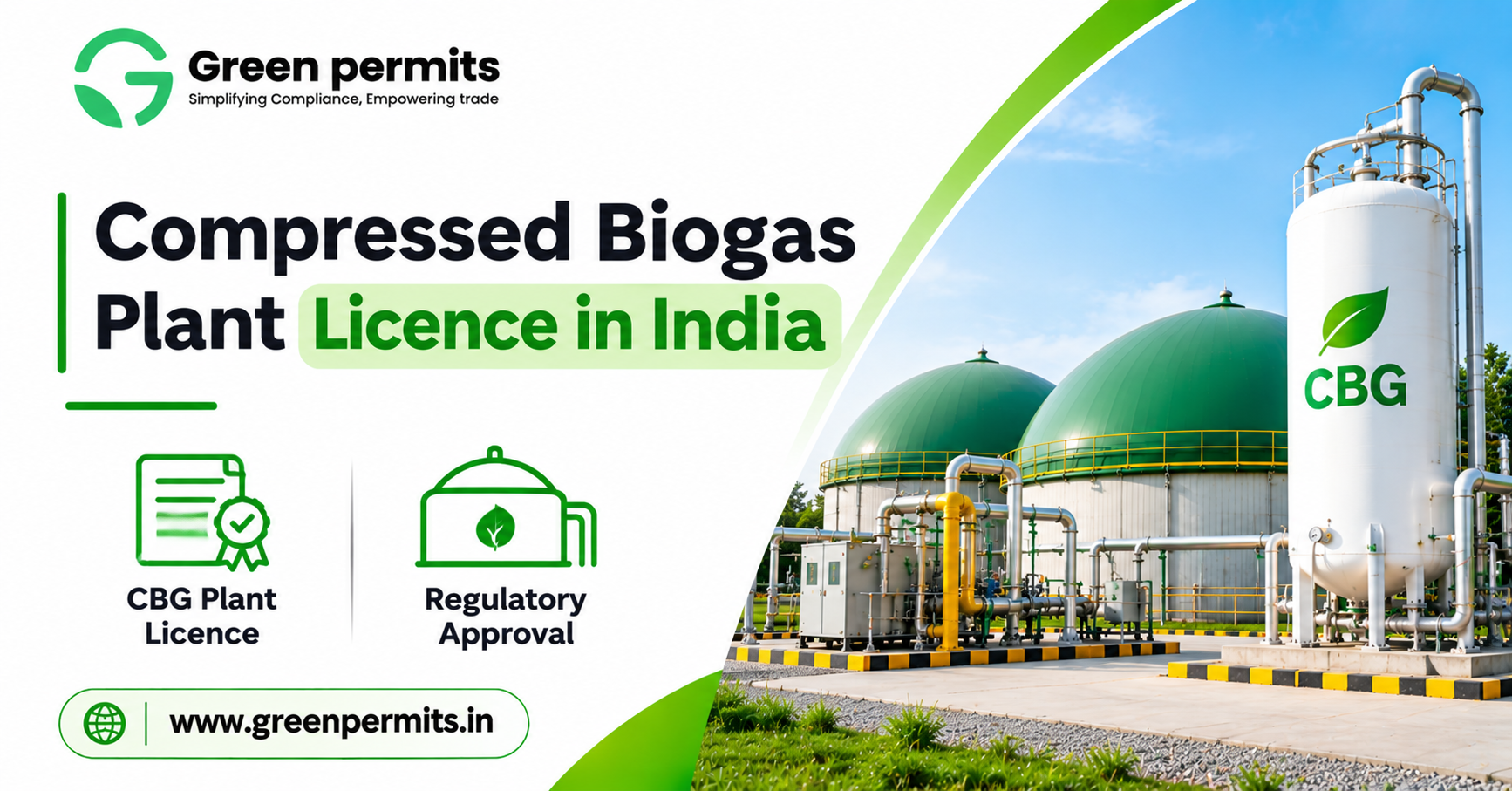
A Compressed Biogas Plant Licence in India is not usually one single licence obtained from one authority. A CBG or Bio-CNG project may require a combination of environmental consents, gas-storage and compression approvals, fire-safety permissions, land and local approvals, and other project-specific registrations depending on the site, feedstock, plant capacity, technology, storage system, and gas-offtake model.
For an investor, this distinction is important. A CBG plant should not be constructed first and licensed later. The regulatory roadmap should begin when the project is still at the feasibility and DPR stage.
A practical approval sequence can be understood as:
Feasibility → Site Selection → CTE → Plant Construction → Safety and Gas Infrastructure → CTO → PESO / Other Applicable Approvals → Commercial Operations
CPCB has also issued environmental guidelines specifically for CBG/Bio-CNG plants, while official SATAT guidance identifies Pollution Control Board approvals, fire-related requirements, PESO and local permissions among the major approvals that may apply to a project.
Green Permits Consulting supports businesses with Compressed Biogas Plant Licence in India, DPR preparation, CTE/CTO, PESO coordination, GOBARdhan registration guidance, plant-layout review, regulatory mapping, CAPEX-OPEX planning, and complete CBG project implementation.
Is There One Licence for a CBG Plant?
The term “CBG plant licence” is commonly used by promoters, but in practice the project may need multiple approvals.
The exact combination depends on the facility.
A plant handling cattle dung and supplying gas through a nearby pipeline can have a different approval profile from a project processing municipal food waste and transporting compressed gas through cascades.
Similarly, projects with large compressed-gas storage systems may require a different safety and licensing approach compared with plants where gas is transferred directly to another network.
The approval strategy should therefore start with the actual process:
Feedstock → Digestion → Gas Upgradation → Compression → Storage / Dispatch
Every stage can influence the regulatory requirements.
Consent to Establish for a CBG Plant
Consent to Establish, commonly called CTE, is generally one of the important environmental approvals for an applicable CBG facility.
This should normally be considered before construction and major machinery installation.
The CTE application typically needs to reflect the proposed plant capacity, feedstock, processing technology, water requirement, wastewater generation, air emissions, digestate management, odour-control systems, pollution-control arrangements, and site layout.
This is why the CTE should not be prepared using temporary technical assumptions.
If the project later changes its feedstock mix, plant capacity, wastewater system, gas-upgradation technology, or digestate-processing arrangement, the environmental implications may also change.
The stronger sequence is:
DPR → Process Design → Plant Capacity → Layout → Environmental Planning → CTE
Consent to Operate
After the plant is installed and ready for operation, Consent to Operate, or CTO, generally becomes relevant.
The actual facility should reasonably match the project described during the establishment stage.
This includes the digesters, feedstock handling, gas purification, compression systems, pollution-control infrastructure, wastewater management, digestate systems, and capacity.
One of the common project problems is that the machinery or process changes substantially after CTE.
For example, a project may originally propose one type of feedstock but later add food waste or another organic stream requiring more extensive pre-treatment.
Such changes should be reviewed before regular operations begin.
Official SATAT guidance lists Pollution Control Board consent for establishment before construction and consent for operation before production among the major approvals for CBG plants.
PESO Approval for CBG Projects
PESO, the Petroleum and Explosives Safety Organisation, becomes particularly relevant where compressed gas storage, filling, dispensing, cylinders, cascades, or associated high-pressure systems fall within its regulatory scope.
This is one of the most important safety-related approvals in many CBG projects.
PESO approvals should be considered while the plant layout is being prepared because storage, compression, safety distances, access, equipment placement, and firefighting arrangements can affect the final design.
In 2026, PESO continued processing approvals and licences for CNG/CBG dispensing stations and biogas cylinder filling and storage plants, demonstrating the continuing relevance of its licensing role for compressed-gas infrastructure.
The key lesson for promoters is simple:
Do not finalise the compression and storage layout before reviewing PESO applicability.
Redesigning high-pressure gas systems after construction can be expensive.
Fire Safety Approval
CBG is combustible, so fire and emergency planning are essential.
The project may require fire NOC or other fire-related permissions depending on the state, local authority, plant design, storage arrangement, and gas-handling infrastructure.
The plant should consider gas-leak detection, pressure protection, emergency shutdown systems, firefighting, ventilation, access for emergency vehicles, and safe separation of process areas.
Fire safety should be integrated into plant design from the beginning.
A well-designed facility should clearly separate feedstock handling, digestion, gas upgradation, compression, storage, electrical systems, and administrative areas.
Safety should never be treated as a final-stage approval exercise.
GOBARdhan Registration
CBG project developers should also understand the GOBARdhan ecosystem.
The Government’s unified GOBARdhan framework now provides a national platform for development of the CBG sector. Official government information states that entities operating or intending to establish CBG/Bio-CNG plants can obtain registration through the GOBARdhan Unified Registration Portal, and that the registration number is used for accessing applicable MoPNG support and benefits.
In August and October 2026, the Government also announced and launched the expanded GOBARdhan scheme for CBG development, with a ten-year framework extending from FY 2026-27 to FY 2035-36.
Promoters should therefore distinguish between:
Regulatory Licence / Consent and Scheme Registration / Benefit Eligibility
A GOBARdhan registration does not automatically replace CTE, CTO, PESO, fire or local regulatory approvals.
Land and Local Approvals
The land selected for the CBG plant should be suitable for the proposed activity.
Depending on the location, the project may need land-use conversion, building-plan approval, local authority permission, development approval, or other district or state-level clearances.
This is why site selection should not be based only on land price.
The promoter should review:
Land Use → Access → Feedstock Logistics → Gas Dispatch → Environmental Suitability → Approval Feasibility
A low-cost site can become expensive if the land is unsuitable for the intended industrial use or if major approvals become difficult.
The regulatory review should therefore happen before land acquisition or a long-term lease is finalised.
Factory and Labour-Related Requirements
Depending on the size, workforce, machinery, and state-specific framework, factory-related and labour-related approvals may also become applicable.
These requirements can include factory-plan approval, factory licence, building and construction-related registrations, electrical safety approvals, and worker health and safety compliance.
The exact requirements should be reviewed project by project.
A CBG plant should therefore avoid using a generic licence checklist copied from another state.
The correct compliance roadmap depends on location, plant design, workforce, and operating model.
Feedstock Can Affect the Approval Strategy
Feedstock is not only a commercial issue. It can also influence regulatory planning.
A plant processing cattle dung may have different environmental and odour-control considerations from a project processing food waste, sewage-related material, or industrial organic waste.
Food waste can require segregation and contamination management.
Certain industrial feedstocks may require additional review before they are accepted into the digestion process.
The DPR should clearly define the proposed feedstock categories so that the environmental application, machinery, water balance, digestate strategy, and plant layout all remain consistent.
A project should avoid changing feedstock after approval without reviewing the regulatory impact.
Digestate and Waste Management
A CBG plant produces digestate in addition to gas.
The facility should have a clear strategy for solid-liquid separation, storage, treatment, use, transport, or disposal depending on the project.
Digestate may have commercial potential when processed appropriately, but it should not simply be assumed that all digestate can be sold without further planning.
The environmental application should explain what happens to the complete material flow.
A simplified balance is:
Organic Feedstock → CBG + Digestate + Process Losses
This helps both regulatory planning and project economics.
Water and Wastewater Compliance
Water demand varies significantly depending on the feedstock and digestion technology.
The plant may require water for slurry preparation, cleaning, utilities, and supporting operations.
The project should prepare a water balance showing fresh-water requirement, recycled water, wastewater generation, and proposed treatment or disposal.
A clear process may be:
Fresh Water → Process Use → Wastewater → Treatment → Reuse / Disposal
This should be reflected in the CTE/CTO documentation.
Ignoring water and wastewater planning until after construction can create redesign and compliance issues.
Gas Quality and Offtake Compliance
Gas quality becomes particularly important when CBG is supplied to Oil Marketing Companies, CGD systems, pipeline networks, or other buyers.
The gas purification and upgradation system should be designed to meet the applicable buyer and technical requirements.
The project should therefore connect:
Raw Biogas → Purification → CBG Quality → Metering → Offtake
Under the SATAT ecosystem, Oil and Gas Marketing Companies have procured CBG from project developers, while newer policy frameworks also support CBG integration into gas networks and direct pipeline injection subject to applicable technical requirements.
The offtake model should therefore be decided before final machinery and compliance planning.
Plant Layout Should Be Prepared with Approvals in Mind
A CBG plant layout is not merely a civil drawing.
It should integrate feedstock receiving, pre-treatment, digesters, gas holders, purification systems, compressors, storage, utilities, digestate handling, internal roads, safety zones, and emergency access.
The regulatory team, process designer, civil consultant, and equipment supplier should ideally work from the same layout.
This avoids a common situation where the engineering layout and approval layout are completely different.
A strong project keeps:
DPR → Layout → Machinery → CTE → PESO / Safety Design → CTO
aligned throughout implementation.
Documents Should Remain Consistent
One of the biggest causes of licensing delays is inconsistent project documentation.
The legal entity name, plant address, capacity, feedstock quantity, gas output, machinery, water demand, land details, process flow, and storage arrangements should remain consistent wherever they appear.
The promoter should create one master technical data sheet before applications begin.
That master sheet can then become the reference for DPR, CTE, CTO, PESO documentation, fire applications, scheme registrations, and technical proposals.
This greatly reduces contradictions between applications.
CBG Licence Planning Should Begin with the DPR
A Detailed Project Report is not only a financing document.
For a CBG project, it can also become the technical foundation for the licensing strategy.
The DPR should cover feedstock, gas yield, technology, plant capacity, machinery, land, layout, water, digestate, gas purification, compression, storage, offtake, CAPEX, OPEX, and financial viability.
Once these assumptions are stable, the approval roadmap becomes much clearer.
This is much safer than filing permissions before the project itself has been properly defined.
Common CBG Licensing Mistakes
One of the most common mistakes is treating GOBARdhan registration as the complete licence for the plant.
Another is constructing the compressor and gas-storage section before checking PESO and safety requirements.
Projects may also face problems due to unsuitable land, inconsistent CTE and machinery capacity, poor wastewater planning, weak fire-safety design, or changes in feedstock after approvals.
The stronger sequence is:
Feasibility → DPR → Site → CTE → Plant Setup → PESO / Safety Approvals → CTO → Commercial Operations
This creates a more structured project and reduces expensive corrections later.
How a CBG Plant Licence Consultant Helps
A professional consultant helps the promoter understand which approvals apply and in what sequence they should be obtained.
The consultant can review the feedstock, process, plant capacity, land, machinery, gas storage, compression, safety systems, pollution-control requirements, and project documents before applications begin.
For new projects, this approach allows regulatory gaps to be identified early.
The objective should not simply be to collect licences.
The objective should be to establish a plant where the engineering, environmental compliance, safety approvals, and commercial operations all describe the same facility.
How Green Permits Helps with Compressed Biogas Plant Licence in India
Green Permits Consulting supports entrepreneurs, industries, waste-management companies, and investors with complete Compressed Biogas Plant Licence in India planning.
Our services can include feasibility studies, DPR preparation, regulatory mapping, CTE/CTO support, PESO coordination, GOBARdhan registration guidance, plant-layout review, feedstock and process assessment, CAPEX-OPEX modelling, and complete CBG project implementation.
We help align:
Site + Feedstock + Technology + Plant Capacity + Environmental Approvals + Gas Safety + Commercial Operations
before major capital is committed.
Learn More About Compressed Biogas Plant Licence
A Compressed Biogas Plant Licence in India should be understood as a complete approval framework rather than one certificate.
The right approach is to plan land, CTE/CTO, gas compression and storage, PESO applicability, fire safety, GOBARdhan registration, feedstock, digestate, and commercial offtake together.
Read more about Bio CNG and CBG plant setup consulting services here:
https://www.greenpermits.in/07/compressed-biogas-plant-approval-consultant-in-india/
📞 Get Expert Assistance for Compressed Biogas Plant Licence in India
If you need support for a Compressed Biogas Plant Licence in India, Green Permits Consulting can assist with DPR preparation, CTE/CTO, PESO planning, GOBARdhan registration guidance, plant layout, feedstock and process review, environmental documentation, CAPEX-OPEX modelling, and complete CBG plant setup.
🌐 Website: www.greenpermits.in
📞 Phone: +91 78350 06182
📧 Email: wecare@greenpermits.in

 English
 French
 Spanish
 Portuguese
 Deutsch
 Turkish
 Dutch
 Italiano
 Russian
 Romaian
 Portuguese (Brazil)
 Greek