
Ethanol Distillery Machinery in India
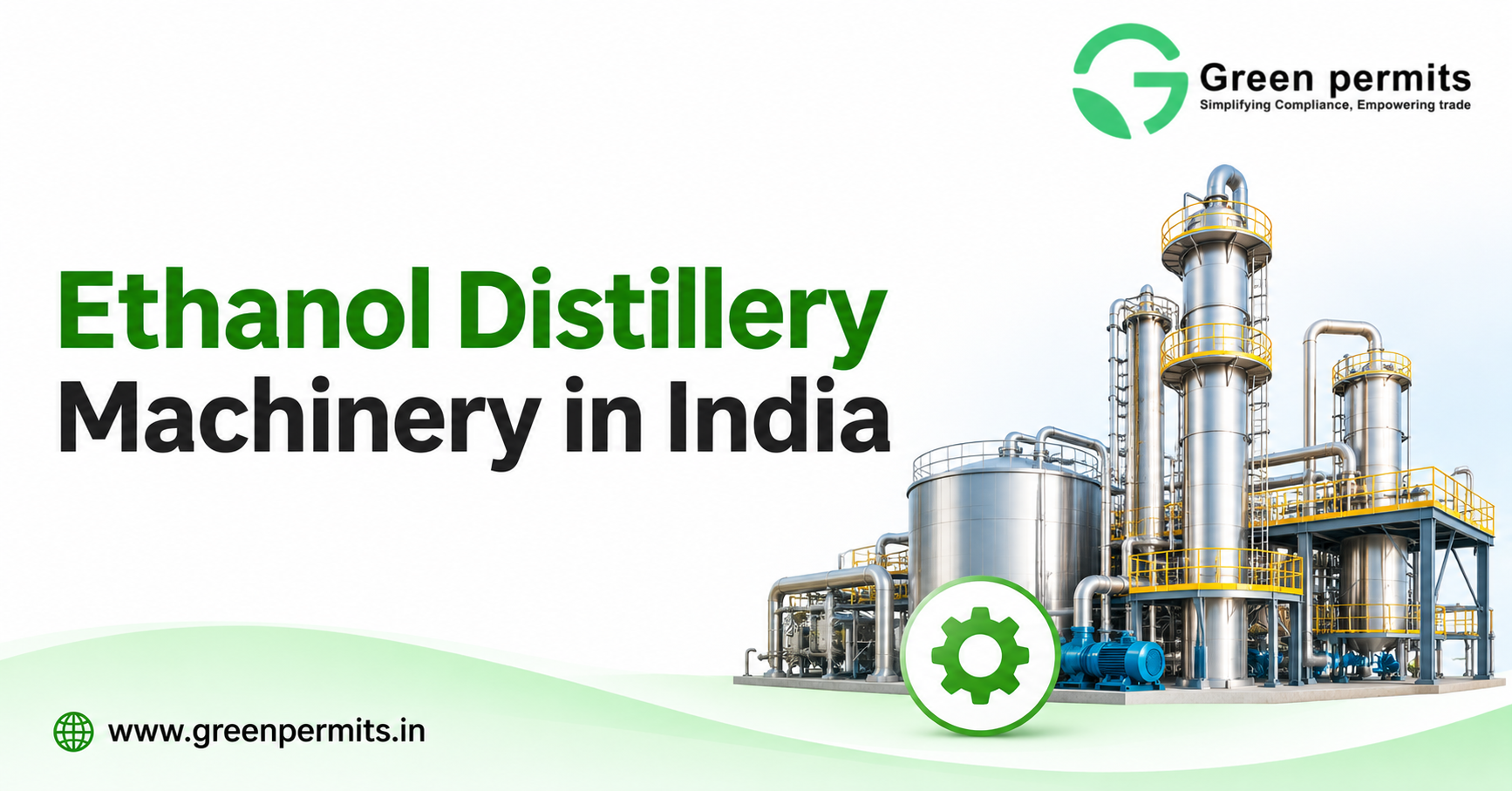
Choosing the right Ethanol Distillery Machinery is one of the most important decisions when planning a grain-based or molasses-based ethanol project. Machinery affects ethanol recovery, steam consumption, electricity demand, plant reliability, water use, maintenance cost, by-product recovery, and overall project profitability.
An ethanol plant should not be designed by simply selecting a distillation column and fermenters from a supplier catalogue. The correct machinery configuration depends on feedstock, plant capacity, ethanol specification, utility availability, water balance, by-product strategy, and expected operating efficiency.
A stronger planning sequence is:
Feedstock → Ethanol Yield → Process Technology → Plant Capacity → Machinery → Utilities → Financial Viability
Green Permits Consulting supports businesses with ethanol distillery machinery selection, feasibility studies, DPR preparation, feedstock assessment, technology comparison, plant-capacity planning, CAPEX-OPEX modelling, environmental planning, and complete project implementation support.
What Machinery is Used in an Ethanol Distillery?
An ethanol distillery uses a combination of feedstock handling, fermentation, distillation, dehydration, utility, storage, and environmental-control systems.
For a grain-based project, the process may broadly follow:
Grain Receiving → Cleaning → Milling → Slurry Preparation → Liquefaction → Saccharification → Fermentation → Distillation → Dehydration → Ethanol Storage
A molasses-based distillery follows a different front-end process because fermentable sugars are already present in the feedstock.
The exact machinery package should therefore be selected according to the process route rather than using one standard configuration for all ethanol plants.
Feedstock Should Decide the Machinery
Machinery selection starts with feedstock.
A grain-based plant may use maize, rice, damaged food grain, or another suitable starch-rich feedstock. These materials generally need grain handling, cleaning, milling, slurry preparation, liquefaction, and saccharification before fermentation.
A molasses-based plant does not require the same grain-processing section.
This means the correct sequence is:
Feedstock Type → Process Requirement → Machinery Configuration
If feedstock changes after machinery is selected, the plant may need redesign, additional equipment, or different utility systems.
The DPR should therefore freeze the feedstock strategy before equipment orders are placed.
Grain Handling and Cleaning Equipment
For grain-based ethanol plants, the first machinery section is usually grain receiving and preparation.
The plant may need unloading systems, conveyors, bucket elevators, storage silos, cleaners, screens, magnetic separators, and dust-control systems.
The purpose is to remove foreign matter and create a consistent grain stream before milling.
Good grain handling improves process stability and reduces unnecessary equipment wear.
Storage capacity should also be planned carefully because larger grain inventory improves supply security but increases working-capital requirement.
Milling Equipment
After cleaning, grain is milled into a suitable particle size.
Milling affects starch availability and downstream slurry preparation.
If grain is too coarse, conversion efficiency may reduce. Excessively fine grinding can increase power consumption and handling issues.
The mill should therefore be selected based on feedstock type, hourly throughput, required particle size, and energy consumption.
Machinery suppliers should clearly specify expected power use and output consistency.
This information should then be included in the DPR.
Slurry Preparation and Liquefaction Systems
Once grain is milled, it is mixed with water to create slurry.
The slurry may then undergo liquefaction, where starch is broken down using controlled heat, enzymes, and mixing.
This part of the plant may require slurry tanks, pumps, agitators, heat exchangers, dosing systems, process vessels, and control instrumentation.
The equipment should be designed around feedstock solids content and plant capacity.
Poor slurry handling can lead to blockages, uneven processing, and lower conversion efficiency.
This is why front-end process machinery is as important as the distillation section.
Saccharification Equipment
Saccharification converts partially broken starch into fermentable sugars.
This process can use enzymes, controlled temperature, and defined retention time.
The machinery may include process tanks, dosing systems, mixing equipment, instrumentation, and piping.
The efficiency of this stage has a direct impact on ethanol yield.
A small reduction in conversion efficiency can create a significant annual revenue loss at commercial scale.
Therefore, the machinery should be evaluated on actual process performance rather than only purchase price.
Fermentation Tanks
Fermentation is one of the core stages of ethanol production.
Fermentation tanks should be properly sized for residence time, feed rate, temperature control, cleaning, and production schedule.
The system may include fermenters, yeast preparation, cooling, pumps, heat exchangers, CIP systems, instrumentation, and process controls.
Stable fermentation helps improve ethanol recovery.
Poor temperature control, contamination, or inconsistent feed quality can reduce performance.
The machinery package should therefore include strong process-monitoring and cleaning systems.
Distillation Columns
Distillation is one of the most important sections of an ethanol plant.
After fermentation, alcohol concentration in the fermented wash is relatively low. Distillation increases the ethanol concentration through controlled separation.
The distillation system may use multiple columns depending on process design and product requirement.
The supplier should clearly state expected ethanol recovery, steam consumption, operating pressure, heat integration, and process efficiency.
Distillation can be one of the largest steam consumers in the plant.
This means steam economy should be considered as seriously as equipment price.
Ethanol Dehydration System
Where the final ethanol specification requires very low water content, dehydration becomes necessary after distillation.
The selected dehydration technology should be evaluated on ethanol recovery, energy consumption, regeneration requirement, operating stability, and maintenance.
The project should also understand the quality specification required by the intended buyer.
A plant producing ethanol for one industrial application may have different quality requirements from another project.
Machinery selection should therefore follow:
Buyer Specification → Product Quality → Dehydration Requirement → Equipment
Boilers and Steam Systems
Steam is one of the most important utilities in an ethanol distillery.
It may be used in cooking, liquefaction, distillation, evaporation, drying, and other process operations.
The plant may require boilers, fuel-handling systems, feed-water treatment, condensate recovery, steam distribution, and related controls.
Boiler capacity should be based on a complete steam balance.
The project should avoid selecting boiler size independently from the process machinery.
A better approach is:
Process Steam Demand → Boiler Capacity → Fuel Requirement → OPEX
This gives a more accurate picture of long-term energy cost.
Cooling and Utility Systems
Fermentation, distillation, condensers, pumps, and other process systems generate heat and may require cooling.
The plant may therefore need cooling towers, chilled water systems where required, utility pumps, heat exchangers, and water circulation systems.
Utility sizing should be based on the final process configuration.
If machinery suppliers provide separate packages without coordinated utility design, the plant can face mismatches during commissioning.
The DPR should therefore include an integrated utility balance.
DDGS Machinery for Grain-Based Ethanol Plants
For grain-based projects, DDGS can be an important by-product.
The process may require evaporation, concentration, drying, cooling, storage, and packaging equipment.
This machinery adds CAPEX and can also consume significant steam and electricity.
However, it can create an additional revenue stream where a suitable feed market exists.
The project should therefore evaluate:
DDGS Revenue - Drying Cost - Handling Cost = Net By-Product Contribution
The decision to install DDGS processing equipment should be based on both process design and market demand.
CO2 Recovery Equipment
Carbon dioxide is generated during fermentation.
Some ethanol plants may consider recovering this CO2 through purification, compression, storage, and sale.
The machinery may include gas collection, purification, drying, compression, and storage systems.
However, the investment is justified only if a reliable buyer exists.
The DPR should therefore assess local demand before including CO2 recovery as a major revenue stream.
By-product machinery should support the project economics rather than complicate the plant without a clear market.
Water Treatment Systems
Water quality affects fermentation, boilers, cooling, cleaning, and process stability.
The plant may require raw-water treatment, filtration, softening, reverse osmosis, demineralisation, condensate recovery, or other systems depending on source water quality.
Water-treatment machinery should therefore be selected after water testing.
A standard water-treatment package may not be suitable for every site.
The project should connect:
Raw Water Quality → Treatment Requirement → Process Water Quality
This reduces operating problems after commissioning.
Effluent Treatment Machinery
Environmental systems are a critical part of ethanol distillery machinery.
Depending on feedstock and process design, the plant may need effluent-treatment systems, evaporation, biological treatment, sludge handling, water recycling, and related infrastructure.
These systems can represent a significant part of project CAPEX.
The environmental machinery should therefore be integrated with the main process design from the beginning.
Trying to add ETP or advanced wastewater systems after the main plant is installed can cause major cost overruns.
Ethanol Storage and Transfer Systems
Finished ethanol requires controlled storage and handling.
The project may need dedicated tanks, pumps, pipelines, loading systems, metering, bunding, and firefighting infrastructure.
Storage capacity should be linked with production rate, dispatch schedule, buyer arrangements, and operational buffer.
Too much storage increases CAPEX.
Too little storage can disrupt production and dispatch.
The plant should therefore optimise tank sizing through the DPR.
Automation and Instrumentation
Modern ethanol plants use automation to control process variables such as temperature, pressure, flow, pH, tank level, steam demand, and product quality.
Automation can improve consistency and reduce operator error.
However, a highly automated plant also requires skilled maintenance and technical support.
The supplier should clearly define what is included in the automation package, which instruments are critical, and what spare parts are needed.
The investor should also understand whether control software and technical support will remain available after commissioning.
How to Compare Ethanol Machinery Suppliers
Machinery suppliers should not be compared only on total quotation value.
The technical offer should be evaluated on ethanol recovery, steam consumption, power consumption, water requirement, automation, maintenance, spare parts, installation, commissioning, warranty, and after-sales support.
One supplier may appear cheaper because utilities, environmental equipment, or installation are excluded.
Another may offer a higher quotation but a more complete scope.
The better comparison is:
Total Installed Cost + Operating Cost + Yield + Reliability
This gives a much clearer picture of actual project economics.
Domestic vs Imported Distillery Machinery
Indian ethanol projects can use domestic machinery, imported technology, or a combination of both.
Domestic suppliers can offer advantages in service support, spare parts, communication, installation, and maintenance.
Imported equipment may be considered for specialised technology or performance requirements.
However, imported machinery should be evaluated on total installed cost.
Freight, customs-related cost, commissioning, spare parts, technical support, and downtime risk should all be included.
The best option is the one that provides reliable long-term performance at a commercially reasonable cost.
Machinery Price vs Total Project Cost
One of the most common mistakes is assuming that the machinery quotation represents the full project cost.
The actual project may also require land, civil works, utilities, boilers, water treatment, effluent treatment, storage tanks, fire safety, electrical infrastructure, laboratory equipment, installation, and working capital.
Therefore:
Machinery Cost ≠ Total Ethanol Plant Cost
A complete DPR should calculate the full project investment.
This gives investors a much more realistic estimate of the capital required before commercial operations can begin.
Energy Efficiency Matters
Energy efficiency can significantly affect ethanol production cost.
Distillation, evaporation, drying, boilers, cooling, and pumps can consume substantial utilities.
Two machinery packages with similar purchase prices can have very different steam and power consumption.
The DPR should therefore calculate specific utility consumption per litre of ethanol.
A technically efficient system can improve profitability throughout the operating life of the plant.
This is why equipment selection should focus on life-cycle economics rather than only initial CAPEX.
DPR Before Finalising Ethanol Distillery Machinery
A Detailed Project Report should ideally be prepared before major equipment orders are placed.
The DPR should connect feedstock, ethanol yield, technology, plant capacity, machinery, utilities, water, by-products, environmental systems, CAPEX, OPEX, working capital, and financial viability.
It should also test downside scenarios.
For example, what happens if grain price increases, ethanol yield decreases, steam consumption rises, or plant utilisation remains below target?
These calculations help management decide whether the proposed machinery package is financially justified.
Common Ethanol Machinery Selection Mistakes
One common mistake is choosing the lowest quotation without comparing supplier scope.
Another is selecting machinery before feedstock and plant capacity are fully defined.
Projects may also underestimate steam, water, environmental systems, DDGS drying, storage, or installation cost.
The stronger sequence is:
Feedstock First → Yield Second → Technology Third → Utilities Fourth → Machinery Fifth → Financial Model Sixth
This reduces both technical and financial risk.
How Green Permits Helps with Ethanol Distillery Machinery
Green Permits Consulting supports entrepreneurs, grain processors, distilleries, sugar businesses, and investors evaluating Ethanol Distillery Machinery in India.
Our services include feedstock assessment, feasibility studies, DPR preparation, technology comparison, machinery-supplier evaluation, plant-capacity planning, site assessment, utility planning, environmental approval strategy, CAPEX-OPEX modelling, and complete project implementation support.
We help evaluate machinery based on:
Yield + Energy Efficiency + Reliability + Installed Cost + Operating Cost + Financial Viability
rather than equipment price alone.
Learn More About Ethanol Distillery Machinery
The right Ethanol Distillery Machinery should match the feedstock, plant capacity, required ethanol quality, utility availability, by-product strategy, and financial model.
A feasibility study and DPR can help investors compare suppliers on technical performance and life-cycle cost before major equipment orders are placed.
Read more about ethanol and industrial plant setup consulting services here:
https://www.greenpermits.in/ethanol-distillery-setup-in-india/
📞 Get Expert Assistance for Ethanol Distillery Machinery in India
If you are evaluating Ethanol Distillery Machinery in India, Green Permits Consulting can assist with technology comparison, machinery-supplier evaluation, feedstock assessment, DPR preparation, plant-capacity planning, utility analysis, CAPEX-OPEX modelling, environmental planning, and complete ethanol plant implementation.
🌐 Website: www.greenpermits.in
📞 Phone: +91 78350 06182
📧 Email: wecare@greenpermits.in

 English
 Arabic
 French
 Spanish
 Portuguese
 Turkish
 Dutch
 Italiano
 Russian
 Romaian
 Portuguese (Brazil)
 Greek