
RVSF Machinery in India
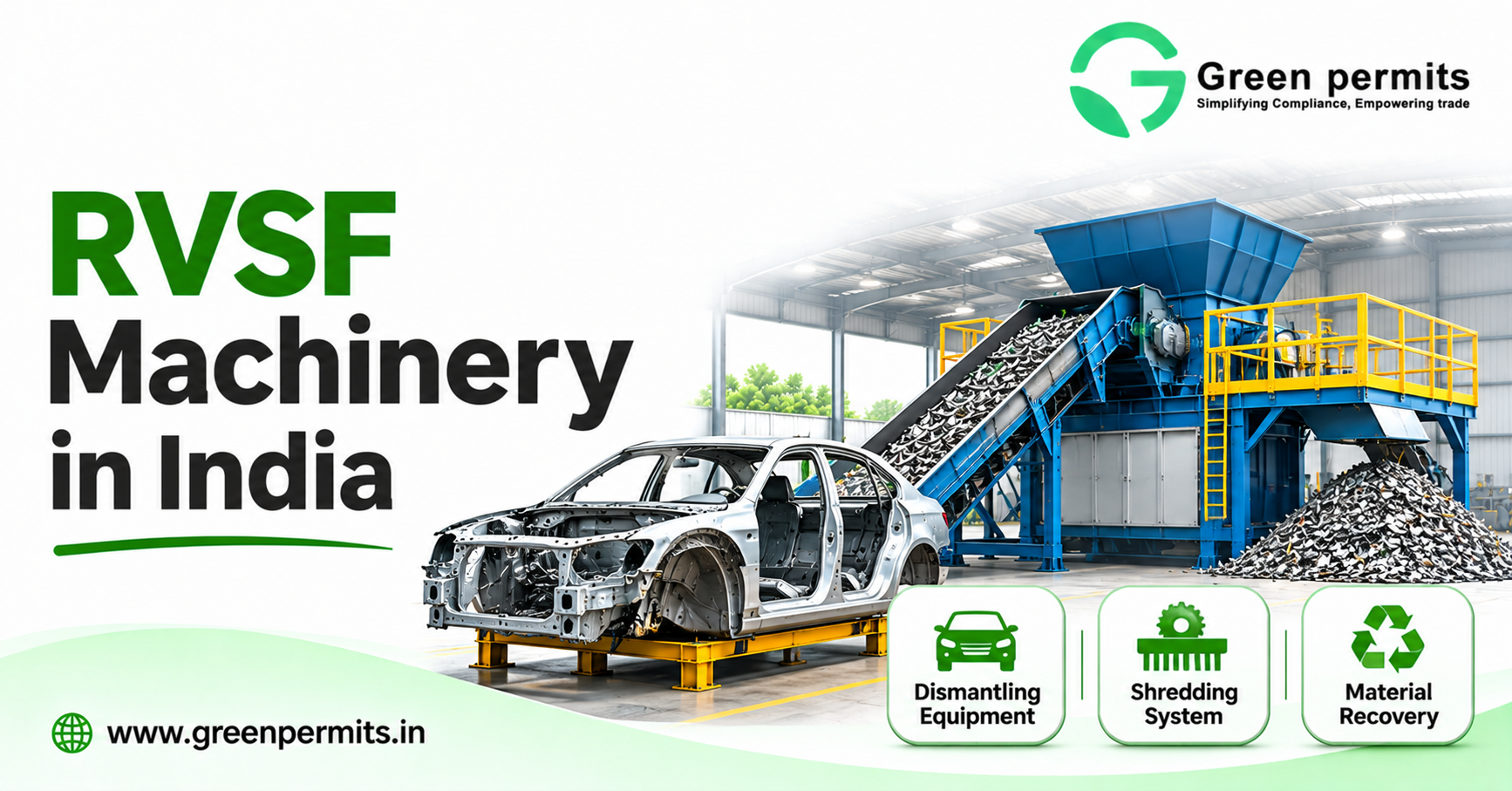
RVSF Machinery in India is used for the safe depollution, dismantling, segregation and material recovery of End-of-Life Vehicles inside a Registered Vehicle Scrapping Facility.
Setting up an RVSF is not simply about installing a crusher or baler. A proper vehicle scrapping facility requires equipment for vehicle receiving, fluid drainage, battery and tyre removal, lifting, dismantling, cutting, segregation, scrap handling and storage.
The right machinery depends on the proposed plant capacity, types of vehicles to be processed, level of automation and whether the facility will only dismantle vehicles or also carry out shredding and advanced material recovery.
Green Permits Consulting supports investors with RVSF feasibility studies, DPR preparation, machinery planning, plant layout, environmental approvals, RVSF registration and complete vehicle scrapping facility setup.
What Machinery is Required for an RVSF?
An RVSF requires a combination of dismantling, depollution, material handling and safety equipment.
A typical vehicle scrapping process can be understood as:
Vehicle Receipt → Inspection → Depollution → Dismantling → Component Removal → Material Segregation → Baling / Processing → Storage / Recycling
Machinery should be selected according to this process flow.
The equipment installed at the plant should also match the capacity and activity mentioned in the project documents and regulatory applications.
Vehicle Receiving and Weighing Equipment
The vehicle receiving area is the first operational section of an RVSF.
Incoming End-of-Life Vehicles should be properly recorded before dismantling starts.
Typical equipment can include:
- Electronic weighbridge
- Vehicle identification system
- Inspection platform
- CCTV and documentation systems
- Vehicle parking and staging infrastructure
A weighbridge helps record incoming vehicle weight and can also support material accounting after dismantling.
Proper vehicle identification is important because RVSFs operate within a traceable regulatory system.
Vehicle Lifting Equipment
Vehicles must be raised safely for depollution and dismantling.
Common equipment can include:
- Two-post vehicle lifts
- Four-post lifts
- Scissor lifts
- Hydraulic lifting platforms
- Forklifts
The lifting system should be selected according to the type and weight of vehicles being processed.
A facility handling heavy commercial vehicles may require significantly different lifting equipment from a facility focused mainly on passenger cars.
ELV Depollution System
Depollution is one of the most important parts of an RVSF.
Before dismantling, hazardous and potentially polluting fluids should be removed safely.
A vehicle depollution system can include equipment for draining:
- Petrol or diesel
- Engine oil
- Transmission oil
- Brake fluid
- Coolant
- Power steering fluid
- Refrigerant
- Other operating fluids
The drained fluids should be transferred into suitable storage containers.
A proper depollution setup can include pumps, collection tanks, hoses, filters and leak-proof storage systems.
Fuel Drainage Equipment
Fuel remaining inside an End-of-Life Vehicle needs to be removed carefully.
Specialized fuel drainage equipment can be used to extract fuel from the tank while reducing spill and fire risk.
The system can include:
- Fuel extraction unit
- Pumping equipment
- Storage tanks
- Flame-safe fittings
- Spill collection arrangement
Fire safety should be integrated into the fuel-handling area.
Used Oil Collection System
Engine and transmission oils must be collected separately.
A used-oil handling system can include:
- Oil drainers
- Mobile collection tanks
- Storage drums or tanks
- Transfer pumps
- Spill trays
The collected used oil should be stored and channelized according to applicable waste-management requirements.
The storage section should also be clearly identified in the plant layout.
Battery Removal and Storage Equipment
Vehicle batteries should normally be removed early in the dismantling process.
The facility may require:
- Battery handling tools
- Insulated equipment
- Battery trays
- Acid-resistant storage area
- Dedicated battery racks
Conventional lead-acid batteries and batteries from electric vehicles require different safety considerations.
An RVSF planning to handle electric vehicles should specifically evaluate high-voltage battery removal, isolation and storage requirements.
EV Battery Handling Equipment
As electric vehicles increase in the Indian market, RVSFs may increasingly receive vehicles containing lithium-ion battery packs.
Handling these vehicles can require specialized systems such as:
- High-voltage insulated tools
- Battery lifting tables
- Battery pack handling equipment
- Insulated PPE
- Thermal monitoring
- Safe battery storage
- Emergency fire-control arrangements
An EV battery should not be handled like a normal starter battery.
The RVSF should establish a separate operating procedure for electric vehicles.
Tyre Removal Equipment
Tyres and wheels are removed during dismantling and should be stored separately.
Common equipment can include:
- Wheel removal tools
- Pneumatic impact wrenches
- Tyre changers
- Wheel handling systems
Waste tyres should be channelized in accordance with the applicable waste tyre management framework.
If the RVSF also plans tyre recycling within the same project, separate machinery and registrations may be required.
Air Conditioning Refrigerant Recovery Machine
Vehicle air-conditioning systems contain refrigerant that should be recovered before dismantling.
A refrigerant recovery system can help remove and store refrigerant safely.
This reduces the risk of uncontrolled release during cutting or dismantling.
The requirement should be evaluated according to the vehicles accepted by the facility and the applicable environmental and safety standards.
Engine and Gearbox Removal Equipment
Engines and gearboxes are heavy components and need safe material handling.
Equipment can include:
- Engine hoists
- Hydraulic cranes
- Chain blocks
- Lifting tables
- Forklifts
- Material-handling trolleys
These components may be routed for reuse, remanufacturing, recycling or metal recovery depending on their condition.
The plant layout should provide sufficient space for removing and storing large components.
Hydraulic Cutting Equipment
Dismantling certain vehicle parts can require hydraulic cutting tools.
Typical equipment can include:
- Hydraulic cutters
- Hydraulic shears
- Cable cutters
- Metal cutting tools
- Reciprocating saws
These tools can be used for removing structural components, wiring, exhaust systems and other assemblies.
Proper guarding and operator training are important because cutting operations can create significant safety risks.
Cable and Wiring Removal Equipment
Vehicles contain copper wiring that can have good recovery value.
Cable removal and segregation can be carried out manually or with suitable tools.
Depending on the business model, an RVSF may also use:
- Cable stripping machines
- Wire granulators
- Copper separation equipment
However, these machines should be considered only if the facility plans to process wiring internally rather than selling segregated wiring to authorized recyclers.
Catalytic Converter Removal
Catalytic converters can contain valuable metals and should be removed carefully.
Appropriate cutting or removal tools can be used without unnecessarily damaging the component.
Catalytic converters should be segregated and stored securely because of their material value.
If further processing is proposed, separate technical and regulatory evaluation may be needed.
Glass Removal Equipment
Automotive glass may include windscreens, side windows and rear glass.
Tools can include:
- Windscreen cutting tools
- Glass removal kits
- Suction lifters
- Protective equipment
Careful removal can reduce contamination and improve downstream recycling.
Glass should be stored separately from metals and plastics.
Plastic Component Removal Tools
Modern vehicles contain significant quantities of plastic.
Components may include:
- Bumpers
- Dashboards
- Interior panels
- Fuel-system components
- Trims
- Underbody parts
Manual tools, pneumatic tools and component-specific dismantling equipment can be used.
Plastic segregation by polymer type can improve its downstream recycling value where practical.
Scrap Baler Machine
A scrap baler can compress metal scrap into compact bales.
This can help reduce storage requirements and make transportation easier.
A baler is especially useful where the RVSF generates significant quantities of sheet metal.
The required baling capacity should be selected according to daily vehicle throughput.
Installing an oversized baler can increase CAPEX without providing proportional operational benefit.
Hydraulic Shear Machine
Hydraulic shears can be used to cut metal structures into smaller sections.
This can help prepare scrap for transportation or further recycling.
Large RVSFs may use:
- Alligator shears
- Guillotine shears
- Heavy-duty hydraulic shears
The machinery should be selected according to the type and thickness of material handled.
Car Baler or Car Flattener
Some RVSFs may install equipment for compacting vehicle shells after dismantling.
A car baler or car flattener reduces the volume of the stripped vehicle body.
This can improve storage and transport efficiency.
The decision to install such equipment depends on plant capacity, available space and whether stripped shells are sold locally or transported over longer distances.
Vehicle Shredder
A large-scale RVSF may consider installing a vehicle shredding system.
However, shredding requires significantly higher investment and additional separation and pollution-control infrastructure.
A shredder line may include:
Vehicle Shell → Shredder → Magnetic Separation → Non-Ferrous Separation → Material Sorting
Not every RVSF needs a shredder.
For many facilities, dismantling and baling may be commercially more appropriate than complete shredding.
A feasibility study should compare both models before the investor commits to high-cost machinery.
Magnetic Separator
If shredding or metal processing is carried out, magnetic separators can help recover ferrous metal.
Magnetic separation is widely used for separating steel and iron from mixed material streams.
The recovered ferrous material can then be prepared for sale to metal recyclers or steel plants.
Eddy Current Separator
An eddy current separator can help recover non-ferrous metals such as aluminium from processed material.
This equipment becomes relevant mainly where the RVSF has a more advanced shredding and separation line.
It may not be economically necessary for a basic dismantling facility.
Material Handling Equipment
Material movement is an important operational part of an RVSF.
Typical equipment may include:
- Forklifts
- Hand pallet trucks
- Hydraulic trolleys
- Cranes
- Conveyors
- Storage bins
- Scrap skips
Material handling should be designed to minimize repeated manual movement.
Efficient movement can improve productivity and reduce safety risks.
Pollution-Control Equipment for RVSF
RVSF machinery planning should also include environmental equipment.
Depending on the process, this can include:
- Oil-water separator
- Effluent treatment system
- Spill collection system
- Drainage system
- Dust extraction system
- Ventilation equipment
- Hazardous waste storage
- Fire-control system
The CPCB registration process for RVSFs specifically includes details of installed equipment, plant capacity and pollution-control devices.
This means pollution-control infrastructure should be treated as part of the plant machinery package rather than as an optional expense.
Fire and Safety Equipment
Vehicle scrapping facilities handle fuel, oils, batteries, tyres and combustible materials.
The plant therefore requires strong fire and occupational safety planning.
Common systems can include:
- Fire extinguishers
- Hydrant network
- Fire-water tank
- Sprinkler systems, where applicable
- Spill kits
- Emergency showers
- Eye-wash stations
- PPE
- Safety signage
- Emergency exits
The exact system should be designed according to local fire requirements and plant risk assessment.
RVSF Machinery Layout
Machinery should not be placed randomly inside the facility.
A practical layout can follow the vehicle processing sequence:
Entry → Weighing → Holding Area → Depollution → Dismantling → Component Sorting → Scrap Processing → Storage → Dispatch
Hazardous materials should have dedicated storage areas.
Vehicle movement and scrap movement should also be separated wherever practical.
A good plant layout can reduce handling time and improve both safety and productivity.
How to Select RVSF Machinery Capacity
Machinery capacity should be linked with the expected number of vehicles processed per day.
The investor should evaluate:
- Cars per day
- Commercial vehicles per day
- Average vehicle weight
- Number of working shifts
- Labour productivity
- Storage capacity
- Vehicle sourcing
- Target annual throughput
For example, machinery selected for a 10 to 15 vehicle-per-day facility may be significantly different from equipment required for a high-volume centralized scrapping facility.
Plant capacity should be based on realistic vehicle availability rather than machinery supplier claims.
Automatic vs Semi-Automatic RVSF Machinery
RVSFs can be designed with different levels of automation.
A semi-automatic plant may use more manual dismantling supported by hydraulic and pneumatic tools.
A highly automated facility may include conveyors, specialized depollution stations, automated material handling and shredding systems.
Higher automation can increase productivity but also increases:
- CAPEX
- Maintenance requirements
- Power consumption
- Technical manpower needs
The right automation level should therefore be selected based on expected throughput and project economics.
Cost of RVSF Machinery in India
There is no single standard cost for RVSF machinery.
The investment depends on:
- Plant capacity
- Number of dismantling stations
- Automation level
- Vehicle types
- Depollution technology
- Baling system
- Shredding requirement
- Pollution-control equipment
- Material handling
- Safety systems
A basic dismantling facility can have a very different machinery budget from a fully automated RVSF with shredding and advanced metal separation.
The machinery cost should therefore be estimated only after defining the complete process flow.
Machinery Cost is Not the Total Project Cost
A common mistake is treating machinery quotation as the total project investment.
An RVSF project may also require expenditure on:
Land + Civil Construction + Machinery + Utilities + Electrical Systems + Pollution Control + Fire Systems + IT Infrastructure + Licensing + Pre-operative Expenses + Working Capital
Working capital can be particularly important because the facility may need funds for acquiring vehicles before scrap materials are sold.
RVSF Machinery and EPR Compliance
Under the End-of-Life Vehicle EPR framework, registered RVSFs play an important role in material recovery.
RVSFs registered on the centralized ELV portal can generate EPR certificates based on eligible steel recovery as per the applicable framework.
This makes accurate weighing and material tracking important.
The facility should therefore maintain reliable records of:
- Vehicles received
- Vehicle weight
- Steel recovered
- Other materials recovered
- Waste generated
- Materials dispatched
- Authorized downstream recyclers
Machinery and weighing systems should support this traceability.
Documents Related to RVSF Machinery
During project approvals and registration, the promoter may need to provide machinery-related information.
This can include:
- Machinery list
- Equipment capacity
- Manufacturer details
- Installation details
- Plant layout
- Photographs
- Pollution-control systems
- Utility requirements
- Processing capacity
The machinery list should remain consistent across the DPR, layout, environmental applications and RVSF registration.
Common Mistakes While Purchasing RVSF Machinery
One of the biggest mistakes is purchasing equipment before deciding the facility's actual business model.
Other common mistakes include:
- Buying oversized machinery
- Ignoring depollution equipment
- Underestimating material handling
- Poor EV battery planning
- No dedicated fluid storage
- Insufficient safety equipment
- Installing a shredder without enough vehicle supply
- Ignoring maintenance support
- Focusing only on machine price
Machinery should support the complete operating model, not become the operating model itself.
Why Prepare an RVSF DPR Before Machinery Purchase?
A Detailed Project Report helps determine what machinery the project actually requires.
An RVSF DPR can evaluate:
- Vehicle availability
- Plant capacity
- Process flow
- Machinery
- Plant layout
- Material recovery
- Utilities
- Manpower
- Regulatory approvals
- CAPEX
- OPEX
- Revenue
- Working capital
- Profitability
- ROI
- Payback
This prevents the entrepreneur from purchasing equipment based only on a supplier quotation.
How an RVSF Machinery Consultant Helps
An experienced RVSF Machinery Consultant in India can help match the machinery with the project capacity and business model.
Consulting support can include:
- Machinery requirement assessment
- Capacity planning
- Equipment specification
- Vendor comparison
- Plant layout
- Depollution system planning
- Material handling
- Pollution-control planning
- Utility estimation
- CAPEX estimation
- DPR preparation
- Regulatory alignment
This helps the investor avoid both under-sizing and over-investment.
How Green Permits Helps with RVSF Machinery and Plant Setup
Green Permits Consulting supports businesses planning RVSF projects across India.
Our support can include RVSF feasibility studies, DPR preparation, machinery planning, plant layout, capacity assessment, environmental approvals, RVSF registration and EPR compliance.
We help connect:
Vehicle Sourcing → Capacity → Process → Machinery → Layout → Approvals → Material Recovery → Financials
The objective is to select machinery that supports a technically compliant and commercially viable vehicle scrapping facility.
Learn More About RVSF Plant Setup
If you are planning to set up an RVSF in India, machinery should be selected only after finalising the expected vehicle throughput, process flow, plant layout and regulatory requirements.
Proper machinery planning can reduce unnecessary CAPEX, improve material recovery and simplify plant operations.
Read more about recycling plant setup consulting services here:
👉 https://www.greenpermits.in/11/vehicle-scrapping-plant-layout-machinery-for-india/
📞 Get Expert Assistance for RVSF Machinery in India
If you need support for RVSF Machinery in India, Green Permits Consulting can assist with machinery planning, DPR preparation, feasibility study, plant layout, approvals, RVSF registration and complete vehicle scrapping facility setup.
🌐 Website: www.greenpermits.in
📞 Phone: +91 78350 06182
📧 Email: wecare@greenpermits.in
 Spanish
 English
 Arabic
 French
 Portuguese
 Deutsch
 Turkish
 Dutch
 Italiano
 Russian
 Romaian
 Portuguese (Brazil)
 Greek